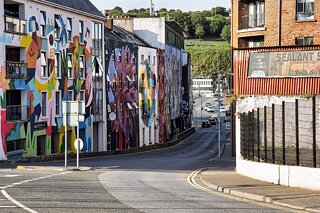
THE WALLS OF BRIDGE STREET BECAME A PANORAMIC CANVAS FOR A COLLECTION OF MURALS
The regeneration of Bridge Street through large-scale public art forms one of the most prominent urban renewal initiatives spearheaded by The Walls Project CLG under the umbrella of the internationally acclaimed Waterford Walls International Street Art Festival. Situated near the River Suir and serving as a gateway into Waterford’s historic core and the Waterford Cultural Quarter, Bridge Street had suffered decades of visual neglect, dilapidated facades, and commercial vacancy.
Beginning in earnest in 2022 and expanding through 2023, The Walls Project partnered with Waterford City and County Council and Creative Ireland to transform this corridor into an open-air public gallery.
History of the Programme
Waterford Walls was founded in 2015 to combat urban blight following the post-2008 economic downturn, revitalising vacant gables and derelict city centre plots. By 2022, The Walls Project transitioned from ad-hoc wall painting to cohesive streetscape interventions.
Bridge Street was selected as a strategic priority under the Bridge Street Mural Project. Flanked by prominent structures such as the Fitzwilton Hotel and multi-unit residential apartment blocks (Nos. 9, 11, and 12), the thoroughfare was chosen to create a colourful welcoming vista for motorists and pedestrians crossing Rice Bridge. The programme combined large-scale artistic curation with community co-design methodologies developed under the EU Creative Europe Murals for Communities project (2018–2020), engaging long-term locals as well as newly arrived displaced persons from Ukraine accommodated nearby.
The Murals and Responsible Artists
The Bridge Street corridor features distinct installations completed across successive festival editions:
Fitzwilton Hotel Facade (2022) – Curtis Hylton (UK):
The Mural: A soaring, multi-storey naturalistic piece integrating wildlife and botanical motifs, turning the concrete elevation of the hotel into an organic woodland scene.
The Artist: Curtis Hylton is a British muralist celebrated internationally for his environmental trompe-l’œil and large-scale wildlife work. Blending aerosol with acrylic wash techniques, Hylton’s career spans major festival commissions across Europe, Asia, and the Americas, highlighting biodiversity and environmental conservation.
11 Bridge Street (2022) – Claire Prouvost (France / Ireland):
The Mural: A bright, cubist-inspired composition featuring expressive, fragmented figures and bold graphic shapes designed to reflect human connection and neighbourly warmth.
The Artist: Based in Dublin, Claire Prouvost has built an international portfolio spanning commercial illustration, gallery painting, and public street art. Her style draws directly on 20th-century post-cubism, focusing on deconstructed portraiture, vibrant colour palettes, and intuitive feminist iconography.
12 Bridge Street (2022) – Sophie Mess (UK):
The Mural: A hyper-vibrant, botanical botanical-realism piece bursting across the residential facade, developed directly from co-design workshops with the building's tenants.
The Artist: Sophie Mess is a prominent UK street artist known for magnifying macro flora and fauna. Trained in graphic design and fine art, she uses high-contrast spray painting techniques to introduce intense botanical nature into hard urban landscapes.
Fitzwilton Hotel / Bridge Street Elevations (2023) – Dan Kitchener (DANK) (UK):
The Mural: A large-scale piece titled Butterflies, which fuses Kitchener's iconic impressionistic, rain-streaked urban streetscapes with iridescent winged insects.
The Artist: Dan Kitchener is a fixture of the global street art scene. Renowned for his cinematic, Blade Runner-esque nocturnal lighting and Tokyo street scenes, he has painted monumental walls across Tokyo, Hong Kong, New York, and throughout Europe.
Bridge Street Facades (2023) – George Rose (Australia):
The Mural: A vivid geometric and botanical installation characterised by radiant colour gradients and typographic flourishes.
The Artist: George Rose is an Australian public artist who has executed monumental murals globally. She has received major accolades including Melbourne’s Lord Mayor’s Creative Fellowship and regularly collaborates with civic bodies to construct community-focused, palette-driven abstract flora.
Bridge Street Adjoinments (2023) – Bustart (Switzerland):
The Mural: A high-energy "neo-pop" piece combining vintage cartoon graphics, classic New York-style graffiti lettering, and stencil overlays.
The Artist: Active since the late 1990s, Basel-born Bustart transitioned from classic graffiti tagging to an internationally acclaimed pop-art street style, exhibited across European galleries, outdoor museums, and urban festivals.
Planning Permission and Logistics
Delivering large-scale public art onto heritage fabric and functioning commercial/residential buildings requires a strict administrative and operational apparatus.
Planning Permission & Legal Consents
Under Irish planning law (Planning and Development Act 2000, as amended), altering the external appearance of a building facade to an extent that materially affects its visual character normally requires full planning permission. For the Bridge Street murals, consent was navigated through two primary mechanisms:
Local Authority Partnership Exemption: Under Section 4(1)(f) of the Planning and Development Act, works carried out by, jointly with, or on behalf of a local authority (Waterford City & County Council) can be deemed exempted development. Because the Bridge Street project was integrated into council-supported urban renewal and Creative Ireland strategies, projects were processed via formal council partnerships and Section 5 declarations of exemption where applicable.
Private Landowner Agreements: The Walls Project secured formal, binding license agreements with property holders—including the commercial management of the Fitzwilton Hotel and the individual landlords/owners of apartment blocks at Nos. 9, 11, and 12 Bridge Street. These agreements demarcated indemnity, surface maintenance, artistic freedom, and duration of display.
Operational Logistics
Access Equipment & Licencing: Due to the multi-storey heights of the hotel and adjoining blocks, mobile elevating work platforms (MEWPs), boom lifts, and heavy-duty cherry pickers were mobilised. These required road occupancy licences and hoarding permits from the council's roads department.
Traffic & Pedestrian Management: Bridge Street is a vital feeder route for incoming traffic from the bridge and railway station. Logistics teams enforced phased footpath diversions, safety cordons, and banksman-guided traffic lanes during peak festival painting weeks to mitigate disruption.
Surface Preparation & Durability: The coastal riverfront climate of Waterford exposes exterior walls to heavy moisture and wind-driven rain. Walls were jet-washed, repaired for loose masonry, and primed with durable exterior masonry stabilisers before application with high-grade, UV-resistant aerosol paints and protective clear lacquers.
THE WALLS OF BRIDGE STREET