WHY WAS A MURAL BY INIGO SESMA REPLACED BY A MURAL BY CONSE
My standard approach to the Waterford Walls International Street Art Festival is to visit during its active creation phase, capturing the energy of artists at work and murals taking shape in real time. Because I typically travel home before the festival concludes, I leave behind several unfinished pieces; historically, this was never an issue, as I simply returned the following August to photograph the completed works in their settled urban environment.
In August 2026, however, that reliable rhythm fell apart. Scheduling disruptions and delayed starts meant that several artists had barely commenced painting, while numerous pieces remained incomplete by the time I had to depart on Friday morning. More unexpectedly, several prominent murals from previous editions had already vanished—none more surprisingly than a major installation from 2025.
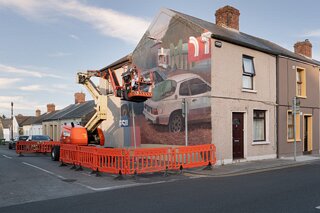
Documenting street art always requires accepting its transient nature, yet some disappearances remain particularly striking. During the August 2025 festival, Spanish painter and muralist Iñigo Sesma was commissioned to paint what was officially designated as the event's "Final Wall". Sesma, a Basque-born contemporary artist renowned for bringing fine art sensibilities and muted narrative realism to monumental public canvases, produced an evocative, cinematic composition. Centred on late-20th-century motoring nostalgia and peripheral roadside spaces, the piece featured a vintage white coupe nestled in dry scrub, framed by muted commercial typography and abstract signage panels. When I first photographed it in August 2025, the mural was still in progress, with a mobile boom lift and safety barriers enclosing the work area.
Returning in August 2026 with the expectation of finally photographing the finished piece, I was met with an unexpected scene: Sesma’s mural was entirely gone. In its place stood a brand-new work-in-progress—a large-scale, expressive figurative portrait by Spanish artist Conse (signed CONSE 26), with hydraulic machinery and traffic cones once again lining the street.
For a substantial gable end on a domestic dwelling, a total turnaround within twelve months is exceptionally unusual. While low-level hoarding and high-turnover car park walls rotate on an annual basis, large residential gables are typically preserved across multiple festival cycles.
This swift erasure suggests that complications may have disrupted the 2025 installation. Plausible explanations range from substrate issues—such as underlying masonry damp, render failure, or pigment adhesion problems—to building-owner requests, planning revisions, or unforeseen scheduling constraints that left the original composition unresolved.
Why Unresolved Murals Vanish from Public Records
Note: This is not an assertion that Iñigo Sesma’s mural was left unsigned, but rather a reflection on the broader mechanics of street art festivals and digital archives.
The Signature as Sign-Off: In large-scale contemporary muralism, an artist's signature serves as the formal declaration that a piece is fully resolved and approved under their name. When adverse weather, technical hitches, or severe time constraints prevent completion to the artist’s standard, a piece often remains unsigned.
Curatorial Policies on Unfinished Works: Street art festivals rarely promote unresolved pieces. Without an artist’s formal sign-off, organisers generally omit the wall from official trail maps, guided tours, and retrospective publications to protect both curatorial standards and the artist's professional portfolio.
Prime Wall Re-allocation: Because prominent residential gables represent prime visual real estate, an uncompleted or compromised wall will not be preserved as a multi-year legacy installation. Instead, it is prioritised for the subsequent year's roster, offering a fresh canvas for a new artist.
Digital Scarcity: Without an official sign-off, neither the artist nor the festival will publish or archive the final piece online. Aside from candid, in-progress street photographs captured during that narrow festival window, virtually no public visual record remains.
Whatever the precise circumstances behind its brief existence, Sesma’s 2025 contribution has slipped quietly into history—a vivid reminder of the unpredictable, ephemeral nature of urban documentary photography.
In August 2026, however, that reliable rhythm fell apart. Scheduling disruptions and delayed starts meant that several artists had barely commenced painting, while numerous pieces remained incomplete by the time I had to depart on Friday morning. More unexpectedly, several prominent murals from previous editions had already vanished—none more surprisingly than a major installation from 2025.
Documenting street art always requires accepting its transient nature, yet some disappearances remain particularly striking. During the August 2025 festival, Spanish painter and muralist Iñigo Sesma was commissioned to paint what was officially designated as the event's "Final Wall". Sesma, a Basque-born contemporary artist renowned for bringing fine art sensibilities and muted narrative realism to monumental public canvases, produced an evocative, cinematic composition. Centred on late-20th-century motoring nostalgia and peripheral roadside spaces, the piece featured a vintage white coupe nestled in dry scrub, framed by muted commercial typography and abstract signage panels. When I first photographed it in August 2025, the mural was still in progress, with a mobile boom lift and safety barriers enclosing the work area.
Returning in August 2026 with the expectation of finally photographing the finished piece, I was met with an unexpected scene: Sesma’s mural was entirely gone. In its place stood a brand-new work-in-progress—a large-scale, expressive figurative portrait by Spanish artist Conse (signed CONSE 26), with hydraulic machinery and traffic cones once again lining the street.
For a substantial gable end on a domestic dwelling, a total turnaround within twelve months is exceptionally unusual. While low-level hoarding and high-turnover car park walls rotate on an annual basis, large residential gables are typically preserved across multiple festival cycles.
This swift erasure suggests that complications may have disrupted the 2025 installation. Plausible explanations range from substrate issues—such as underlying masonry damp, render failure, or pigment adhesion problems—to building-owner requests, planning revisions, or unforeseen scheduling constraints that left the original composition unresolved.
Why Unresolved Murals Vanish from Public Records
Note: This is not an assertion that Iñigo Sesma’s mural was left unsigned, but rather a reflection on the broader mechanics of street art festivals and digital archives.
The Signature as Sign-Off: In large-scale contemporary muralism, an artist's signature serves as the formal declaration that a piece is fully resolved and approved under their name. When adverse weather, technical hitches, or severe time constraints prevent completion to the artist’s standard, a piece often remains unsigned.
Curatorial Policies on Unfinished Works: Street art festivals rarely promote unresolved pieces. Without an artist’s formal sign-off, organisers generally omit the wall from official trail maps, guided tours, and retrospective publications to protect both curatorial standards and the artist's professional portfolio.
Prime Wall Re-allocation: Because prominent residential gables represent prime visual real estate, an uncompleted or compromised wall will not be preserved as a multi-year legacy installation. Instead, it is prioritised for the subsequent year's roster, offering a fresh canvas for a new artist.
Digital Scarcity: Without an official sign-off, neither the artist nor the festival will publish or archive the final piece online. Aside from candid, in-progress street photographs captured during that narrow festival window, virtually no public visual record remains.
Whatever the precise circumstances behind its brief existence, Sesma’s 2025 contribution has slipped quietly into history—a vivid reminder of the unpredictable, ephemeral nature of urban documentary photography.
WHY DIS ONE MURAL REPLACE ANOTHER