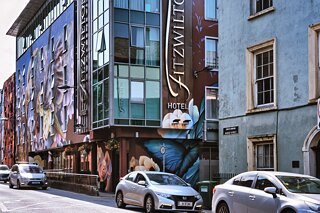
THE MAIN MURAL IS NOT EASY TO PHOTOGRAPH
The Fitzwilton as an Urban Canvas: Architectural Geometry and the Mary Street Murals
Long before the Fitzwilton Hotel on Bridge Street became a central fixture of the Waterford Walls international street art festival, its plain, rendered multistory elevations presented a stark, unyielding face to the surrounding streetscape. Offering these expansive surfaces to the festival served a dual purpose: it revitalised an austere building envelope within Waterford's Cultural Quarter and embedded the hotel directly into the city's modern cultural identity, turning private walls into lasting public assets.
The Spatial Puzzle of Mary Street
Rather than presenting a flat facade down a wide thoroughfare, the hotel's rear elevations along Mary Street present an intricate, stepped architectural layout:
The Perpendicular Forward Gable: The outermost multistory wall carries Dan Kitchener’s (DANK) striking portrait of a Geisha cradling a butterfly, framed by blossoms and delicate colour washes. This wall sits at a strict right angle to Mary Street, facing directly across a compressed access gap and car park rather than down the open street.
The Recessed Nightscape: Set back on the stepped return wall immediately beside it is Kitchener’s classic atmospheric Tokyo night scene, complete with rain-slicked asphalt, glowing vehicle headlamps, and elevated rail structures.
The Flanking Elevation: Running parallel to Mary Street is the main multistory hotel facade, adorned with continuous figurative and botanical murals wrapping down to the ground-floor underpass.
For documentary photography, this compressed footprint poses severe compositional challenges. With residential buildings and perimeter fencing blocking any true straight-on vantage, viewing the full verticality of Kitchener's dual murals requires walking deep into the narrow corridor. Even with ultra-wide glass, severe upward perspective distortion and keystoning are unavoidable.
Long before the Fitzwilton Hotel on Bridge Street became a central fixture of the Waterford Walls international street art festival, its plain, rendered multistory elevations presented a stark, unyielding face to the surrounding streetscape. Offering these expansive surfaces to the festival served a dual purpose: it revitalised an austere building envelope within Waterford's Cultural Quarter and embedded the hotel directly into the city's modern cultural identity, turning private walls into lasting public assets.
The Spatial Puzzle of Mary Street
Rather than presenting a flat facade down a wide thoroughfare, the hotel's rear elevations along Mary Street present an intricate, stepped architectural layout:
The Perpendicular Forward Gable: The outermost multistory wall carries Dan Kitchener’s (DANK) striking portrait of a Geisha cradling a butterfly, framed by blossoms and delicate colour washes. This wall sits at a strict right angle to Mary Street, facing directly across a compressed access gap and car park rather than down the open street.
The Recessed Nightscape: Set back on the stepped return wall immediately beside it is Kitchener’s classic atmospheric Tokyo night scene, complete with rain-slicked asphalt, glowing vehicle headlamps, and elevated rail structures.
The Flanking Elevation: Running parallel to Mary Street is the main multistory hotel facade, adorned with continuous figurative and botanical murals wrapping down to the ground-floor underpass.
For documentary photography, this compressed footprint poses severe compositional challenges. With residential buildings and perimeter fencing blocking any true straight-on vantage, viewing the full verticality of Kitchener's dual murals requires walking deep into the narrow corridor. Even with ultra-wide glass, severe upward perspective distortion and keystoning are unavoidable.
FITZWILTON MURALS