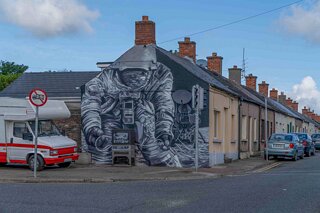
TWO RELATED MURALS PHOTOGRAPHED IN AUGUST 2019
I photographed both examples during my 2019 visit to Waterford and used a Sony A7RIII. The mural at the Fitzwilton Hotel, which I did not like, did not survive but I have recent photographs of the other mural, which is excellent, and I will publish them within a few days.
Shane Sutton’s recurring astronaut persona—known across his body of work simply as the Spacer—has left two distinct visual footprints on Waterford’s streetscape through the annual Waterford Walls International Street Art Festival. While both feature his signature cosmic wanderer, their context, technique, and spatial relationship to their environments offer a sharp contrast in execution.
The Artist & The "Spacer" Motif
Shane Sutton is a Dublin-based visual artist whose practice spans fine art oil painting, stencil and aerosol street art, and creative digital technologies. His iconic Spacer character originated in a studio painting series titled "That Space In Between", conceptualised around the suspended moments between decision and consequence. Transposed onto the urban canvas, the weightless, reflective astronaut serves as a universal observer—unmarked by gender, age, or identity—navigating terrestrial urban decay and modern architecture alike.
Sutton’s collaboration with the Waterford Walls Festival provided a high-profile public platform for this character. His contributions helped anchor the festival’s blend of narrative figurative art with dynamic street placements.
Comparing the Two Murals
Bridge Street (Fitzwilton Hotel Site)
Painted during the 2018 festival run in partnership with Space Week and Blackrock Castle Observatory, this piece was added to the schedule on very short notice.
Placement & Feel: Located at street level along Bridge Street near the Fitzwilton Hotel, the piece had an undeniably rapid, flat stencil execution.
Critique: The compressed preparation window is visible in the final result. The figure floats against a relatively plain background without deep tonal integration into the masonry, giving it the quality of a hurried pop-up rather than a site-specific installation.
Slievekeale Road
Executed for the 2019 festival edition, the Slievekeale Road Spacer is by far the more complete and sophisticated work.
Urban Camouflage & Utility Box: Its defining brilliance lies in how Sutton tackled street infrastructure. Rather than treating the ground-level utility cabinet as an awkward obstacle to paint around, he incorporated its physical volume directly into the composition. The box becomes an extension of the structural terrain, rendering it practically invisible to passers-by unless viewed from an acute angle.
Longevity & Finish: With richer gradation in the suit’s folds, deeper shadow rendering, and higher pigment resilience, this piece has stood the test of time, remaining intact and vibrant through August 2026.
At Waterford Walls and across Waterford's urban landscape, street artists frequently encounter street furniture, electrical junction boxes, ESB substations, drainpipes, and bollards. Rather than avoiding these obstacles or leaving awkward negative gaps, artists employ several distinct creative strategies to engage with the city's functional infrastructure:
1. The Anamorphic Camouflage / Physical Continuation
The technique seen in Shane Sutton’s Slievekeale Road mural is among the most technically demanding. In this approach, the artist uses the three-dimensional surfaces of a utility cabinet as a direct continuation of the 2D background or foreground plane.
Surface Alignment: Artists project lines, horizons, and gradient shading across the top, front, and sides of the cabinet so that, from a primary street viewing angle, the box effectively disappears into the wall design.
Structural Blending: Elements like faux brickwork, continuing landscape horizons, or textured shadows wrap seamlessly over metal seams, handles, and hinges.
2. The Functional Object as a Narrative Prop
Instead of hiding the utility cabinet, several artists treat the box as a physical object interacting with the characters in the artwork.
Plinths and Pedestals: A painted character might appear to be leaning against, sitting on, or leaping off the top edge of a junction box.
Mechanical & Industrial Extensions: In sci-fi, steampunk, or mechanical themes, utility boxes, external conduit pipes, and meter housings are painted to resemble generator units, battery packs, or control consoles belonging to the character or scene behind them.
3. "Canvas Wrap" Standalone Interventions
Alongside large-scale gable murals, initiatives such as the Waterford Cultural Quarter's Thinking Outside the Box (run in conjunction with local regeneration schemes and festival artists) treat freestanding metal utility boxes as self-contained micro-canvases.
360-Degree Wraps: Artists design four-sided compositions that encourage pedestrians to walk around the box, utilising bold graphic typography, illustrative wildlife, or abstract pattern work.
Visual Calming of Clutter: By turning dull grey or green telecom cabinets into colourful standalone pieces, street corners and pedestrian junctions are visually tied into the broader mural trail.
4. Architectural Feature Integration (Pipes, Vents & Cable Runs)
Large architectural walls across Waterford's older quarters often feature vertical downpipes, soil stacks, air vents, and surface-mounted cabling.
Foliage and Tendrils: Botanical and organic murals often use downpipes as tree trunks, vines, or stems, allowing painted leaves and flowers to curl around the physical hardware.
Line Integration: Illustrators and geometric muralists incorporate straight-line piping into geometric grids, wireframe backdrops, or architectural framework lines within the illustration.
1. Spacer – Morrisson's Road, Waterford
Part of the broader Waterford Walls footprint, this piece features another iteration of the iconic astronaut painted on a residential approach wall.
Augmented Reality Integration: Selected as part of The Walls Project Digital Arts Programme (in partnership with BEPART), this mural was digitised and animated. Viewers scanning the artwork with an AR app can watch the cosmic scene expand and animate with motion and sound.
Composition: Painted in a high-contrast style, it anchors the outer residential fringe of Waterford’s open-air mural gallery.
2. Spacer – Island Key, East Wall, Dublin
Commissioned by Co-operative Housing Ireland (CHI), this prominent mural looks out over the courtyard of the Island Key apartment complex.
Community-Led Design: The concept was developed in collaboration with local residents and unveiled with Dublin civic representatives.
Interactive AR Layers: Sutton built custom augmented reality filters into the piece, incorporating drawings created by local neighbourhood children that appear when the mural is viewed through a smartphone screen.
3. To Ronnie and Deirdre With Love (Ronnie Drew Tribute) – Eblana Avenue, Dún Laoghaire
Created for the dlr Anseo street art festival, this piece departs from the Spacer theme to deliver a deeply personal cultural portrait.
Subject: A tribute to Dubliners frontman Ronnie Drew, positioned around the corner from where Drew attended school on Eblana Avenue.
Execution: Rendered in Sutton's distinct textured stencil-and-spray portrait technique, celebrating both the folk icon and the personal connection between their families.
4. Always Looking For Trouble (RNLI Tribute) – Dún Laoghaire
Also executed as part of the dlr Anseo festival programme along the coastal boundary.
Subject: A dynamic tribute dedicated to the volunteers of the Royal National Lifeboat Institution (RNLI).
Styling: Features life-saving crew members navigating heavy seas, rendered with high kinetic energy, sharp lighting, and graphic spray techniques.
5. Brendan Behan & James Joyce – Richmond Cottages North, Summerhill, Dublin 1
A community-driven public art project painted in collaboration with Summerhill residents.
Subject: Large-scale portraits of Irish literary figures James Joyce and Brendan Behan.
Context: Located in Dublin's north inner city, transforming a residential laneway gable wall into a celebrated local landmark.
6. Life Preserver / Festival Piece – High Street, Belfast
Created for Seedhead Arts' Hit the North street art festival.
Execution: Sutton took over a plain urban facade near the historic entryways of High Street, bringing his stencil work and figurative street style to Belfast’s contemporary mural quarter.
7. City Fox (Dorset Street Lower / Canal Approach)
Location: Painted on a prominent building wall at 59 Dorset Street Lower, right along the main thoroughfare approaching the canal crossing.
Subject & Style: Rather than the sci-fi motif of his Spacer series or literary portraiture, this piece focuses on urban wildlife, capturing one of Dublin’s elusive nocturnal residents—the urban fox.
Execution: Rendered in high-contrast monochrome and greyscale spray techniques, the piece gives the creature a striking, watchful presence looking out over the busy city traffic.
Shane Sutton’s recurring astronaut persona—known across his body of work simply as the Spacer—has left two distinct visual footprints on Waterford’s streetscape through the annual Waterford Walls International Street Art Festival. While both feature his signature cosmic wanderer, their context, technique, and spatial relationship to their environments offer a sharp contrast in execution.
The Artist & The "Spacer" Motif
Shane Sutton is a Dublin-based visual artist whose practice spans fine art oil painting, stencil and aerosol street art, and creative digital technologies. His iconic Spacer character originated in a studio painting series titled "That Space In Between", conceptualised around the suspended moments between decision and consequence. Transposed onto the urban canvas, the weightless, reflective astronaut serves as a universal observer—unmarked by gender, age, or identity—navigating terrestrial urban decay and modern architecture alike.
Sutton’s collaboration with the Waterford Walls Festival provided a high-profile public platform for this character. His contributions helped anchor the festival’s blend of narrative figurative art with dynamic street placements.
Comparing the Two Murals
Bridge Street (Fitzwilton Hotel Site)
Painted during the 2018 festival run in partnership with Space Week and Blackrock Castle Observatory, this piece was added to the schedule on very short notice.
Placement & Feel: Located at street level along Bridge Street near the Fitzwilton Hotel, the piece had an undeniably rapid, flat stencil execution.
Critique: The compressed preparation window is visible in the final result. The figure floats against a relatively plain background without deep tonal integration into the masonry, giving it the quality of a hurried pop-up rather than a site-specific installation.
Slievekeale Road
Executed for the 2019 festival edition, the Slievekeale Road Spacer is by far the more complete and sophisticated work.
Urban Camouflage & Utility Box: Its defining brilliance lies in how Sutton tackled street infrastructure. Rather than treating the ground-level utility cabinet as an awkward obstacle to paint around, he incorporated its physical volume directly into the composition. The box becomes an extension of the structural terrain, rendering it practically invisible to passers-by unless viewed from an acute angle.
Longevity & Finish: With richer gradation in the suit’s folds, deeper shadow rendering, and higher pigment resilience, this piece has stood the test of time, remaining intact and vibrant through August 2026.
At Waterford Walls and across Waterford's urban landscape, street artists frequently encounter street furniture, electrical junction boxes, ESB substations, drainpipes, and bollards. Rather than avoiding these obstacles or leaving awkward negative gaps, artists employ several distinct creative strategies to engage with the city's functional infrastructure:
1. The Anamorphic Camouflage / Physical Continuation
The technique seen in Shane Sutton’s Slievekeale Road mural is among the most technically demanding. In this approach, the artist uses the three-dimensional surfaces of a utility cabinet as a direct continuation of the 2D background or foreground plane.
Surface Alignment: Artists project lines, horizons, and gradient shading across the top, front, and sides of the cabinet so that, from a primary street viewing angle, the box effectively disappears into the wall design.
Structural Blending: Elements like faux brickwork, continuing landscape horizons, or textured shadows wrap seamlessly over metal seams, handles, and hinges.
2. The Functional Object as a Narrative Prop
Instead of hiding the utility cabinet, several artists treat the box as a physical object interacting with the characters in the artwork.
Plinths and Pedestals: A painted character might appear to be leaning against, sitting on, or leaping off the top edge of a junction box.
Mechanical & Industrial Extensions: In sci-fi, steampunk, or mechanical themes, utility boxes, external conduit pipes, and meter housings are painted to resemble generator units, battery packs, or control consoles belonging to the character or scene behind them.
3. "Canvas Wrap" Standalone Interventions
Alongside large-scale gable murals, initiatives such as the Waterford Cultural Quarter's Thinking Outside the Box (run in conjunction with local regeneration schemes and festival artists) treat freestanding metal utility boxes as self-contained micro-canvases.
360-Degree Wraps: Artists design four-sided compositions that encourage pedestrians to walk around the box, utilising bold graphic typography, illustrative wildlife, or abstract pattern work.
Visual Calming of Clutter: By turning dull grey or green telecom cabinets into colourful standalone pieces, street corners and pedestrian junctions are visually tied into the broader mural trail.
4. Architectural Feature Integration (Pipes, Vents & Cable Runs)
Large architectural walls across Waterford's older quarters often feature vertical downpipes, soil stacks, air vents, and surface-mounted cabling.
Foliage and Tendrils: Botanical and organic murals often use downpipes as tree trunks, vines, or stems, allowing painted leaves and flowers to curl around the physical hardware.
Line Integration: Illustrators and geometric muralists incorporate straight-line piping into geometric grids, wireframe backdrops, or architectural framework lines within the illustration.
1. Spacer – Morrisson's Road, Waterford
Part of the broader Waterford Walls footprint, this piece features another iteration of the iconic astronaut painted on a residential approach wall.
Augmented Reality Integration: Selected as part of The Walls Project Digital Arts Programme (in partnership with BEPART), this mural was digitised and animated. Viewers scanning the artwork with an AR app can watch the cosmic scene expand and animate with motion and sound.
Composition: Painted in a high-contrast style, it anchors the outer residential fringe of Waterford’s open-air mural gallery.
2. Spacer – Island Key, East Wall, Dublin
Commissioned by Co-operative Housing Ireland (CHI), this prominent mural looks out over the courtyard of the Island Key apartment complex.
Community-Led Design: The concept was developed in collaboration with local residents and unveiled with Dublin civic representatives.
Interactive AR Layers: Sutton built custom augmented reality filters into the piece, incorporating drawings created by local neighbourhood children that appear when the mural is viewed through a smartphone screen.
3. To Ronnie and Deirdre With Love (Ronnie Drew Tribute) – Eblana Avenue, Dún Laoghaire
Created for the dlr Anseo street art festival, this piece departs from the Spacer theme to deliver a deeply personal cultural portrait.
Subject: A tribute to Dubliners frontman Ronnie Drew, positioned around the corner from where Drew attended school on Eblana Avenue.
Execution: Rendered in Sutton's distinct textured stencil-and-spray portrait technique, celebrating both the folk icon and the personal connection between their families.
4. Always Looking For Trouble (RNLI Tribute) – Dún Laoghaire
Also executed as part of the dlr Anseo festival programme along the coastal boundary.
Subject: A dynamic tribute dedicated to the volunteers of the Royal National Lifeboat Institution (RNLI).
Styling: Features life-saving crew members navigating heavy seas, rendered with high kinetic energy, sharp lighting, and graphic spray techniques.
5. Brendan Behan & James Joyce – Richmond Cottages North, Summerhill, Dublin 1
A community-driven public art project painted in collaboration with Summerhill residents.
Subject: Large-scale portraits of Irish literary figures James Joyce and Brendan Behan.
Context: Located in Dublin's north inner city, transforming a residential laneway gable wall into a celebrated local landmark.
6. Life Preserver / Festival Piece – High Street, Belfast
Created for Seedhead Arts' Hit the North street art festival.
Execution: Sutton took over a plain urban facade near the historic entryways of High Street, bringing his stencil work and figurative street style to Belfast’s contemporary mural quarter.
7. City Fox (Dorset Street Lower / Canal Approach)
Location: Painted on a prominent building wall at 59 Dorset Street Lower, right along the main thoroughfare approaching the canal crossing.
Subject & Style: Rather than the sci-fi motif of his Spacer series or literary portraiture, this piece focuses on urban wildlife, capturing one of Dublin’s elusive nocturnal residents—the urban fox.
Execution: Rendered in high-contrast monochrome and greyscale spray techniques, the piece gives the creature a striking, watchful presence looking out over the busy city traffic.
THE SPACE BETWEEN MURALS