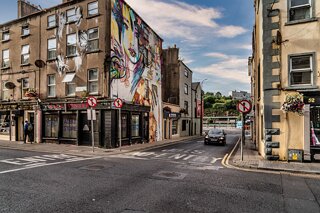
PHOTOGRAPHED A FEW WEEKS BEFORE IT WAS PAINTED OVER BY ANOTHE MURAL
Back in 2018 and earlier I had to visit Waterford in June or July because of other commitments and that presented a problem as Waterford Walls usually scheduled for August which meant that I was a year behind. When I visited in 2018 I photographed murals created during the 2027 festival.
Main Mural & Artist
Artist: Dank It / Dan Kitchener (often signing as DANK) painted the vibrant geisha selfie mural during the Waterford Walls street art festival in August 2015. You can spot his signature tag @DANKITW and the Waterford Walls 15 festival marking near the lower-left and bottom right of the piece.
Replacement: Kitchener returned to this exact wall in August 2018 (shortly after I captured these July 2018 shots) during the 2018 edition of Waterford Walls to repaint the site with his updated rainy Japanese street scene, Neon Waves.
The "Ghost Art" on the Left Facade
Artist: Le Bas (Louis Le Bas, a French street and visual artist based in Dublin/Ireland).
Date & Context: Painted during the inaugural Waterford Walls 2015 edition alongside the main piece.
Explanation: Rather than being an older painted-over mural bleeding through, this was created deliberately using a dry-brush / monochromatic wash technique in white and pale grey directly over the raw, unpainted pebble-dash/render. Le Bas used the bare building facade as the mid-tone background to create ethereal, sketch-like floating faces and figures, giving it that distinct translucent "ghost" appearance. Over the three years between August 2015 and July 2018, natural Irish weather and road grime naturally softened the raw pigment further into the stone.
About Vulcan Street
The name in is rooted in the city's 18th- and 19th-century maritime and industrial heritage.
1. The Roman God of the Forge
In Roman mythology, Vulcan was the god of fire, metalworking, volcanology, and the forge (the Roman counterpart to the Greek god Hephaestus). During the Industrial Revolution, "Vulcan" became a popular emblem across the British Isles for heavy metal trades, foundries, and ironworks.
2. Quayside Metalworking & Foundries
Waterford’s quays along the River Suir were one of Ireland's busiest shipping and commercial ports. Ships docking in the city required constant maintenance:
Anchor and chain forging
Boiler and engine repairs
General blacksmithing, copper-smithing, and shipwright metal fittings
The lanes leading directly off Merchants Quay—including Vulcan Street—housed small workshops, iron foundries, and smithies serving the dockyard and shipping industry. Naming the street after the patron deity of blacksmiths and metalworkers was a direct nod to the heavy clanging, forges, and metal trades that once operated right along that corridor.
3. Historical Street Alignment
Historically, local records (such as Rev. Patrick Power's The Place-Names of Decies) note that the name Vulcan Street was applied to the short northern connecting stretch running between O'Connell Street (historically King Street) and the Quay. While nearby streets took political, civic, or saintly titles (like Thomas Street, George’s Street, or Patrick Street), Vulcan Street remained a rare industrial-mythological survival on the Irish urban map.
Main Mural & Artist
Artist: Dank It / Dan Kitchener (often signing as DANK) painted the vibrant geisha selfie mural during the Waterford Walls street art festival in August 2015. You can spot his signature tag @DANKITW and the Waterford Walls 15 festival marking near the lower-left and bottom right of the piece.
Replacement: Kitchener returned to this exact wall in August 2018 (shortly after I captured these July 2018 shots) during the 2018 edition of Waterford Walls to repaint the site with his updated rainy Japanese street scene, Neon Waves.
The "Ghost Art" on the Left Facade
Artist: Le Bas (Louis Le Bas, a French street and visual artist based in Dublin/Ireland).
Date & Context: Painted during the inaugural Waterford Walls 2015 edition alongside the main piece.
Explanation: Rather than being an older painted-over mural bleeding through, this was created deliberately using a dry-brush / monochromatic wash technique in white and pale grey directly over the raw, unpainted pebble-dash/render. Le Bas used the bare building facade as the mid-tone background to create ethereal, sketch-like floating faces and figures, giving it that distinct translucent "ghost" appearance. Over the three years between August 2015 and July 2018, natural Irish weather and road grime naturally softened the raw pigment further into the stone.
About Vulcan Street
The name in is rooted in the city's 18th- and 19th-century maritime and industrial heritage.
1. The Roman God of the Forge
In Roman mythology, Vulcan was the god of fire, metalworking, volcanology, and the forge (the Roman counterpart to the Greek god Hephaestus). During the Industrial Revolution, "Vulcan" became a popular emblem across the British Isles for heavy metal trades, foundries, and ironworks.
2. Quayside Metalworking & Foundries
Waterford’s quays along the River Suir were one of Ireland's busiest shipping and commercial ports. Ships docking in the city required constant maintenance:
Anchor and chain forging
Boiler and engine repairs
General blacksmithing, copper-smithing, and shipwright metal fittings
The lanes leading directly off Merchants Quay—including Vulcan Street—housed small workshops, iron foundries, and smithies serving the dockyard and shipping industry. Naming the street after the patron deity of blacksmiths and metalworkers was a direct nod to the heavy clanging, forges, and metal trades that once operated right along that corridor.
3. Historical Street Alignment
Historically, local records (such as Rev. Patrick Power's The Place-Names of Decies) note that the name Vulcan Street was applied to the short northern connecting stretch running between O'Connell Street (historically King Street) and the Quay. While nearby streets took political, civic, or saintly titles (like Thomas Street, George’s Street, or Patrick Street), Vulcan Street remained a rare industrial-mythological survival on the Irish urban map.
2015 MURAL ON VULCAN STREET