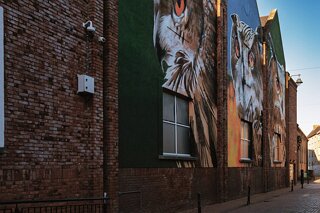
THIS WAS THE HIGHLIGHT EVENT OF MY AUGUST 2026 VISIT TO WATERFORD
The highlight of my visit to Waterford coincided with the August 12 solar eclipse. While totality crossed Spain and Iceland, Ireland saw the moon obscure over 90% of the sun. Using a Leica Q3, I documented the event from ground level: capturing the sudden shift in ambient street lighting and the candid reactions of onlookers gathered across the city. I focused on the uncanny, desaturated twilight falling over the historic streetscapes and the shared curiosity of people pausing on footpaths to watch the skies dim.
One thing I noticed was that the LED streetlight switched on for the duration of the event.
Here is why that happens:
Photocell Sensors (Dusk-to-Dawn Control): Most modern street lighting systems are not run on fixed clock timers. Instead, individual lanterns (or centralized nodes) use photoelectric control units (photocells) that continuously measure ambient illuminance (lux levels) in the sky.
The Lux Switching Threshold: Standard council-spec photocells are typically calibrated to trigger the light on when ambient daylight drops below roughly 20 to 35 lux (simulating civil twilight).
The Eclipse "False Night": When the Moon blocks out the vast majority of the Sun—especially when combined with existing cloud cover or late-day sun angles—ambient daylight plummets below that calibrated threshold. The sensors interpret the sudden darkness as nightfall and close the circuit, powering up the LEDs.
Turning Back Off: As the Moon moves past maximum obscuration and ambient light levels rise back above the cut-off threshold (often around 18–20 lux), the sensors trigger the lights to turn back off until actual sunset.
I really enjoyed my visit to Waterford but in my opinion this year there was something different about the Waterford Walls festival in that it lacked the "buzz" that it once had to the extent that I began to wonder if management had changed. For example the staff at my hotel were unaware that the festival was ongoing event though the were aware that it is an annual event
While the festival hasn't vanished—the 2026 edition runs from August 7 to 16—the structure, atmosphere, and local visibility of Waterford Walls have shifted noticeably over recent years.
1. Shift from Grassroots to Corporate Agency
In its early years, Waterford Walls operated as a tight-knit, community-driven local initiative led by founder Edel Byrne (Partington).
Over time, it formalised into The Walls Project CLG, a registered non-profit placemaking agency. Today, executive direction is handled by John O'Connell alongside a formal management team. Because The Walls Project now manages large-scale year-round projects nationwide (such as Dublin Walls and national public commissions), the organisation’s bandwidth and focus are split across a much broader scope than just the August festival in Waterford.
The Walls Project
2. Dispersed Footprint vs. Centralised "Hub"
In earlier editions, much of the action was concentrated in tight urban clusters in the city centre, creating a visible, tangible buzz where artists, spectators, and locals constantly crossed paths.
In recent years, the festival expanded its physical footprint across a wider regional perimeter (including outer suburban walls and surrounding areas). While this spreads art into more neighbourhoods, it dilutes the central "festival hub" feel in the core city streets.
3. Digital-First Marketing & Local Disconnect
The promotion strategy has increasingly moved toward digital maps, artist social media channels, and national tourism campaigns (such as Discover Ireland).
A unintended side-effect of this shift is a reduced physical presence in local commerce. Without heavy printed signage, central information kiosks, or traditional local PR bursts, key front-line hospitality workers—like hotel front desks or shopkeepers—are frequently out of the loop regarding daily schedules or artist locations.
One thing I noticed was that the LED streetlight switched on for the duration of the event.
Here is why that happens:
Photocell Sensors (Dusk-to-Dawn Control): Most modern street lighting systems are not run on fixed clock timers. Instead, individual lanterns (or centralized nodes) use photoelectric control units (photocells) that continuously measure ambient illuminance (lux levels) in the sky.
The Lux Switching Threshold: Standard council-spec photocells are typically calibrated to trigger the light on when ambient daylight drops below roughly 20 to 35 lux (simulating civil twilight).
The Eclipse "False Night": When the Moon blocks out the vast majority of the Sun—especially when combined with existing cloud cover or late-day sun angles—ambient daylight plummets below that calibrated threshold. The sensors interpret the sudden darkness as nightfall and close the circuit, powering up the LEDs.
Turning Back Off: As the Moon moves past maximum obscuration and ambient light levels rise back above the cut-off threshold (often around 18–20 lux), the sensors trigger the lights to turn back off until actual sunset.
I really enjoyed my visit to Waterford but in my opinion this year there was something different about the Waterford Walls festival in that it lacked the "buzz" that it once had to the extent that I began to wonder if management had changed. For example the staff at my hotel were unaware that the festival was ongoing event though the were aware that it is an annual event
While the festival hasn't vanished—the 2026 edition runs from August 7 to 16—the structure, atmosphere, and local visibility of Waterford Walls have shifted noticeably over recent years.
1. Shift from Grassroots to Corporate Agency
In its early years, Waterford Walls operated as a tight-knit, community-driven local initiative led by founder Edel Byrne (Partington).
Over time, it formalised into The Walls Project CLG, a registered non-profit placemaking agency. Today, executive direction is handled by John O'Connell alongside a formal management team. Because The Walls Project now manages large-scale year-round projects nationwide (such as Dublin Walls and national public commissions), the organisation’s bandwidth and focus are split across a much broader scope than just the August festival in Waterford.
The Walls Project
2. Dispersed Footprint vs. Centralised "Hub"
In earlier editions, much of the action was concentrated in tight urban clusters in the city centre, creating a visible, tangible buzz where artists, spectators, and locals constantly crossed paths.
In recent years, the festival expanded its physical footprint across a wider regional perimeter (including outer suburban walls and surrounding areas). While this spreads art into more neighbourhoods, it dilutes the central "festival hub" feel in the core city streets.
3. Digital-First Marketing & Local Disconnect
The promotion strategy has increasingly moved toward digital maps, artist social media channels, and national tourism campaigns (such as Discover Ireland).
A unintended side-effect of this shift is a reduced physical presence in local commerce. Without heavy printed signage, central information kiosks, or traditional local PR bursts, key front-line hospitality workers—like hotel front desks or shopkeepers—are frequently out of the loop regarding daily schedules or artist locations.
SOLAR ECLIPSE