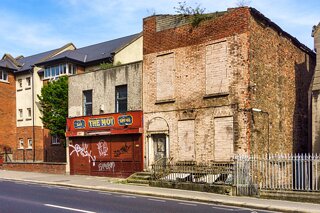
THE MOY WAS DERELICT FOR ABOUT TWO DECADES
The Complicated Tale of Dorset Street: The Moy Pub & The Birthplace of Richard Brinsley Sheridan
When I first moved to the area around Bolton Street, a neighbour mentioned that the famous 18th-century playwright Richard Brinsley Sheridan was born at No. 12 Upper Dorset Street—right next door to the abandoned Moy Pub. Intrigued by the literary heritage on my doorstep, I began digging into archival records and planning files. What I uncovered was a fascinatingly tangled story of shifting street numbers, planning deadlocks, and urban decay turning into careful restoration.
Who was Richard Brinsley Sheridan?
Born in Dublin in 1751, Sheridan was one of the late 18th century's premier satirists and politicians. A long-standing Member of Parliament at Westminster, he is best remembered for masterpiece comedies of manners such as The Rivals (1775) and The School for Scandal (1777).
1. The Historic Misunderstanding & The Plaque Paradox
For generations, local folklore, literary guidebooks, and an official Dublin Tourism blue plaque proudly designated No. 12 Upper Dorset Street as Sheridan’s birthplace. Based on this prestigious cultural link, the building was added to Dublin’s statutory Record of Protected Structures, granting it legal protection against demolition.
However, mid-18th-century Dublin did not use fixed, sequential house numbering. Numbers were assigned fluidly, often reordered as new terraces were built or consolidated. Later archival research and architectural forensics revealed a twist: while Sheridan’s family certainly lived along this stretch of Dorset Street (then known as Drumcondra Lane), subsequent 19th-century street renumbering shifted the address line. The actual house where Sheridan was born in 1751 was likely an adjacent property long since demolished. Modern No. 12 was constructed around 1745, but Sheridan had never actually lived inside its walls.
2. The Moy Pub: From Local Watering Hole to Ghost Sign
Immediately adjoining No. 12 sat The Moy at No. 13 Upper Dorset Street. Unlike famous Dorset Street institutions like The Big Tree, The Moy was never a high-profile destination pub. It was a traditional, working-class local pub—a modest spot where neighbourhood regulars gathered for a pint.
When the pub closed its doors around the turn of the millennium, it fell into complete neglect. Yet in its after-life, The Moy achieved a different kind of fame. Its weathered, hand-painted retro signage and decaying timber storefront became an iconic Dublin "ghost sign," frequently photographed by local urban historians and visual chroniclers tracking the changing face of the North Inner City.
3. Contagious Dereliction & Planning Standoffs
Despite the historical misattribution, No. 12 remained legally protected. In the mid-2000s, when developers submitted planning applications to level both No. 12 and the derelict Moy pub to construct new apartments, a fierce heritage battle erupted. Conservation organisations, including An Taisce and Senator David Norris, fought the demolition of the protected Georgian structure.
As legal and planning appeals stalled the project for years, physical decay set in. The abandonment of The Moy proved catastrophic for its protected neighbour. Water ingress from the pub’s collapsed roof and rotting timbers soaked through the shared party wall and chimney stacks. Starved of routine maintenance and structural bracing, No. 12 began crumbling from the inside out—losing its upper floors and roof while remaining frozen in planning limbo.
4. Regeneration: A Measured Architectural Outcome
When the legal and financial logjams finally cleared, site works required delicate structural engineering. Contractors had to carefully shore up and stabilize the surviving historic brick elevation of No. 12 while clearing the collapsed ruins of The Moy.
The resulting redevelopment across Nos. 12 and 13 demonstrated that patience can yield thoughtful urban infill. Rather than erecting a generic facade, the project delivered a contemporary building that respects the scale, plot width, and brickwork rhythm of the historic streetscape. It honours the memory of the site without resorting to pastiche—bringing closure to a long chapter of decay on Upper Dorset Street.
When I first moved to the area around Bolton Street, a neighbour mentioned that the famous 18th-century playwright Richard Brinsley Sheridan was born at No. 12 Upper Dorset Street—right next door to the abandoned Moy Pub. Intrigued by the literary heritage on my doorstep, I began digging into archival records and planning files. What I uncovered was a fascinatingly tangled story of shifting street numbers, planning deadlocks, and urban decay turning into careful restoration.
Who was Richard Brinsley Sheridan?
Born in Dublin in 1751, Sheridan was one of the late 18th century's premier satirists and politicians. A long-standing Member of Parliament at Westminster, he is best remembered for masterpiece comedies of manners such as The Rivals (1775) and The School for Scandal (1777).
1. The Historic Misunderstanding & The Plaque Paradox
For generations, local folklore, literary guidebooks, and an official Dublin Tourism blue plaque proudly designated No. 12 Upper Dorset Street as Sheridan’s birthplace. Based on this prestigious cultural link, the building was added to Dublin’s statutory Record of Protected Structures, granting it legal protection against demolition.
However, mid-18th-century Dublin did not use fixed, sequential house numbering. Numbers were assigned fluidly, often reordered as new terraces were built or consolidated. Later archival research and architectural forensics revealed a twist: while Sheridan’s family certainly lived along this stretch of Dorset Street (then known as Drumcondra Lane), subsequent 19th-century street renumbering shifted the address line. The actual house where Sheridan was born in 1751 was likely an adjacent property long since demolished. Modern No. 12 was constructed around 1745, but Sheridan had never actually lived inside its walls.
2. The Moy Pub: From Local Watering Hole to Ghost Sign
Immediately adjoining No. 12 sat The Moy at No. 13 Upper Dorset Street. Unlike famous Dorset Street institutions like The Big Tree, The Moy was never a high-profile destination pub. It was a traditional, working-class local pub—a modest spot where neighbourhood regulars gathered for a pint.
When the pub closed its doors around the turn of the millennium, it fell into complete neglect. Yet in its after-life, The Moy achieved a different kind of fame. Its weathered, hand-painted retro signage and decaying timber storefront became an iconic Dublin "ghost sign," frequently photographed by local urban historians and visual chroniclers tracking the changing face of the North Inner City.
3. Contagious Dereliction & Planning Standoffs
Despite the historical misattribution, No. 12 remained legally protected. In the mid-2000s, when developers submitted planning applications to level both No. 12 and the derelict Moy pub to construct new apartments, a fierce heritage battle erupted. Conservation organisations, including An Taisce and Senator David Norris, fought the demolition of the protected Georgian structure.
As legal and planning appeals stalled the project for years, physical decay set in. The abandonment of The Moy proved catastrophic for its protected neighbour. Water ingress from the pub’s collapsed roof and rotting timbers soaked through the shared party wall and chimney stacks. Starved of routine maintenance and structural bracing, No. 12 began crumbling from the inside out—losing its upper floors and roof while remaining frozen in planning limbo.
4. Regeneration: A Measured Architectural Outcome
When the legal and financial logjams finally cleared, site works required delicate structural engineering. Contractors had to carefully shore up and stabilize the surviving historic brick elevation of No. 12 while clearing the collapsed ruins of The Moy.
The resulting redevelopment across Nos. 12 and 13 demonstrated that patience can yield thoughtful urban infill. Rather than erecting a generic facade, the project delivered a contemporary building that respects the scale, plot width, and brickwork rhythm of the historic streetscape. It honours the memory of the site without resorting to pastiche—bringing closure to a long chapter of decay on Upper Dorset Street.
A FAKE HISTORY