PHOTOGRAPHED USING A FUJIFILM GFX100RF
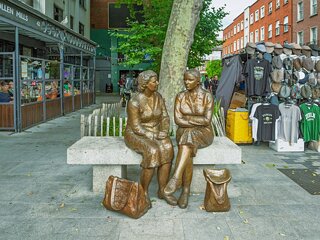
THE MEETING PLACE SCULPTURE IS LOCALLY KNOWN AS THE HAGS WITH BAGS [6 AUGUST 2026]
Meeting place, officially titled Meeting Place and affectionately known to Dubliners as "The Hags with the Bags", is one of Dublin’s most recognizable pieces of public art. Commissioned by Allied Irish Banks and unveiled in 1988 as part of the Dublin Millennium celebrations, the bronze sculpture depicts two everyday women resting on a bench with their shopping bags at their feet, engaged in conversation. It stands near the northern exit of the Ha'penny Bridge at Liffey Street Lower.
The Sculpture and Its Cultural Significance
Unlike conventional public monuments that honour historic statesmen or military figures, Meeting Place celebrates ordinary Dublin life and street culture.
Relatability: The artwork captures an unscripted, human moment—two working-class shoppers pausing amidst a busy day on Dublin's main commercial thoroughfares.
Dublin Humour: True to the city's penchant for cheeky rhyming nicknames for statues, the piece was quickly christened "The Hags with the Bags".
Authentic Details: The detail on the bronze bags includes recognisable elements of Dublin life, including a bag from Arnotts department store. Notably, shortly after its installation in 1988, one of the heavy bronze shopping bags was stolen, leading to a replacement that was firmly bolted down.
The Artist: Jackie McKenna
Jackie McKenna is an Irish sculptor known for her figural works in bronze and stone.
Artistic Focus: McKenna’s portfolio frequently centres on realistic, narrative-driven sculptures depicting human interaction, domesticity, and community heritage.
Public Realm Work: Beyond Meeting Place, McKenna has produced numerous public commissions across Ireland, using tactile materials like bronze to bridge the gap between fine art and public accessibility.
Style and Legacy: Her approach in Meeting Place broke away from grand heroic statues, paving the way for contemporary public art that honours everyday life and social connection.
Street Upgrade, Removal, Restoration, and Return
As part of Dublin City Council's public realm enhancements for Liffey Street Lower, the area underwent a significant pedestrianisation upgrade to create a more accessible, pedestrian-friendly space between the Ha'penny Bridge and Henry Street.
Removal and Conservation: During the heavy construction and paving works, the sculpture was temporarily removed from Liffey Street Lower to prevent damage. During this period off-site, the artwork underwent professional cleaning, bronze conservation, and structural restoration to repair decades of weathering and urban exposure.
Return to Liffey Street Lower: Following the completion of the street's pedestrianisation and high-quality repaving works, the statue was returned to Liffey Street Lower.
Relocation: It was reinstalled in a slightly altered position within the newly formatted, traffic-free pedestrian zone. The new location allows better pedestrian movement around the sculpture while retaining its role as a key meeting spot near the river.
Dubliners have an instinct for instantly stripping grand public monuments of their solemnity by slapping them with irreverent, rhyming, or cheeky monikers. This practice—often dubbed "the Dublin wit"—serves as a cultural equaliser, cutting down artistic pretension and embedding corporate or civic architecture into the vernacular of the city.
Dublin’s Public Art and the Wit Behind Their Nicknames
Dublin is a city that refuses to take its public monuments too seriously. While civic leaders commission statues to commemorate literary giants, historical figures, and national allegories, Dubliners almost immediately rename them with sharp, irreverent, and affectionate rhyming slang.
Here is a guide to some of the capital's most famous public sculptures, their real origins, and the local titles that stuck.
Oscar Wilde Memorial (Merrion Square Park)
Sculptor: Danny Osborne (unveiled 1997)
Location: Merrion Square Park, facing Wilde's childhood home at 1 Merrion Square
Local Monikers: "The Quare in the Square", "The Fag on the Crag"
Carved from semi-precious stones—including a green jade jacket, thulite collar, and granite trousers—the sculpture depicts Oscar Wilde lounging casually on a large boulder of Wicklow quartz. The local nicknames lean into Dublin’s dark rhyming humour, referencing Wilde's sexuality, his 1895 conviction for "gross indecency", and his reclining posture on the stone. In Hiberno-English, quare is the traditional local pronunciation of queer, which Dubliners turned into a neat rhyme for the location.
Chariot of Life (Lower Abbey Street)
Sculptor: Oisín Kelly (unveiled 1982)
Location: The courtyard of the Irish Life Centre, Lower Abbey Street
Local Monikers: "The Mad Milkman", "The Mad Horses"
Commissioned by Irish Life, this massive bronze fountain features a driver struggling to control three powerful, rearing horses pulling a chariot. The frantic energy and galloping motion of the bronze horses led locals to quickly dub the piece "The Mad Milkman", imagining a delivery driver tearing down Dublin’s streets at full tilt.
Molly Malone (Suffolk Street)
Sculptor: Jeanne Rynhart (unveiled 1988)
Location: Outside St Andrew's Church, Suffolk Street (originally Grafton Street)
Local Monikers: "The Tart with the Cart", "The Dish with the Fish", "The Trollop with the Scallop"
Erected as part of the 1988 Dublin Millennium celebrations, this bronze statue commemorates the legendary fishmonger of the city's famous anthem Cockles and Mussels. The period dress designed for the statue features a low-cut 17th-century bodice, which instantly inspired Dubliners to coin "The Tart with the Cart".
The Monument of Light / The Spike (O'Connell Street)
Designers: Ian Ritchie Architects (completed 2003)
Location: O'Connell Street, on the site of the former Nelson's Pillar
Local Monikers: "The Spike", "The Stiletto in the Ghetto", "The Pin in the Bin"
Standing at 120 metres, this stainless-steel needle was designed to beacon light across the capital. Replaced Nelson’s Pillar decades after it was destroyed in 1966, the soaring structure was promptly christened "The Stiletto in the Ghetto" by locals, poking fun at the contrast between a multi-million-euro modern landmark and the gritty inner-city surrounding it.
Anna Livia (Croppies Acre Memorial Park)
Sculptor: Eamonn O'Doherty (unveiled 1988)
Location: Croppies Acre Park, near Heuston Station (originally O'Connell Street)
Local Monikers: "The Floozie in the Jacuzzi"
Created to personify the River Liffey as Anna Livia Plurabelle from James Joyce's Finnegans Wake, this bronze monument shows a female figure reclining in a bed of flowing water. When it sat on O'Connell Street, the rushing water surrounding the bronze earned it the enduring title "The Floozie in the Jacuzzi". It was moved to its current parkland setting near the Liffey in 2011.
Is This Unique to Ireland and the UK?
While the habit is refined to a fine art in Ireland and Britain, it is not entirely unique to these islands—though the specific linguistic style (rhyming couplets and dark irreverence) is particularly characteristic of Anglo-Irish urban culture.
In Ireland and the UK:
The inclination stems from a shared cultural resistance to self-importance. Cities across the UK practice this heavily:
London: The Gherkin (30 St Mary Axe), The Walkie Talkie (20 Fenchurch Street), and The Cheese Grater (122 Leadenhall Street).
Glasgow: Placing a traffic cone on the head of the Duke of Wellington statue is a physical manifestation of the exact same anti-authoritarian humour.
Beyond Ireland and the UK:
Other cultures rename landmarks, but the tone differs depending on local linguistic habits:
Australia: Aussies lean into playful truncation and descriptive irony (e.g., Sydney’s Barangaroo Cutaway being nicknamed "The Bunker", or Melbourne's public artwork Vault dubbed "Yellow Peril").
Germany (Berlin): Berliners share Dublin’s dry, cynical edge. The Weltzeituhr (World Time Clock) was dubbed "the urn", and the Berliner Fernsehturm (TV Tower) was nicknamed Telespargel ("TV Asparagus").
France (Paris): Parisian naming tends to focus on visual disdain rather than rhyming play; the Tour Montparnasse is often called "the black scar".
What makes Dublin's tradition distinct is the speed and poetic structure of the naming: the city almost demands that a new bronze figure rhyme with its context before it can be fully accepted into the urban landscape.
The speed at which a moniker achieves universal adoption in a city like Dublin comes down to a mix of oral culture, media amplification, and social utility. Before the internet, these names moved at the speed of conversation; today, digital loops lock them in within hours.
1. The Mechanics of Transmission
Word-of-Mouth Network Densities: In tight-knit urban environments, informal communication channels—pub banter, taxicab chatter, market trading, and commuter small talk—act as rapid distribution networks. A catchy phrase uttered on a Monday morning in a local shop can easily spread across an entire district by evening.
Media Amplification: Local radio presenters, print columnists, and popular commentators often pick up street slang and repeat it on air. Once a broadcaster uses a nickname during a morning show or a newspaper columnist drops it into a piece, it transitions from casual street talk into the wider public consciousness.
Digital Acceleration: Social media platforms, localised online forums, and meme accounts act as instant force multipliers. A single tweet or image caption referencing a new landmark by a clever moniker can trend locally within hours, effectively bypassing traditional word-of-mouth timelines.
2. Why Monikers Gain Immediate Acceptance
Linguistic Memorability: Names that stick almost always rely on sharp literary devices—alliteration, meter, internal rhyme, or vivid visual metaphors. Monikers like "The Tart with the Cart" or "The Floozie in the Jacuzzi" roll off the tongue far more naturally than formal corporate or civic titles.
Social Utility and Navigation: Formal civic titles are often long, generic, or overly solemn (e.g., Meeting Place or The Spire of Dublin). A short, punchy nickname gives residents a practical, unambiguous shorthand for organising meetups or describing directions.
Cultural Ownership and Subversion: Imposing a irreverent title on an expensive public installation allows locals to claim ownership over the urban environment. It transforms a top-down civic decision into something that belongs to the community's shared language, stripping away corporate or bureaucratic formality.
Once a name crosses the threshold where it is universally understood across generations, it effectively replaces the official title in daily speech, securing its place in the city's living oral history.
Meeting place, officially titled Meeting Place and affectionately known to Dubliners as "The Hags with the Bags", is one of Dublin’s most recognizable pieces of public art. Commissioned by Allied Irish Banks and unveiled in 1988 as part of the Dublin Millennium celebrations, the bronze sculpture depicts two everyday women resting on a bench with their shopping bags at their feet, engaged in conversation. It stands near the northern exit of the Ha'penny Bridge at Liffey Street Lower.
The Sculpture and Its Cultural Significance
Unlike conventional public monuments that honour historic statesmen or military figures, Meeting Place celebrates ordinary Dublin life and street culture.
Relatability: The artwork captures an unscripted, human moment—two working-class shoppers pausing amidst a busy day on Dublin's main commercial thoroughfares.
Dublin Humour: True to the city's penchant for cheeky rhyming nicknames for statues, the piece was quickly christened "The Hags with the Bags".
Authentic Details: The detail on the bronze bags includes recognisable elements of Dublin life, including a bag from Arnotts department store. Notably, shortly after its installation in 1988, one of the heavy bronze shopping bags was stolen, leading to a replacement that was firmly bolted down.
The Artist: Jackie McKenna
Jackie McKenna is an Irish sculptor known for her figural works in bronze and stone.
Artistic Focus: McKenna’s portfolio frequently centres on realistic, narrative-driven sculptures depicting human interaction, domesticity, and community heritage.
Public Realm Work: Beyond Meeting Place, McKenna has produced numerous public commissions across Ireland, using tactile materials like bronze to bridge the gap between fine art and public accessibility.
Style and Legacy: Her approach in Meeting Place broke away from grand heroic statues, paving the way for contemporary public art that honours everyday life and social connection.
Street Upgrade, Removal, Restoration, and Return
As part of Dublin City Council's public realm enhancements for Liffey Street Lower, the area underwent a significant pedestrianisation upgrade to create a more accessible, pedestrian-friendly space between the Ha'penny Bridge and Henry Street.
Removal and Conservation: During the heavy construction and paving works, the sculpture was temporarily removed from Liffey Street Lower to prevent damage. During this period off-site, the artwork underwent professional cleaning, bronze conservation, and structural restoration to repair decades of weathering and urban exposure.
Return to Liffey Street Lower: Following the completion of the street's pedestrianisation and high-quality repaving works, the statue was returned to Liffey Street Lower.
Relocation: It was reinstalled in a slightly altered position within the newly formatted, traffic-free pedestrian zone. The new location allows better pedestrian movement around the sculpture while retaining its role as a key meeting spot near the river.
Dubliners have an instinct for instantly stripping grand public monuments of their solemnity by slapping them with irreverent, rhyming, or cheeky monikers. This practice—often dubbed "the Dublin wit"—serves as a cultural equaliser, cutting down artistic pretension and embedding corporate or civic architecture into the vernacular of the city.
Dublin’s Public Art and the Wit Behind Their Nicknames
Dublin is a city that refuses to take its public monuments too seriously. While civic leaders commission statues to commemorate literary giants, historical figures, and national allegories, Dubliners almost immediately rename them with sharp, irreverent, and affectionate rhyming slang.
Here is a guide to some of the capital's most famous public sculptures, their real origins, and the local titles that stuck.
Oscar Wilde Memorial (Merrion Square Park)
Sculptor: Danny Osborne (unveiled 1997)
Location: Merrion Square Park, facing Wilde's childhood home at 1 Merrion Square
Local Monikers: "The Quare in the Square", "The Fag on the Crag"
Carved from semi-precious stones—including a green jade jacket, thulite collar, and granite trousers—the sculpture depicts Oscar Wilde lounging casually on a large boulder of Wicklow quartz. The local nicknames lean into Dublin’s dark rhyming humour, referencing Wilde's sexuality, his 1895 conviction for "gross indecency", and his reclining posture on the stone. In Hiberno-English, quare is the traditional local pronunciation of queer, which Dubliners turned into a neat rhyme for the location.
Chariot of Life (Lower Abbey Street)
Sculptor: Oisín Kelly (unveiled 1982)
Location: The courtyard of the Irish Life Centre, Lower Abbey Street
Local Monikers: "The Mad Milkman", "The Mad Horses"
Commissioned by Irish Life, this massive bronze fountain features a driver struggling to control three powerful, rearing horses pulling a chariot. The frantic energy and galloping motion of the bronze horses led locals to quickly dub the piece "The Mad Milkman", imagining a delivery driver tearing down Dublin’s streets at full tilt.
Molly Malone (Suffolk Street)
Sculptor: Jeanne Rynhart (unveiled 1988)
Location: Outside St Andrew's Church, Suffolk Street (originally Grafton Street)
Local Monikers: "The Tart with the Cart", "The Dish with the Fish", "The Trollop with the Scallop"
Erected as part of the 1988 Dublin Millennium celebrations, this bronze statue commemorates the legendary fishmonger of the city's famous anthem Cockles and Mussels. The period dress designed for the statue features a low-cut 17th-century bodice, which instantly inspired Dubliners to coin "The Tart with the Cart".
The Monument of Light / The Spike (O'Connell Street)
Designers: Ian Ritchie Architects (completed 2003)
Location: O'Connell Street, on the site of the former Nelson's Pillar
Local Monikers: "The Spike", "The Stiletto in the Ghetto", "The Pin in the Bin"
Standing at 120 metres, this stainless-steel needle was designed to beacon light across the capital. Replaced Nelson’s Pillar decades after it was destroyed in 1966, the soaring structure was promptly christened "The Stiletto in the Ghetto" by locals, poking fun at the contrast between a multi-million-euro modern landmark and the gritty inner-city surrounding it.
Anna Livia (Croppies Acre Memorial Park)
Sculptor: Eamonn O'Doherty (unveiled 1988)
Location: Croppies Acre Park, near Heuston Station (originally O'Connell Street)
Local Monikers: "The Floozie in the Jacuzzi"
Created to personify the River Liffey as Anna Livia Plurabelle from James Joyce's Finnegans Wake, this bronze monument shows a female figure reclining in a bed of flowing water. When it sat on O'Connell Street, the rushing water surrounding the bronze earned it the enduring title "The Floozie in the Jacuzzi". It was moved to its current parkland setting near the Liffey in 2011.
Is This Unique to Ireland and the UK?
While the habit is refined to a fine art in Ireland and Britain, it is not entirely unique to these islands—though the specific linguistic style (rhyming couplets and dark irreverence) is particularly characteristic of Anglo-Irish urban culture.
In Ireland and the UK:
The inclination stems from a shared cultural resistance to self-importance. Cities across the UK practice this heavily:
London: The Gherkin (30 St Mary Axe), The Walkie Talkie (20 Fenchurch Street), and The Cheese Grater (122 Leadenhall Street).
Glasgow: Placing a traffic cone on the head of the Duke of Wellington statue is a physical manifestation of the exact same anti-authoritarian humour.
Beyond Ireland and the UK:
Other cultures rename landmarks, but the tone differs depending on local linguistic habits:
Australia: Aussies lean into playful truncation and descriptive irony (e.g., Sydney’s Barangaroo Cutaway being nicknamed "The Bunker", or Melbourne's public artwork Vault dubbed "Yellow Peril").
Germany (Berlin): Berliners share Dublin’s dry, cynical edge. The Weltzeituhr (World Time Clock) was dubbed "the urn", and the Berliner Fernsehturm (TV Tower) was nicknamed Telespargel ("TV Asparagus").
France (Paris): Parisian naming tends to focus on visual disdain rather than rhyming play; the Tour Montparnasse is often called "the black scar".
What makes Dublin's tradition distinct is the speed and poetic structure of the naming: the city almost demands that a new bronze figure rhyme with its context before it can be fully accepted into the urban landscape.
The speed at which a moniker achieves universal adoption in a city like Dublin comes down to a mix of oral culture, media amplification, and social utility. Before the internet, these names moved at the speed of conversation; today, digital loops lock them in within hours.
1. The Mechanics of Transmission
Word-of-Mouth Network Densities: In tight-knit urban environments, informal communication channels—pub banter, taxicab chatter, market trading, and commuter small talk—act as rapid distribution networks. A catchy phrase uttered on a Monday morning in a local shop can easily spread across an entire district by evening.
Media Amplification: Local radio presenters, print columnists, and popular commentators often pick up street slang and repeat it on air. Once a broadcaster uses a nickname during a morning show or a newspaper columnist drops it into a piece, it transitions from casual street talk into the wider public consciousness.
Digital Acceleration: Social media platforms, localised online forums, and meme accounts act as instant force multipliers. A single tweet or image caption referencing a new landmark by a clever moniker can trend locally within hours, effectively bypassing traditional word-of-mouth timelines.
2. Why Monikers Gain Immediate Acceptance
Linguistic Memorability: Names that stick almost always rely on sharp literary devices—alliteration, meter, internal rhyme, or vivid visual metaphors. Monikers like "The Tart with the Cart" or "The Floozie in the Jacuzzi" roll off the tongue far more naturally than formal corporate or civic titles.
Social Utility and Navigation: Formal civic titles are often long, generic, or overly solemn (e.g., Meeting Place or The Spire of Dublin). A short, punchy nickname gives residents a practical, unambiguous shorthand for organising meetups or describing directions.
Cultural Ownership and Subversion: Imposing a irreverent title on an expensive public installation allows locals to claim ownership over the urban environment. It transforms a top-down civic decision into something that belongs to the community's shared language, stripping away corporate or bureaucratic formality.
Once a name crosses the threshold where it is universally understood across generations, it effectively replaces the official title in daily speech, securing its place in the city's living oral history.
THE HAGS WITH THE BAGS