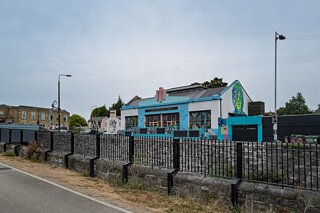
THE FICTION OF THE BERNARD SHAW BEING A HISTORIC NORTHSIDE PUB - PHOTOGRAPHED 2 AUGUST 2026
The street art murals around Cross Guns Bridge caught my attention today, and while I certainly admire the building's presence, the reality is that much of the surrounding art is actually clever commercial advertising.
The public outcry surrounding public house closures across Ireland often paints a picture of cultural erasure, yet a closer examination reveals a far more complex economic reality. Beneath the headlines of fading heritage lies a mix of natural market consolidation, property economics, changing consumer habits, and collective selective memory.
Market Realities Behind Closing Doors
The narrative that every shuttered pub is a tragic casualty of corporate greed ignores fundamental business dynamics:
Natural Market Correction: Decades of oversupply left many urban and suburban areas saturated with drinking establishments. As alcohol consumption habits shift towards home entertainment and healthier lifestyles, the market naturally contracts to support only viable operations.
Property Value Realisation: Land values in city centres have surged dramatically. Pub owners frequently realise that the real estate beneath their feet is worth vastly more when redeveloped into hotels, student accommodation, or apartments than as a continuing hospitality enterprise.
Generational Shifts: Many family-owned pubs face an inevitable end when aging proprietors reach retirement. Without interested successors willing to manage the demanding hours of modern hospitality, selling to property developers becomes the most pragmatic exit strategy.
The "Beloved" Paradox: Public grief online rarely translates into footfall at the tills. Many establishments mourned on social media had been quietly struggling for years due to insufficient regular trade. A pub cannot survive on sentimental affection alone; it requires daily patronage.
Fact-Checking the Myth: The Case of The Bernard Shaw
The narrative surrounding the 2019 closure of The Bernard Shaw on South Richmond Street highlights how quickly modern nostalgia invents historic roots.
The Misconception: It was widely mourned as a centuries-old historic institution.
The Historical Fact: The venue opened under its modern identity only in October 2006, created by the Bodytonic group when they took over the former Brannigan's pub premises.
The Misconception: It was permanently destroyed by site redevelopment.
The Historical Fact: The venue operates as a commercial business model that successfully relocated to Cross Guns Bridge within weeks of leaving Richmond Street.
The Misconception: It was a generational local frequented by patrons and their families for over forty years.
The Historical Fact: The brand existed for just 13 years at its original Richmond Street location before moving. Claims of decades-long loyalty confuse The Bernard Shaw with the older, unrelated pubs that previously occupied the building.
When news broke that The Bernard Shaw was closing its original premises, widespread outrage targeted property developers for dismantling Dublin's cultural fabric. Yet far from being forced out of existence, the operation executed a seamlessly planned relocation across town to Phibsborough.
Ironically, their new venue at Cross Guns Bridge carries genuine historical weight: in the 1920s, Hugh Cahill established his motor and engineering works here, using the site as the operational base for maintaining aircraft parts for his pioneering venture, Iona National Airways.
The myth that patrons had frequented The Bernard Shaw for forty years illustrates how rapidly short-term pop-culture fixtures are elevated into ancient heritage, obscuring the pragmatic, evolving nature of commercial nightlife.
Curated Commercialism vs. Organic Street Art
While The Bernard Shaw in Portobello built a strong reputation around urban street art, the artwork visible at the new site tells a somewhat different story. A number of the large wall pieces are hand-painted commercial murals designed to mimic authentic graffiti aesthetics.
Take the layered CMYK-style mural featuring product packaging for Fizzique soda, signed with a commercial partnership line for Katie Taylor. It relies on spray techniques and artist tags, but its core function is explicit product placement.
Similarly, the massive wall installation tied to the Adidas x Oasis campaign was commissioned to coincide with high-profile reunion concerts at nearby Croke Park. Agencies like Collectiv, Talon, and WPP Media strategically secured these high-visibility pedestrian corridors through Phibsborough and Drumcondra to capture footfall heading toward the stadium, directly linking the artwork to the release of an apparel collection.
Venues like The Bernard Shaw routinely lease high-visibility exterior wall space to global brands. Hiring urban artists to paint promotional campaigns gives commercial adverts an organic feel, blurring the line between public art and a billboard.
What presents itself as an edgy, counter-cultural hub is, in practice, a carefully curated commercial enterprise. The exterior art is largely paid "artvertising," while the venue's brand trades on a rugged industrial aesthetic that remains entirely disconnected from the site's actual history. It projects an atmosphere of grassroots rebel culture, but underneath the spray paint, it functions as a modern retail machine.
An Unfortunate and Unusual Local History
That actual history, however, is striking. During the late 1920s, the premises at Cross Guns Bridge—then operating as the Iona Garage and Engineering Works—was the setting for two tragic fatalities within a single 18-month period.
When my family relocated from Donegal to Dublin and were searching for a house near the Botanic Gardens, my father strongly objected to one property my mother had taken a liking to. He warned her against it, recalling that back when the adjacent site operated as a petrol garage, it had been the scene of a fatal armed robbery—a remarkably rare and shocking occurrence in Ireland at the time.
On the night of October 23, 1928, two armed men entered the Iona Garage to steal the cash receipts from petrol sales. Denis O'Brien, an employee working the late shift, was confronted by the raiders. When O'Brien offered resistance or hesitated, one of the men fired at point-blank range, fatally wounding him. Gun violence linked to ordinary commercial crime—rather than political conflict—was exceptionally rare in 1920s Dublin, and the murder sent shockwaves through the local community.
Just over a year prior, in May 1927, another employee named Arthur "Atty" Cahill (a relative of Hugh Cahill involved in the engineering business) was killed on site during a catastrophic petrol vapour explosion and fire while servicing equipment.
The double blow of a fatal industrial accident followed closely by a rare gun murder sealed the Iona site's reputation in local Phibsborough memory for decades. My father's vivid recollection of the petrol garage tragedy accurately reflected a dark, significant chapter in the neighborhood's history—one far more dramatic than the modern myths crafted around the venue today.
The public outcry surrounding public house closures across Ireland often paints a picture of cultural erasure, yet a closer examination reveals a far more complex economic reality. Beneath the headlines of fading heritage lies a mix of natural market consolidation, property economics, changing consumer habits, and collective selective memory.
Market Realities Behind Closing Doors
The narrative that every shuttered pub is a tragic casualty of corporate greed ignores fundamental business dynamics:
Natural Market Correction: Decades of oversupply left many urban and suburban areas saturated with drinking establishments. As alcohol consumption habits shift towards home entertainment and healthier lifestyles, the market naturally contracts to support only viable operations.
Property Value Realisation: Land values in city centres have surged dramatically. Pub owners frequently realise that the real estate beneath their feet is worth vastly more when redeveloped into hotels, student accommodation, or apartments than as a continuing hospitality enterprise.
Generational Shifts: Many family-owned pubs face an inevitable end when aging proprietors reach retirement. Without interested successors willing to manage the demanding hours of modern hospitality, selling to property developers becomes the most pragmatic exit strategy.
The "Beloved" Paradox: Public grief online rarely translates into footfall at the tills. Many establishments mourned on social media had been quietly struggling for years due to insufficient regular trade. A pub cannot survive on sentimental affection alone; it requires daily patronage.
Fact-Checking the Myth: The Case of The Bernard Shaw
The narrative surrounding the 2019 closure of The Bernard Shaw on South Richmond Street highlights how quickly modern nostalgia invents historic roots.
The Misconception: It was widely mourned as a centuries-old historic institution.
The Historical Fact: The venue opened under its modern identity only in October 2006, created by the Bodytonic group when they took over the former Brannigan's pub premises.
The Misconception: It was permanently destroyed by site redevelopment.
The Historical Fact: The venue operates as a commercial business model that successfully relocated to Cross Guns Bridge within weeks of leaving Richmond Street.
The Misconception: It was a generational local frequented by patrons and their families for over forty years.
The Historical Fact: The brand existed for just 13 years at its original Richmond Street location before moving. Claims of decades-long loyalty confuse The Bernard Shaw with the older, unrelated pubs that previously occupied the building.
When news broke that The Bernard Shaw was closing its original premises, widespread outrage targeted property developers for dismantling Dublin's cultural fabric. Yet far from being forced out of existence, the operation executed a seamlessly planned relocation across town to Phibsborough.
Ironically, their new venue at Cross Guns Bridge carries genuine historical weight: in the 1920s, Hugh Cahill established his motor and engineering works here, using the site as the operational base for maintaining aircraft parts for his pioneering venture, Iona National Airways.
The myth that patrons had frequented The Bernard Shaw for forty years illustrates how rapidly short-term pop-culture fixtures are elevated into ancient heritage, obscuring the pragmatic, evolving nature of commercial nightlife.
Curated Commercialism vs. Organic Street Art
While The Bernard Shaw in Portobello built a strong reputation around urban street art, the artwork visible at the new site tells a somewhat different story. A number of the large wall pieces are hand-painted commercial murals designed to mimic authentic graffiti aesthetics.
Take the layered CMYK-style mural featuring product packaging for Fizzique soda, signed with a commercial partnership line for Katie Taylor. It relies on spray techniques and artist tags, but its core function is explicit product placement.
Similarly, the massive wall installation tied to the Adidas x Oasis campaign was commissioned to coincide with high-profile reunion concerts at nearby Croke Park. Agencies like Collectiv, Talon, and WPP Media strategically secured these high-visibility pedestrian corridors through Phibsborough and Drumcondra to capture footfall heading toward the stadium, directly linking the artwork to the release of an apparel collection.
Venues like The Bernard Shaw routinely lease high-visibility exterior wall space to global brands. Hiring urban artists to paint promotional campaigns gives commercial adverts an organic feel, blurring the line between public art and a billboard.
What presents itself as an edgy, counter-cultural hub is, in practice, a carefully curated commercial enterprise. The exterior art is largely paid "artvertising," while the venue's brand trades on a rugged industrial aesthetic that remains entirely disconnected from the site's actual history. It projects an atmosphere of grassroots rebel culture, but underneath the spray paint, it functions as a modern retail machine.
An Unfortunate and Unusual Local History
That actual history, however, is striking. During the late 1920s, the premises at Cross Guns Bridge—then operating as the Iona Garage and Engineering Works—was the setting for two tragic fatalities within a single 18-month period.
When my family relocated from Donegal to Dublin and were searching for a house near the Botanic Gardens, my father strongly objected to one property my mother had taken a liking to. He warned her against it, recalling that back when the adjacent site operated as a petrol garage, it had been the scene of a fatal armed robbery—a remarkably rare and shocking occurrence in Ireland at the time.
On the night of October 23, 1928, two armed men entered the Iona Garage to steal the cash receipts from petrol sales. Denis O'Brien, an employee working the late shift, was confronted by the raiders. When O'Brien offered resistance or hesitated, one of the men fired at point-blank range, fatally wounding him. Gun violence linked to ordinary commercial crime—rather than political conflict—was exceptionally rare in 1920s Dublin, and the murder sent shockwaves through the local community.
Just over a year prior, in May 1927, another employee named Arthur "Atty" Cahill (a relative of Hugh Cahill involved in the engineering business) was killed on site during a catastrophic petrol vapour explosion and fire while servicing equipment.
The double blow of a fatal industrial accident followed closely by a rare gun murder sealed the Iona site's reputation in local Phibsborough memory for decades. My father's vivid recollection of the petrol garage tragedy accurately reflected a dark, significant chapter in the neighborhood's history—one far more dramatic than the modern myths crafted around the venue today.
FAKE HISTORY