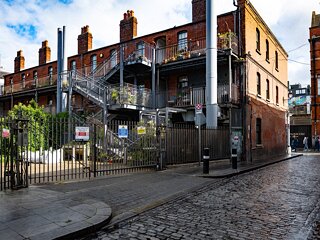
IT IS MORE THAN JUST A PUB
TEMPLE BAR IS A RIVERSIDE AREA ON DUBLIN SOUTH QUAYS RATHER THAN JUST A PUB [PHOTOGRAPHED 5 AUGUST 2026]
Beyond the Pub: Dublin’s Historic Riverside Quarter
Many first-time visitors to Dublin mistake Temple Bar for a single famous red-brick public house. In reality, Temple Bar is one of the city's oldest surviving medieval and early modern quarters. Bounded by the River Liffey to the north and Dame Street to the south, its name originates in the early 17th century when Sir William Temple—Provost of Trinity College—built his house and gardens on reclaimed land along the riverbank ("bar" referring to a raised estuary sandbank used for walking).
By the mid-20th century, far from being a tourist nightlife hub, Temple Bar was the gritty, working heart of Dublin's wholesale trade.
The 1960s Wholesalers & Underground Passages
During the late 1960s, the cobbled laneways were dominated by garment manufacturers, paper merchants, produce distributors, and electronics importers like ITG (International Trading Company), which brought high-end hi-fi equipment into Ireland.
Because the area sits on historic reclaimed marshland along the Liffey, the commercial buildings featured massive, vaulted basement spaces originally constructed for cool timber, wine, and spirits storage. Many of these basements interconnected, forming an extensive subterranean network of passages underneath the streets. These cellars allowed merchants to haul heavy goods between properties without venturing into the congested street traffic above.
The Near-Demolition: CIE's Bus Transport Hub Plan
In the late 1960s and 1970s, CÍE (Córas Iompair Éireann), Ireland's state transport company, began quietly buying up vast swathes of property across Temple Bar. The intention was radical: wholesale demolition of the old streetscape to construct a massive, central underground and surface bus terminal.
While awaiting full planning approval and capital funds, CÍE let the acquired properties on short-term, low-rent leases. This unintentional reprieve saved the district:
Artists and Independents: Cheap rents attracted musicians, vintage clothes traders, recording studios, art galleries, and record shops.
Community Resistance: Local activists and cultural groups fiercely opposed the demolition, arguing that the area's historic character was worth preserving.
The Turnaround: In 1991, the Irish government officially cancelled the bus hub plan and established Temple Bar Properties to regenerate the sector as Dublin's dedicated cultural quarter.
The Temple Bar Pub: Origins and Former Names
The famous pub sitting at the corner of Temple Bar and Temple Lane South took on the name of the surrounding district rather than the other way around.
Establishment: The premises was first licensed in 1835 under Cornelius O'Meara and developed into a full public house and grocery by spirit dealer James Farley in 1840.
Former Names: Over the decades, the pub changed hands repeatedly and was almost always named after its operating publican:
P. J. Hartnett's (1880s)
Purcell's / Byrne's / Ramsbottom's (late 19th century)
Edward Walsh & Co. (early 20th century)
Flannery's (1961–1992): During the era of ITG and the CÍE purchases, local Dubliners knew the pub as Flannery’s, owned by William Flannery.
The Temple Bar Pub - It was only after the Cleary family acquired the pub in 1992 that it was extensively refurbished, expanded, and rebranded specifically as The Temple Bar, capitalizing on the cultural revival of the historic district around it.
Beyond the Pub: Dublin’s Historic Riverside Quarter
Many first-time visitors to Dublin mistake Temple Bar for a single famous red-brick public house. In reality, Temple Bar is one of the city's oldest surviving medieval and early modern quarters. Bounded by the River Liffey to the north and Dame Street to the south, its name originates in the early 17th century when Sir William Temple—Provost of Trinity College—built his house and gardens on reclaimed land along the riverbank ("bar" referring to a raised estuary sandbank used for walking).
By the mid-20th century, far from being a tourist nightlife hub, Temple Bar was the gritty, working heart of Dublin's wholesale trade.
The 1960s Wholesalers & Underground Passages
During the late 1960s, the cobbled laneways were dominated by garment manufacturers, paper merchants, produce distributors, and electronics importers like ITG (International Trading Company), which brought high-end hi-fi equipment into Ireland.
Because the area sits on historic reclaimed marshland along the Liffey, the commercial buildings featured massive, vaulted basement spaces originally constructed for cool timber, wine, and spirits storage. Many of these basements interconnected, forming an extensive subterranean network of passages underneath the streets. These cellars allowed merchants to haul heavy goods between properties without venturing into the congested street traffic above.
The Near-Demolition: CIE's Bus Transport Hub Plan
In the late 1960s and 1970s, CÍE (Córas Iompair Éireann), Ireland's state transport company, began quietly buying up vast swathes of property across Temple Bar. The intention was radical: wholesale demolition of the old streetscape to construct a massive, central underground and surface bus terminal.
While awaiting full planning approval and capital funds, CÍE let the acquired properties on short-term, low-rent leases. This unintentional reprieve saved the district:
Artists and Independents: Cheap rents attracted musicians, vintage clothes traders, recording studios, art galleries, and record shops.
Community Resistance: Local activists and cultural groups fiercely opposed the demolition, arguing that the area's historic character was worth preserving.
The Turnaround: In 1991, the Irish government officially cancelled the bus hub plan and established Temple Bar Properties to regenerate the sector as Dublin's dedicated cultural quarter.
The Temple Bar Pub: Origins and Former Names
The famous pub sitting at the corner of Temple Bar and Temple Lane South took on the name of the surrounding district rather than the other way around.
Establishment: The premises was first licensed in 1835 under Cornelius O'Meara and developed into a full public house and grocery by spirit dealer James Farley in 1840.
Former Names: Over the decades, the pub changed hands repeatedly and was almost always named after its operating publican:
P. J. Hartnett's (1880s)
Purcell's / Byrne's / Ramsbottom's (late 19th century)
Edward Walsh & Co. (early 20th century)
Flannery's (1961–1992): During the era of ITG and the CÍE purchases, local Dubliners knew the pub as Flannery’s, owned by William Flannery.
The Temple Bar Pub - It was only after the Cleary family acquired the pub in 1992 that it was extensively refurbished, expanded, and rebranded specifically as The Temple Bar, capitalizing on the cultural revival of the historic district around it.
THE TEMPLE BAR AREA