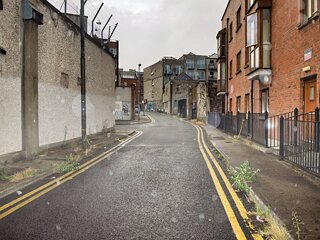
I REVISIT BETHESDA PLACE FOR A SECOND TIME BUT THIS TIME I USED A FUJIFILM GFX100RF
I REVISIT BETHESDA PLACE AND THE ASSOCIATED COMPLEX OF LANEWAYS [AND PHOTOGRAPHED RAINDROPS]
I included the images with raindrop reflections for the record
Revisiting Bethesda Place & The Parnell Square Cultural Precinct
I set off along Granby Row, turned onto Parnell Square, continued down North Frederick Street, and ducked onto North Frederick Lane. Section B of Bethesda Place was blocked off, forcing a detour before I eventually emerged on Upper Dorset Street.
When I first turned off Dorset Street into Bethesda Place a few days ago, I thought I was documenting a quiet, isolated cul-de-sac. The lane terminated abruptly at a brick wall bearing a large street art mural, framed by the gritty, layered textures of Dublin’s inner city. It felt like a self-contained pocket of urban decay and quiet resistance. What I did not realise then was that I was standing on the fringe of a much larger, intricate complex of historical laneways—and that directly behind that painted brick wall sat an enigmatic, multi-faceted structure waiting to be rediscovered.
The Derelict School & Bethesda Chapel Complex
That mysterious structure behind the wall is inextricably linked to the history of the old Bethesda Chapel and its associated school complex. Originally founded in the late 18th century as an Episcopal chapel and female orphan school, the site evolved into a focal point for local educational and charitable work. Over the 19th and 20th centuries, shifting demographics, inner-city decline, and the consolidation of local parish schools led to the gradual abandonment of the site. Today, the building stands derelict—its weather-worn brickwork, boarded windows, and encroaching vegetation serving as a vivid reminder of Dublin’s layered socio-religious architectural past.
The Hugh Lane Gallery & Surrounding Landmarks
Revisiting the complex of lanes behind Parnell Square North inevitably brings you into contact with Charlemont House, the grand 1765 town palace of the Earl of Charlemont that now houses the Hugh Lane Gallery.
The Art Gallery: Established by Sir Hugh Lane in 1908 as the Municipal Gallery of Modern Art, it relocated to Charlemont House in 1933. It remains one of the world's finest public modern art collections and famously houses Francis Bacon’s relocated London studio.
Abbey Presbyterian Church: Dominating the corner of Parnell Square and Frederick Street stands the striking 1864 Gothic Revival church, historically known as the Abbey Church (or "Findlater's Church," named after its benefactor Alexander Findlater). Its soaring spire offers a dramatic vertical contrast to the surrounding Georgian grid and low-slung laneways.
Chapter One Restaurant: Situated in the vaulted basement of the Hugh Lane Gallery, this Michelin-starred Dublin institution continues its long-term operation as a cornerstone of fine dining in the city, seamlessly integrating world-class culinary art into the museum’s historic framework.
Julian Opie Installation: Visitors to the forecourt of the gallery will note that Julian Opie’s iconic LED walking figure animation (Suzanne Walking) has been removed. Today, only its stone concrete base remains, leaving a conspicuous void where modern digital street art once bridged the gallery’s interior with the public square.
Miami Showband Memorial: Located nearby in the Parnell Square precinct, this memorial honours the victims of the tragic 1975 Miami Showband massacre. As part of ongoing urban redevelopment and public realm upgrades around the Parnell Square Cultural Quarter, plans are underway for the memorial to be thoughtfully relocated within the precinct to afford it a more prominent, reflective space.
Field Testing Equipment: Raindrops & Fill-Flash
Today, 4 August, I decided to devote time to resolving configuration issues with my Fujifilm GFX setup. I purchased a Godox iT30 Pro for Fuji cameras and updated the GFX100RF to its latest firmware. I chose the Bethesda Place complex and the perimeter of the Hugh Lane Gallery as my testing grounds.
As soon as I arrived at Parnell Square, the sky opened up. I quickly learned that using direct fill-flash in heavy rain is problematic: the flash illuminates foreground raindrops into harsh, out-of-focus white specks across the frame. Additionally, the in-camera geotagging logged only my starting location and my exit onto Dorset Street, missing the intermediate laneway points.
Despite being advised against pairing the compact Godox with the larger GFX system, the combo performed remarkably well overall. However, because my dealer noted a lack of suitable dedicated risers, navigating the lens hood geometry required specific workarounds:
Lens Hood Geometry Note: On the GFX100RF, the lens-barrel filter adapter and hood assembly form an integral part of the weather-sealing system over the telescoping front element. Stripping that back just to clear a low-slung mini flash compromises the weather protection.
Handling & Coverage Solutions
Distance Shots (Beyond 1.5 m / 5 ft): The flash trajectory clears the top edge of the hood cleanly, delivering uniform illumination across the frame.
Close-Up / Macro Range (Under 1 m / 3 ft): Because the iT30Pro head sits low relative to the hot shoe, the top lip of the weather-sealed hood casts a slight shadow at the bottom edge of the frame.
Built-in Wide Panel (W Mode): Flipping down the iT30Pro’s built-in wide-angle diffuser spreads the light beam out. At moderate close-up distances, this softens the shadow edge enough to render it invisible in the frame.
Godox TR-F Riser: If shooting close-up subjects or street portraits indoors where direct flash at tight distances is essential, adding a small Godox TR-F TTL hot shoe riser raises the flash head by 30 mm. This completely clears the hood rim at all distances while preserving full TTL and HSS communication.
The Dealer Advice
That dealer advice comes down to a tiny mechanical detail: the GFX100RF hot shoe uses standard Fujifilm TTL contacts, but its top-plate design and fixed-lens body profile can make generic or off-the-shelf hot-shoe extensions sit awkwardly or fail to lock down completely flat.
While third-party risers like the Godox TR series pass through standard Fuji TTL signals, some camera shop staff steer users away from them on compact fixed-lens bodies because a high-profile riser introduces extra leverage onto the hot shoe mount—potentially straining the top plate if bumped during active street shooting.
If you decide to clear that 35mm lens hood rim without adding vertical strain to the camera hot shoe, here are the most effective alternatives:
Fuji Off-Camera TTL Cord (TTL Extension Cable): Using a dedicated TTL cord (or standard Canon OC-E3 compatible cord, which matches the Fuji contact pattern) lets you handhold the flash off-camera or mount it to a tiny side bracket. This completely bypasses the hood shadowing issue without putting leverage on the camera top plate.
Godox Wireless Transmitter (X3 / X2T-F): Mounting a micro wireless trigger on the hot shoe and holding the iT30 Pro off-camera in your off hand gives you complete freedom over light direction, absolute clearance over the fixed-lens hood, and full TTL/HSS support.
Flip-Down Wide Panel (W-Mode): For quick street work in the field, sticking with the built-in wide diffuser remains the cleanest zero-hardware solution to blend out lower-edge lens hood shadows.
I included the images with raindrop reflections for the record
Revisiting Bethesda Place & The Parnell Square Cultural Precinct
I set off along Granby Row, turned onto Parnell Square, continued down North Frederick Street, and ducked onto North Frederick Lane. Section B of Bethesda Place was blocked off, forcing a detour before I eventually emerged on Upper Dorset Street.
When I first turned off Dorset Street into Bethesda Place a few days ago, I thought I was documenting a quiet, isolated cul-de-sac. The lane terminated abruptly at a brick wall bearing a large street art mural, framed by the gritty, layered textures of Dublin’s inner city. It felt like a self-contained pocket of urban decay and quiet resistance. What I did not realise then was that I was standing on the fringe of a much larger, intricate complex of historical laneways—and that directly behind that painted brick wall sat an enigmatic, multi-faceted structure waiting to be rediscovered.
The Derelict School & Bethesda Chapel Complex
That mysterious structure behind the wall is inextricably linked to the history of the old Bethesda Chapel and its associated school complex. Originally founded in the late 18th century as an Episcopal chapel and female orphan school, the site evolved into a focal point for local educational and charitable work. Over the 19th and 20th centuries, shifting demographics, inner-city decline, and the consolidation of local parish schools led to the gradual abandonment of the site. Today, the building stands derelict—its weather-worn brickwork, boarded windows, and encroaching vegetation serving as a vivid reminder of Dublin’s layered socio-religious architectural past.
The Hugh Lane Gallery & Surrounding Landmarks
Revisiting the complex of lanes behind Parnell Square North inevitably brings you into contact with Charlemont House, the grand 1765 town palace of the Earl of Charlemont that now houses the Hugh Lane Gallery.
The Art Gallery: Established by Sir Hugh Lane in 1908 as the Municipal Gallery of Modern Art, it relocated to Charlemont House in 1933. It remains one of the world's finest public modern art collections and famously houses Francis Bacon’s relocated London studio.
Abbey Presbyterian Church: Dominating the corner of Parnell Square and Frederick Street stands the striking 1864 Gothic Revival church, historically known as the Abbey Church (or "Findlater's Church," named after its benefactor Alexander Findlater). Its soaring spire offers a dramatic vertical contrast to the surrounding Georgian grid and low-slung laneways.
Chapter One Restaurant: Situated in the vaulted basement of the Hugh Lane Gallery, this Michelin-starred Dublin institution continues its long-term operation as a cornerstone of fine dining in the city, seamlessly integrating world-class culinary art into the museum’s historic framework.
Julian Opie Installation: Visitors to the forecourt of the gallery will note that Julian Opie’s iconic LED walking figure animation (Suzanne Walking) has been removed. Today, only its stone concrete base remains, leaving a conspicuous void where modern digital street art once bridged the gallery’s interior with the public square.
Miami Showband Memorial: Located nearby in the Parnell Square precinct, this memorial honours the victims of the tragic 1975 Miami Showband massacre. As part of ongoing urban redevelopment and public realm upgrades around the Parnell Square Cultural Quarter, plans are underway for the memorial to be thoughtfully relocated within the precinct to afford it a more prominent, reflective space.
Field Testing Equipment: Raindrops & Fill-Flash
Today, 4 August, I decided to devote time to resolving configuration issues with my Fujifilm GFX setup. I purchased a Godox iT30 Pro for Fuji cameras and updated the GFX100RF to its latest firmware. I chose the Bethesda Place complex and the perimeter of the Hugh Lane Gallery as my testing grounds.
As soon as I arrived at Parnell Square, the sky opened up. I quickly learned that using direct fill-flash in heavy rain is problematic: the flash illuminates foreground raindrops into harsh, out-of-focus white specks across the frame. Additionally, the in-camera geotagging logged only my starting location and my exit onto Dorset Street, missing the intermediate laneway points.
Despite being advised against pairing the compact Godox with the larger GFX system, the combo performed remarkably well overall. However, because my dealer noted a lack of suitable dedicated risers, navigating the lens hood geometry required specific workarounds:
Lens Hood Geometry Note: On the GFX100RF, the lens-barrel filter adapter and hood assembly form an integral part of the weather-sealing system over the telescoping front element. Stripping that back just to clear a low-slung mini flash compromises the weather protection.
Handling & Coverage Solutions
Distance Shots (Beyond 1.5 m / 5 ft): The flash trajectory clears the top edge of the hood cleanly, delivering uniform illumination across the frame.
Close-Up / Macro Range (Under 1 m / 3 ft): Because the iT30Pro head sits low relative to the hot shoe, the top lip of the weather-sealed hood casts a slight shadow at the bottom edge of the frame.
Built-in Wide Panel (W Mode): Flipping down the iT30Pro’s built-in wide-angle diffuser spreads the light beam out. At moderate close-up distances, this softens the shadow edge enough to render it invisible in the frame.
Godox TR-F Riser: If shooting close-up subjects or street portraits indoors where direct flash at tight distances is essential, adding a small Godox TR-F TTL hot shoe riser raises the flash head by 30 mm. This completely clears the hood rim at all distances while preserving full TTL and HSS communication.
The Dealer Advice
That dealer advice comes down to a tiny mechanical detail: the GFX100RF hot shoe uses standard Fujifilm TTL contacts, but its top-plate design and fixed-lens body profile can make generic or off-the-shelf hot-shoe extensions sit awkwardly or fail to lock down completely flat.
While third-party risers like the Godox TR series pass through standard Fuji TTL signals, some camera shop staff steer users away from them on compact fixed-lens bodies because a high-profile riser introduces extra leverage onto the hot shoe mount—potentially straining the top plate if bumped during active street shooting.
If you decide to clear that 35mm lens hood rim without adding vertical strain to the camera hot shoe, here are the most effective alternatives:
Fuji Off-Camera TTL Cord (TTL Extension Cable): Using a dedicated TTL cord (or standard Canon OC-E3 compatible cord, which matches the Fuji contact pattern) lets you handhold the flash off-camera or mount it to a tiny side bracket. This completely bypasses the hood shadowing issue without putting leverage on the camera top plate.
Godox Wireless Transmitter (X3 / X2T-F): Mounting a micro wireless trigger on the hot shoe and holding the iT30 Pro off-camera in your off hand gives you complete freedom over light direction, absolute clearance over the fixed-lens hood, and full TTL/HSS support.
Flip-Down Wide Panel (W-Mode): For quick street work in the field, sticking with the built-in wide diffuser remains the cleanest zero-hardware solution to blend out lower-edge lens hood shadows.
I REVISIT BETHESDA PLACE