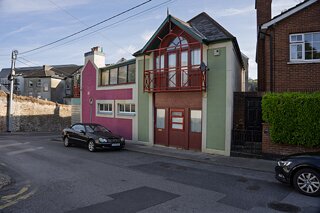
A CAR BLOCKED TWO LARGE BIN TRUCKS
I VISITED SUMMERHILL TERRACE IN WATERFORD AND ENCOUNTERED TWO TRAPPED BIN LORRIES [ONE DRIVER GOT ANNOYED WITH ME]
I used a Sony A7RVI and a Sony FE 24-105mm F$ Lens
Summerhill Terrace is one of Waterford’s quintessential historic laneways, tucked away immediately behind Bridge Street and Mary Street on the north-western approach to the city centre. Characterised by steep gradients, tight sightlines, and narrow carriageways originally laid out for foot and horse traffic, it encapsulates the domestic and working-class evolution of Victorian Waterford.
History and Urban Fabric
Developed during the late nineteenth century to house families serving the bustling river quays, local rail hubs, and manufacturing yards along the River Suir, the terrace comprises modest two-storey rendered artisan dwellings.
Michael A Flanagan Irish Music Heritage Inc
The Flanagan Brothers Connection: The terrace holds a notable cultural legacy. Number 1 Summerhill Terrace was the childhood home of the famous musical emigrants, the Flanagan Brothers (Joe, Louis, and Mike). Their father worked as a carter and quay labourer along the riverfront before the family emigrated to the United States in 1911, eventually finding acclaim in the Irish dance halls of New York.
Nineteenth-Century Topography: Because Waterford expanded upward along the rocky escarpments rising from the Suir, lanes like Summerhill Terrace were constructed without room for modern vehicular clearances, retaining high retaining boundary walls and tightly hemmed curtilages.
The Guesthouse Appeal
The eccentric lodging in this immediate enclave—most notably around the intersection of Summerhill Terrace, Mary Street, and the upper lanes—often operates with the cosy, idiosyncratic charm of a continental Pension or backpacker base (such as the long-standing Portree cluster nearby).
Properties in this specific pocket have long held niche appeal for German and continental European hill-walkers, cycling tourers, and independent travellers. The draw comes down to a few practical factors:
Direct proximity to the Waterford Greenway trailhead, Waterford Suir Valley Railway connections, and Plunkett Station across the bridge.
Promotion in continental guidebooks (such as Michael Müller Verlag and Lonely Planet Germany) that champion low-key, family-run lodgings over commercial business hotels.
An unvarnished, authentic local streetscape that contrasts sharply with formulaic riverside chains.
The Standoff: Modern Vehicles in a Medieval Footprint
My encounter with the two bin lorries captures the everyday absurdity of Waterford’s older quarters. When two heavy municipal waste trucks enter opposing ends of a single-track nineteenth-century lane, neither driver has anywhere to pull aside.
Add a car parked along the kerb—even if completely legally squeezed against a wall—and the effective carriageway shrinks to under 2.5 metres. In such scenarios, tempers fray quickly. A bystander, such as myself, on foot holding a camera or observing the chaos naturally becomes the lightning rod for a stressed driver convinced you are the motorist responsible for trapping them. It is urban comedy at its finest, but a genuine headache for waste management and delivery drivers navigating lanes never designed for modern wheelbases.
I used a Sony A7RVI and a Sony FE 24-105mm F$ Lens
Summerhill Terrace is one of Waterford’s quintessential historic laneways, tucked away immediately behind Bridge Street and Mary Street on the north-western approach to the city centre. Characterised by steep gradients, tight sightlines, and narrow carriageways originally laid out for foot and horse traffic, it encapsulates the domestic and working-class evolution of Victorian Waterford.
History and Urban Fabric
Developed during the late nineteenth century to house families serving the bustling river quays, local rail hubs, and manufacturing yards along the River Suir, the terrace comprises modest two-storey rendered artisan dwellings.
Michael A Flanagan Irish Music Heritage Inc
The Flanagan Brothers Connection: The terrace holds a notable cultural legacy. Number 1 Summerhill Terrace was the childhood home of the famous musical emigrants, the Flanagan Brothers (Joe, Louis, and Mike). Their father worked as a carter and quay labourer along the riverfront before the family emigrated to the United States in 1911, eventually finding acclaim in the Irish dance halls of New York.
Nineteenth-Century Topography: Because Waterford expanded upward along the rocky escarpments rising from the Suir, lanes like Summerhill Terrace were constructed without room for modern vehicular clearances, retaining high retaining boundary walls and tightly hemmed curtilages.
The Guesthouse Appeal
The eccentric lodging in this immediate enclave—most notably around the intersection of Summerhill Terrace, Mary Street, and the upper lanes—often operates with the cosy, idiosyncratic charm of a continental Pension or backpacker base (such as the long-standing Portree cluster nearby).
Properties in this specific pocket have long held niche appeal for German and continental European hill-walkers, cycling tourers, and independent travellers. The draw comes down to a few practical factors:
Direct proximity to the Waterford Greenway trailhead, Waterford Suir Valley Railway connections, and Plunkett Station across the bridge.
Promotion in continental guidebooks (such as Michael Müller Verlag and Lonely Planet Germany) that champion low-key, family-run lodgings over commercial business hotels.
An unvarnished, authentic local streetscape that contrasts sharply with formulaic riverside chains.
The Standoff: Modern Vehicles in a Medieval Footprint
My encounter with the two bin lorries captures the everyday absurdity of Waterford’s older quarters. When two heavy municipal waste trucks enter opposing ends of a single-track nineteenth-century lane, neither driver has anywhere to pull aside.
Add a car parked along the kerb—even if completely legally squeezed against a wall—and the effective carriageway shrinks to under 2.5 metres. In such scenarios, tempers fray quickly. A bystander, such as myself, on foot holding a camera or observing the chaos naturally becomes the lightning rod for a stressed driver convinced you are the motorist responsible for trapping them. It is urban comedy at its finest, but a genuine headache for waste management and delivery drivers navigating lanes never designed for modern wheelbases.
SUMMERHILL TERRACE