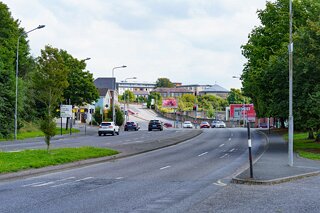
DOCK ROAD AND NORTH QUAYS IN WATERFORD AUGUST 2021
BACK IN AUGUST 2021 I DECIDED TO EXPLORE DOCK ROAD [AND PHOTOGRAPH WATERFORD CITY FROM THE OPPOSITE SIDE OF THE RIVER SUIR]
Street Encounters, Distant Lenses, and the Changing Face of Waterford’s North Quays
Back in August 2021, I spent an afternoon exploring the elevated stretch along Dock Road in Ferrybank, looking to capture the Waterford city skyline across the River Suir. At the time, the area still retained its gritty, post-industrial character—a quiet, overgrown vantage point looking back across the water towards the South Quays, the Clock Tower, and the historic core of the city.
As I walked up the hill leading away from Plunkett railway station, two very attractive young women called out and asked if I would take their photograph.
Anyone who regularly walks urban streets carrying dedicated camera bodies and noticeable glass knows the scenario well. A high-end camera turns you into an impromptu public amenity. People rarely ask because they have thought through the logistics of receiving the image; rather, it is the fleeting novelty of being captured by a "real photographer" in the moment, or an automatic reflex born from handing mobile phones to strangers.
I make it a rule never to take unsolicited portrait commissions on the street. However, because a flat refusal can occasionally lead to awkward friction, I improvised on the spot: I told them my lens was a highly specialised piece of glass designed strictly for subjects at a distance of at least 500 metres.
Much to my amusement, they took my technical fiction entirely at face value. They turned, marched roughly 300 metres up the road, spun round, and struck a pose, fully expecting me to frame the shot. Appreciating their sheer dedication to the task, I fired off a few frames across the distance. I was just beginning to wonder how on earth I might transfer the files when they gave a cheerful wave and continued walking down the hill.
That encounter highlights a perpetual puzzle of street photography: the public almost never considers how the image will actually bridge the gap between a RAW file on a memory card and their phone screen.
Over time, I refined my deflection strategy away from optical excuses to a simpler, more definitive line: “I am under contract, and the boss doesn't allow me to shoot people.”
When someone cheekily tries to negotiate with “Sure, how will the boss ever know?”, the ultimate trump card is modern technology: “The editor monitors a live feed directly from the camera in real time.” The thought of an unseen desk editor watching the camera stream over a remote data link immediately closes the conversation with a smile and zero argument.
Looking back at those August 2021 images also serves as a stark reminder of how rapidly our urban landscapes evolve. Back then, Dock Road and the adjacent North Quays stood largely as a vast expanse of disused brownfield, derelict railway sidings, and neglected river frontage. Today, the entire precinct is undergoing one of the largest urban regeneration projects in the country.
The extensive North Quays Strategic Development Zone (SDZ) is fundamentally rewriting the geography of the Suir. Where there were once quiet embankments and old rail spurs, heavy engineering is delivering a new multi-modal integrated transport hub to replace the old station, alongside the sleek 207-metre sustainable transport bridge directly linking Ferrybank to the South Quays. Realigned roads, new public plazas, riverside boardwalks, and a massive mixed-use quarter comprising residential, hospitality, and commercial space are scheduled to reach full fruition by the end of 2027.
The quiet, semi-derelict hillside where two passersby once posed for an impossible 500-metre lens will soon be part of a bustling, modern civic corridor. While the physical fabric of Dock Road will be unrecognisable by 2027, the unpredictable human theatre of street photography remains entirely timeless.
Street Encounters, Distant Lenses, and the Changing Face of Waterford’s North Quays
Back in August 2021, I spent an afternoon exploring the elevated stretch along Dock Road in Ferrybank, looking to capture the Waterford city skyline across the River Suir. At the time, the area still retained its gritty, post-industrial character—a quiet, overgrown vantage point looking back across the water towards the South Quays, the Clock Tower, and the historic core of the city.
As I walked up the hill leading away from Plunkett railway station, two very attractive young women called out and asked if I would take their photograph.
Anyone who regularly walks urban streets carrying dedicated camera bodies and noticeable glass knows the scenario well. A high-end camera turns you into an impromptu public amenity. People rarely ask because they have thought through the logistics of receiving the image; rather, it is the fleeting novelty of being captured by a "real photographer" in the moment, or an automatic reflex born from handing mobile phones to strangers.
I make it a rule never to take unsolicited portrait commissions on the street. However, because a flat refusal can occasionally lead to awkward friction, I improvised on the spot: I told them my lens was a highly specialised piece of glass designed strictly for subjects at a distance of at least 500 metres.
Much to my amusement, they took my technical fiction entirely at face value. They turned, marched roughly 300 metres up the road, spun round, and struck a pose, fully expecting me to frame the shot. Appreciating their sheer dedication to the task, I fired off a few frames across the distance. I was just beginning to wonder how on earth I might transfer the files when they gave a cheerful wave and continued walking down the hill.
That encounter highlights a perpetual puzzle of street photography: the public almost never considers how the image will actually bridge the gap between a RAW file on a memory card and their phone screen.
Over time, I refined my deflection strategy away from optical excuses to a simpler, more definitive line: “I am under contract, and the boss doesn't allow me to shoot people.”
When someone cheekily tries to negotiate with “Sure, how will the boss ever know?”, the ultimate trump card is modern technology: “The editor monitors a live feed directly from the camera in real time.” The thought of an unseen desk editor watching the camera stream over a remote data link immediately closes the conversation with a smile and zero argument.
Looking back at those August 2021 images also serves as a stark reminder of how rapidly our urban landscapes evolve. Back then, Dock Road and the adjacent North Quays stood largely as a vast expanse of disused brownfield, derelict railway sidings, and neglected river frontage. Today, the entire precinct is undergoing one of the largest urban regeneration projects in the country.
The extensive North Quays Strategic Development Zone (SDZ) is fundamentally rewriting the geography of the Suir. Where there were once quiet embankments and old rail spurs, heavy engineering is delivering a new multi-modal integrated transport hub to replace the old station, alongside the sleek 207-metre sustainable transport bridge directly linking Ferrybank to the South Quays. Realigned roads, new public plazas, riverside boardwalks, and a massive mixed-use quarter comprising residential, hospitality, and commercial space are scheduled to reach full fruition by the end of 2027.
The quiet, semi-derelict hillside where two passersby once posed for an impossible 500-metre lens will soon be part of a bustling, modern civic corridor. While the physical fabric of Dock Road will be unrecognisable by 2027, the unpredictable human theatre of street photography remains entirely timeless.
DOCK ROAD AUGUST 2021