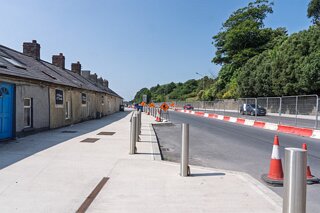
I PHOTOGRAPHED THIS TERRACE OF COTTAGES IN AUGUST2025 AND ALSO IN AUGUST 2026
Sion Row: The Transformation of Ferrybank’s Historic Quayside Cottages
Positioned directly along Dock Road (R711) in Ferrybank, the distinctive single-storey terrace known as Sion Row (Nos. 1–10) stands as one of the few surviving historical residential streetscapes on Waterford’s North Quays.
Industrial Origins & Typology
Dating from the nineteenth century, the row was originally erected to house quayside labourers, dockers, and railway workers serving the thriving North Wharf commercial docks, shipyards, and nearby rail yards. While popular vernacular often mistakenly applies the blanket term "artisan dwelling"—a label specifically derived from commercial philanthropic bodies like the Dublin Artisans' Dwellings Company (DADC)—Sion Row is a genuine speculatively built working-class terrace of dock cottages.
Decades of Decline & Remarkable Market Lows
As the industrial activities along the North Quays waned during the late twentieth century, Sion Row faced severe neglect, vacancies, and compounding dereliction. The true extent of this decline is reflected in the official Property Price Register during the post-2008 economic crash and early SDZ planning phases, where properties changed hands for nominal sums:
November 2014: No. 5 Lower Sion Row sold for a mere €7,000.
July 2015: No. 4 Sion Row changed hands for €30,000.
December 2015: No. 9 Sion Row sold for €25,000.
Regeneration & Current Integration
With the formal designation of the Waterford North Quays Strategic Development Zone (SDZ) and direct state backing through the Urban Regeneration and Development Fund (URDF), the fate of the terrace reversed. Rather than facing demolition, the row has undergone comprehensive structural refurbishment.
Visible across the terrace today are newly re-pitched slate roofs, integrated rooflights, renewed brick chimneys, and updated fenestration. Concurrently, major road realignment and public realm works executed by BAM and the local authority have installed widened, accessible pavements, stainless steel pedestrian safety bollards, and low retaining walls to accommodate the modified road gradient.
The financial realignment followed swiftly: No. 9 resold for €88,000 in 2018, No. 1 and No. 2 reached €150,000 and €156,000 respectively in 2022, and No. 1 achieved €170,000 in 2023.
Future Role at the City Gateway
Once isolated beside a heavy industrial transport corridor, Sion Row now directly overlooks the entry plaza to the new multi-modal Public Transport Hub and the landing span of the Sustainable Transport Bridge across the River Suir. The retained cottages serve as a crucial visual link between Ferrybank’s working-class maritime heritage and Waterford’s modernised transit infrastructure.
Note About Artisan Dwellings
The term originates with the Dublin Artisans' Dwellings Company (DADC), a semi-philanthropic commercial housing enterprise founded in 1876 by figures including Sir William Findlater and the Guinness family.
The Origin vs. Common Usage
The Specific Company: The DADC specifically constructed planned housing schemes across Dublin (and later ventures like the Thomond Artisan's Dwellings Company elsewhere) aimed at regularly employed tradesmen, artisans, and police officers.
Genericized Label: Over time, estate agents and the general public genericized the term "artisan dwelling" or "artisan cottage" as a blanket catch-all for almost any Victorian or Edwardian compact, single-storey or two-storey brick/stone terraced cottage.
True Typology for Sion Row: Rows like Sion Row in Waterford were not built by an artisan dwelling company, but were instead speculative single-storey dockers', railway workers', and quay labourers' cottages built to serve the riverside wharves and rail yards.
They were almost certainly private rental properties leased to workers on weekly tenancies, rather than company-provided "tied" housing or owner-occupied homes.
Tenure & Ownership Model
Private Landlordism / Speculative Investment: In nineteenth-century Ireland, speculative housing of this scale was typically financed by local merchants, builders, or landholders who acquired ground leases along expanding transport corridors. These investors built rows of simple dwellings to generate recurring rental yields from the influx of casual and semi-skilled labourers.
Absence of Tied / Company Housing: Unlike the industrial model villages in the UK (such as Saltaire or Port Sunlight) or specific railway company towns (like the Great Southern and Western Railway’s purpose-built estate at Inchicore in Dublin), dock and railway employers on Waterford's North Wharf rarely built dedicated housing portfolios for casual quay labour. Dockers were hired on a daily or casual "calling-on" basis, meaning shipping companies took no responsibility for their permanent shelter.
Weekly Tenancies: The occupants—ranging from dockers, carters, and coal-heavers to mariners, ferrymen, and railway porters—paid weekly rents. Tenancies could be precarious, fluctuating with the volume of river shipping and seasonal agricultural exports passing through the port.
Rarity of Early Owner-Occupation: Working-class homeownership was virtually non-existent in urban Ireland during the 1800s and early 1900s. Dockers and railway hands earned weekly wages that left no margin for capital accumulation or commercial mortgages.
The prevalence of "Sion" in Waterford placenames stems from two distinct historical influences: the local geography of the Ferrybank bluffs and the city's prominent religious history.
Sion Hill & The Ferrybank Estate
Sion Hill House & Demesne: Directly rising behind Dock Road and the North Quays is the prominent elevated ridge known as Sion Hill. In the 18th and early 19th centuries, it was the demesne of the Pope family—a wealthy merchant shipping dynasty who built Sion Hill House (c. 1820) overlooking the River Suir.
Quayside Spin-Offs: As the quays developed below the hill, features along the waterfront took their name from the overlooking estate, resulting in Sion Row (the cottages at the bottom of the slope) and Lower Sion Row.
Mount Sion & Edmund Rice
Mount Sion (Barrack Street): On the south side of the river, the name has deep religious roots. In 1802–1803, when Blessed Edmund Rice founded the first school and monastery of the Christian Brothers at Barrack Street, the elevated site overlooking the medieval city was named Mount Sion (the biblical spelling often anglicised as Sion rather than Zion).
Cultural Legacy: Bishop Thomas Hussey named the grounds because the high view across Waterford reminded him of Mount Zion overlooking Jerusalem. This cemented "Mount Sion" as one of the most famous cultural and sporting names in the city, encompassing Mount Sion CBS, the monastery, and the celebrated Mount Sion GAA Club.
Topographical Convention
Naming prominent, elevated hills and grand Georgian/Regency estates after biblical heights like Mount Sion or Mount Pisgah was a common convention among 18th- and 19th-century Irish planners and landed gentry to evoke dignity and commanding views. Between the northern river bluffs in Ferrybank and Edmund Rice’s foundation on the southern heights, the name became permanently woven into both banks of Waterford.
Positioned directly along Dock Road (R711) in Ferrybank, the distinctive single-storey terrace known as Sion Row (Nos. 1–10) stands as one of the few surviving historical residential streetscapes on Waterford’s North Quays.
Industrial Origins & Typology
Dating from the nineteenth century, the row was originally erected to house quayside labourers, dockers, and railway workers serving the thriving North Wharf commercial docks, shipyards, and nearby rail yards. While popular vernacular often mistakenly applies the blanket term "artisan dwelling"—a label specifically derived from commercial philanthropic bodies like the Dublin Artisans' Dwellings Company (DADC)—Sion Row is a genuine speculatively built working-class terrace of dock cottages.
Decades of Decline & Remarkable Market Lows
As the industrial activities along the North Quays waned during the late twentieth century, Sion Row faced severe neglect, vacancies, and compounding dereliction. The true extent of this decline is reflected in the official Property Price Register during the post-2008 economic crash and early SDZ planning phases, where properties changed hands for nominal sums:
November 2014: No. 5 Lower Sion Row sold for a mere €7,000.
July 2015: No. 4 Sion Row changed hands for €30,000.
December 2015: No. 9 Sion Row sold for €25,000.
Regeneration & Current Integration
With the formal designation of the Waterford North Quays Strategic Development Zone (SDZ) and direct state backing through the Urban Regeneration and Development Fund (URDF), the fate of the terrace reversed. Rather than facing demolition, the row has undergone comprehensive structural refurbishment.
Visible across the terrace today are newly re-pitched slate roofs, integrated rooflights, renewed brick chimneys, and updated fenestration. Concurrently, major road realignment and public realm works executed by BAM and the local authority have installed widened, accessible pavements, stainless steel pedestrian safety bollards, and low retaining walls to accommodate the modified road gradient.
The financial realignment followed swiftly: No. 9 resold for €88,000 in 2018, No. 1 and No. 2 reached €150,000 and €156,000 respectively in 2022, and No. 1 achieved €170,000 in 2023.
Future Role at the City Gateway
Once isolated beside a heavy industrial transport corridor, Sion Row now directly overlooks the entry plaza to the new multi-modal Public Transport Hub and the landing span of the Sustainable Transport Bridge across the River Suir. The retained cottages serve as a crucial visual link between Ferrybank’s working-class maritime heritage and Waterford’s modernised transit infrastructure.
Note About Artisan Dwellings
The term originates with the Dublin Artisans' Dwellings Company (DADC), a semi-philanthropic commercial housing enterprise founded in 1876 by figures including Sir William Findlater and the Guinness family.
The Origin vs. Common Usage
The Specific Company: The DADC specifically constructed planned housing schemes across Dublin (and later ventures like the Thomond Artisan's Dwellings Company elsewhere) aimed at regularly employed tradesmen, artisans, and police officers.
Genericized Label: Over time, estate agents and the general public genericized the term "artisan dwelling" or "artisan cottage" as a blanket catch-all for almost any Victorian or Edwardian compact, single-storey or two-storey brick/stone terraced cottage.
True Typology for Sion Row: Rows like Sion Row in Waterford were not built by an artisan dwelling company, but were instead speculative single-storey dockers', railway workers', and quay labourers' cottages built to serve the riverside wharves and rail yards.
They were almost certainly private rental properties leased to workers on weekly tenancies, rather than company-provided "tied" housing or owner-occupied homes.
Tenure & Ownership Model
Private Landlordism / Speculative Investment: In nineteenth-century Ireland, speculative housing of this scale was typically financed by local merchants, builders, or landholders who acquired ground leases along expanding transport corridors. These investors built rows of simple dwellings to generate recurring rental yields from the influx of casual and semi-skilled labourers.
Absence of Tied / Company Housing: Unlike the industrial model villages in the UK (such as Saltaire or Port Sunlight) or specific railway company towns (like the Great Southern and Western Railway’s purpose-built estate at Inchicore in Dublin), dock and railway employers on Waterford's North Wharf rarely built dedicated housing portfolios for casual quay labour. Dockers were hired on a daily or casual "calling-on" basis, meaning shipping companies took no responsibility for their permanent shelter.
Weekly Tenancies: The occupants—ranging from dockers, carters, and coal-heavers to mariners, ferrymen, and railway porters—paid weekly rents. Tenancies could be precarious, fluctuating with the volume of river shipping and seasonal agricultural exports passing through the port.
Rarity of Early Owner-Occupation: Working-class homeownership was virtually non-existent in urban Ireland during the 1800s and early 1900s. Dockers and railway hands earned weekly wages that left no margin for capital accumulation or commercial mortgages.
The prevalence of "Sion" in Waterford placenames stems from two distinct historical influences: the local geography of the Ferrybank bluffs and the city's prominent religious history.
Sion Hill & The Ferrybank Estate
Sion Hill House & Demesne: Directly rising behind Dock Road and the North Quays is the prominent elevated ridge known as Sion Hill. In the 18th and early 19th centuries, it was the demesne of the Pope family—a wealthy merchant shipping dynasty who built Sion Hill House (c. 1820) overlooking the River Suir.
Quayside Spin-Offs: As the quays developed below the hill, features along the waterfront took their name from the overlooking estate, resulting in Sion Row (the cottages at the bottom of the slope) and Lower Sion Row.
Mount Sion & Edmund Rice
Mount Sion (Barrack Street): On the south side of the river, the name has deep religious roots. In 1802–1803, when Blessed Edmund Rice founded the first school and monastery of the Christian Brothers at Barrack Street, the elevated site overlooking the medieval city was named Mount Sion (the biblical spelling often anglicised as Sion rather than Zion).
Cultural Legacy: Bishop Thomas Hussey named the grounds because the high view across Waterford reminded him of Mount Zion overlooking Jerusalem. This cemented "Mount Sion" as one of the most famous cultural and sporting names in the city, encompassing Mount Sion CBS, the monastery, and the celebrated Mount Sion GAA Club.
Topographical Convention
Naming prominent, elevated hills and grand Georgian/Regency estates after biblical heights like Mount Sion or Mount Pisgah was a common convention among 18th- and 19th-century Irish planners and landed gentry to evoke dignity and commanding views. Between the northern river bluffs in Ferrybank and Edmund Rice’s foundation on the southern heights, the name became permanently woven into both banks of Waterford.
SION ROW IN WATERFORD