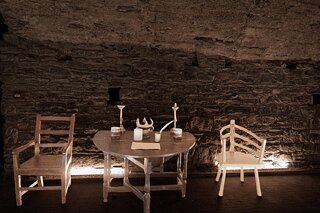
IN MAY 2016 I USED A SONY A7RII AND A ZEISS BATIS 25MM LENS
THIS WAS MY ONE AND ONLY VISIT TO THE MEDIEVAL MUSEUM IN WATERFORD CITY [I NEED TO VISIT AGAIN]
When I visit Waterford most of my time is devoted to the built environment and tracking down street art and murals so I never get the time to visit museums but I made to exceptions. In 2016 I visited the Medieval Museum and this year, August 2026, I explored the Waterford Museum Of Time and I was really impressed.
Back in 2016 when I saw the following "Step back into Medieval Waterford as you begin your tour in the 13th-century Choristers Hall and 15th Century Wine vault where you are sure to be wowed by some of the greatest Treasures of Medieval Ireland, including the Great Charter Roll viewed by HM King Charles III and the Queen Consort and the magnificent 15th-century cloth-of-gold church vestments".
As a result I decided to visit the Medieval Museum in Waterford. I tried my best to photograph what I actually saw and experienced but my skills and equipment was not really up to the task in hand.
The quoted excerpt directly reflects the official promotional narrative of Waterford Treasures: Medieval Museum. Below is an evidence-based assessment of every specific claim:
"Step back into Medieval Waterford as you begin your tour in the 13th-century Choristers' Hall and 15th-century Wine vault..."
Fact: Accurate. The museum is built around and over two genuine, intact medieval subterranean stone structures:
Choristers’ Hall (c. 1270): Built by Dean William de Culham for the cathedral’s vicars choral.
Mayor’s Wine Vault (c. 1440): A vaulted stone merchant storage chamber beneath the cathedral grounds.
"...some of the greatest Treasures of Medieval Ireland..."
Fact: Accurate. The collection houses internationally significant, high-status artefacts spanning the Anglo-Norman, Gaelic, and late-medieval periods.
"...including the Great Charter Roll viewed by HM King Charles III and the Queen Consort..."
Fact: Accurate. The Great Charter Roll of Waterford (1373)—a 4-metre-long vellum scroll containing 17 illuminated miniature portraits of English kings and nobles—was viewed by Charles and Camilla during their official visit to Waterford in March 2022 (when they were the Prince of Wales and the Duchess of Cornwall, prior to the accession of King Charles III). Queen Elizabeth II also viewed it during her 2011 state visit.
"...and the magnificent 15th-century cloth-of-gold church vestments"
Fact: Accurate. Known as The Heavens’ Embroidered Cloths (c. 1460), this collection was woven from Italian silk in Florence and embroidered in Bruges. It remains the only complete set of pre-Reformation high-mass medieval vestments to survive in Northern Europe, having been buried beneath Christ Church Cathedral to protect them during the Cromwellian siege and rediscovered in the 1770s.
Construction, Architects & Funding
When It Was Built:
Construction took place between 2011 and 2013 by main contractor Tom O’Brien Construction. The modern, butter-coloured Dundry limestone-clad building was officially opened on 28 March 2013 by then-Taoiseach Enda Kenny.
Architects:
Designed by Waterford City Council Architects (led by Rupert Maddock, Bartosz Rojowski, and Agnieszka Rojowska). The western gable features The Waterford Lady, a 6-metre relief sculpture inspired by a 13th-century bronze belt mount found during on-site excavations.
Capital & Ongoing Funding:
Initial Development Funding: Financed via a collaborative capital investment including Waterford City & County Council, Fáilte Ireland (under the National Development Plan for the Viking Triangle urban regeneration), and the Department of Tourism, Culture, Arts, Gaeltacht, Sport and Media.
Ongoing Operational Funding: Operated and funded primarily by Waterford City & County Council under the Waterford Treasures museum collective, alongside admissions revenue, philanthropic bequests, and national heritage scheme grants.
What Is on Display & Specific Subjects and Time Periods
The museum covers the period from the arrival of the Anglo-Normans in 1169/1170 up through the end of the Middle Ages and the Tudor era into the 16th and early 17th centuries.
Key Exhibition Highlights & Themes
Civic Regalia & Royal Charters (12th–16th Centuries):
Great Charter Roll of Waterford (1373): Detailed legal and visual records demonstrating Waterford's naval trade and royal charters.
Henry VIII’s Cap of Maintenance (1536): A velvet embroidered cap gifted by King Henry VIII alongside a ceremonial bearing sword—the only surviving piece of Henry VIII’s personal wardrobe in existence.
The 14th-Century Waterford City Charters: Documents granted by Edward III and subsequent monarchs.
Ecclesiastical & Devotional Artefacts:
Cloth-of-Gold Vestments (c. 1460): Silk and gold-embroidered chasubles, dalmatics, and copes illustrating biblical scenes.
Medieval Reliquaries and Crosses: Including the Ring Brooch and devotional jewellery recovered from local monastic foundations.
Everyday Urban Life, Trade & Guilds (13th–15th Centuries):
Excavated leather shoes, pottery imports (Saintonge jugs from France), bone gaming dice, coins, seals, and weaponry.
Structural masonry, corbels, and tiles recovered during archaeological digs across the Viking Triangle.
When I visit Waterford most of my time is devoted to the built environment and tracking down street art and murals so I never get the time to visit museums but I made to exceptions. In 2016 I visited the Medieval Museum and this year, August 2026, I explored the Waterford Museum Of Time and I was really impressed.
Back in 2016 when I saw the following "Step back into Medieval Waterford as you begin your tour in the 13th-century Choristers Hall and 15th Century Wine vault where you are sure to be wowed by some of the greatest Treasures of Medieval Ireland, including the Great Charter Roll viewed by HM King Charles III and the Queen Consort and the magnificent 15th-century cloth-of-gold church vestments".
As a result I decided to visit the Medieval Museum in Waterford. I tried my best to photograph what I actually saw and experienced but my skills and equipment was not really up to the task in hand.
The quoted excerpt directly reflects the official promotional narrative of Waterford Treasures: Medieval Museum. Below is an evidence-based assessment of every specific claim:
"Step back into Medieval Waterford as you begin your tour in the 13th-century Choristers' Hall and 15th-century Wine vault..."
Fact: Accurate. The museum is built around and over two genuine, intact medieval subterranean stone structures:
Choristers’ Hall (c. 1270): Built by Dean William de Culham for the cathedral’s vicars choral.
Mayor’s Wine Vault (c. 1440): A vaulted stone merchant storage chamber beneath the cathedral grounds.
"...some of the greatest Treasures of Medieval Ireland..."
Fact: Accurate. The collection houses internationally significant, high-status artefacts spanning the Anglo-Norman, Gaelic, and late-medieval periods.
"...including the Great Charter Roll viewed by HM King Charles III and the Queen Consort..."
Fact: Accurate. The Great Charter Roll of Waterford (1373)—a 4-metre-long vellum scroll containing 17 illuminated miniature portraits of English kings and nobles—was viewed by Charles and Camilla during their official visit to Waterford in March 2022 (when they were the Prince of Wales and the Duchess of Cornwall, prior to the accession of King Charles III). Queen Elizabeth II also viewed it during her 2011 state visit.
"...and the magnificent 15th-century cloth-of-gold church vestments"
Fact: Accurate. Known as The Heavens’ Embroidered Cloths (c. 1460), this collection was woven from Italian silk in Florence and embroidered in Bruges. It remains the only complete set of pre-Reformation high-mass medieval vestments to survive in Northern Europe, having been buried beneath Christ Church Cathedral to protect them during the Cromwellian siege and rediscovered in the 1770s.
Construction, Architects & Funding
When It Was Built:
Construction took place between 2011 and 2013 by main contractor Tom O’Brien Construction. The modern, butter-coloured Dundry limestone-clad building was officially opened on 28 March 2013 by then-Taoiseach Enda Kenny.
Architects:
Designed by Waterford City Council Architects (led by Rupert Maddock, Bartosz Rojowski, and Agnieszka Rojowska). The western gable features The Waterford Lady, a 6-metre relief sculpture inspired by a 13th-century bronze belt mount found during on-site excavations.
Capital & Ongoing Funding:
Initial Development Funding: Financed via a collaborative capital investment including Waterford City & County Council, Fáilte Ireland (under the National Development Plan for the Viking Triangle urban regeneration), and the Department of Tourism, Culture, Arts, Gaeltacht, Sport and Media.
Ongoing Operational Funding: Operated and funded primarily by Waterford City & County Council under the Waterford Treasures museum collective, alongside admissions revenue, philanthropic bequests, and national heritage scheme grants.
What Is on Display & Specific Subjects and Time Periods
The museum covers the period from the arrival of the Anglo-Normans in 1169/1170 up through the end of the Middle Ages and the Tudor era into the 16th and early 17th centuries.
Key Exhibition Highlights & Themes
Civic Regalia & Royal Charters (12th–16th Centuries):
Great Charter Roll of Waterford (1373): Detailed legal and visual records demonstrating Waterford's naval trade and royal charters.
Henry VIII’s Cap of Maintenance (1536): A velvet embroidered cap gifted by King Henry VIII alongside a ceremonial bearing sword—the only surviving piece of Henry VIII’s personal wardrobe in existence.
The 14th-Century Waterford City Charters: Documents granted by Edward III and subsequent monarchs.
Ecclesiastical & Devotional Artefacts:
Cloth-of-Gold Vestments (c. 1460): Silk and gold-embroidered chasubles, dalmatics, and copes illustrating biblical scenes.
Medieval Reliquaries and Crosses: Including the Ring Brooch and devotional jewellery recovered from local monastic foundations.
Everyday Urban Life, Trade & Guilds (13th–15th Centuries):
Excavated leather shoes, pottery imports (Saintonge jugs from France), bone gaming dice, coins, seals, and weaponry.
Structural masonry, corbels, and tiles recovered during archaeological digs across the Viking Triangle.
MEDIEVAL MUSEUM IN WATERFORD CITY