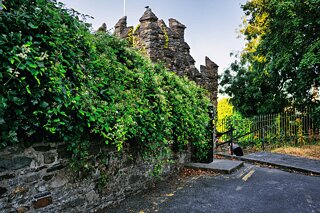
CARRIGEEN PARK AND THOMAS HILL IN WATERFORD
CARRIGEEN PARK AND BEACH TOWER IN WATERFORD
Between the Ridge and the Rock: Exploring Thomas Hill, Carrigeen Park, and Beach Tower
A recent walk through Waterford led to an unexpected convergence of local folklore, medieval military architecture, and childhood memories from the northern coast of Donegal.
Tucked away off the main thoroughfares lies a quiet residential street known today as Carrigeen Park. During a brief stroll, I was approached by two welcoming, community-minded residents who pointed up beyond the rooftops and urged me to capture a photograph. From street level, clearly visible against the skyline, stood the stepped stone crown of one of Waterford’s surviving medieval towers.
Although an impromptu gathering of curious local children meant postponing the photography for another day, the encounter sparked two fascinating questions: Which tower watches over this corner of the city, and how did Carrigeen Park come to bear its name?
The two gentlemen told me that where they now live was originally known as Carrigeen Lane and were not at al pleased by the name change.
From ‘Lane’ to ‘Park’: The Evolution of Carrigeen
The two local residents who pointed out the tower were quite right about the street’s historic title. Historical maps, 19th-century valuation records, and early civil registers confirm that for generations the street was known as Carrigeen Lane (often split into Carrigeen Lane Upper and Carrigeen Lane Lower).
Lying within the historic parish of St Patrick, the lane directly flanked the western ramparts of the old Norman city. In the late 19th century (c. 1890), neat terraces of two-bay artisan worker cottages were constructed along its length. Over the course of 20th-century municipal renumbering and modern urban renewal, the street name evolved into Carrigeen Park (with deeds and local vernacular occasionally referring to Carrigeen Place).
This recent visit to Waterford paired with an excursion through my un-geotagged digital archives from 2021—prompted an unexpected convergence of urban topography, medieval military architecture, and childhood memories from the Donegal coast.
While retracing my steps around the western perimeter of the old walled city, I found myself revisiting two intimately connected thoroughfares: Thomas Hill and Carrigeen Park. Sifting through images from both visits, one dominant stone structure immediately provides the visual and historical anchor for the entire area: the formidable 15th-century Beach Tower.
The Anchor on the Slate: Beach Tower
Perched high on a natural outcrop of dark slate, Beach Tower is one of the most complete surviving mural towers along Waterford’s ancient defensive circuit.
Depending on where you stand, the tower presents two entirely different faces:
The High Ground (Thomas Hill): Approaching from the upper ridge along Thomas Hill brings you near the tower’s substantial stone foundations and the surviving line of the medieval ramparts. From here, early sentries held an commanding view looking out toward Granagh Castle and the winding River Suir.
The Low Vantage (Carrigeen Park): Standing below in Carrigeen Park, the perspective shifts dramatically upwards. The tower’s distinctive 15th-century Irish stepped battlements (crenellations) rise boldly above modern rooftops and chimneys—a sudden, striking glimpse of the Middle Ages framed by residential terraces.
Restored and conserved through the work of the Waterford Civic Trust in 1996, the tower bridges the two streetscapes both physically and historically.
High and Low: Connecting Thomas Hill & Carrigeen Lane
Though separated by a dramatic change in elevation, Thomas Hill and Carrigeen Park belong to the exact same geological and civic fabric.
Thomas Hill: Taking its name from the historic ecclesiastical lands associated with the Priory of St Thomas, this street follows the elevated ridge line. It formed a vital conduit within the historic parish of St Patrick, where high-density domestic quarters gradually grew up against the old stone fortifications.
Carrigeen Park (Historically Carrigeen Lane): Tucked immediately below the bluff, this quiet lane was known for generations simply as Carrigeen Lane (divided in 19th-century valuation records into Carrigeen Lane Upper and Lower).
Late-Victorian terraces of two-bay artisan worker houses were built here around 1890, sheltering beneath the shadow of the rock.
Historically, a network of steep steps and narrow laneways stitched the two levels together. When viewing my 2021 photographs alongside recent frames, the elevation difference tells the story: Thomas Hill captures the skyline along the ridge, while Carrigeen Park captures the life settled at its foot.
The Linguistic Link: Donegal to the Déise
The name Carrigeen struck an immediate personal chord. Growing up in County Donegal, we spent childhood afternoons along the rocky Atlantic shoreline collecting Carrigeen Moss (Chondrus crispus). Back in the kitchen, we would boil the dried red seaweed in fresh milk with sugar and spice, releasing its natural gelatinous carrageenan to create a rich, set dessert pudding and restorative tonic.
Encountering the name in urban Waterford might at first seem curious, but the link is purely linguistic:
Etymology: Carrigeen is the anglicised spelling of the Irish Carraigín, meaning "little rock" or "rocky outcrop".
In Waterford: The street draws its identity from the rocky limestone and slate bluff upon which Thomas Hill and Beach Tower were founded.
In Donegal: The coastal seaweed earned the same moniker because it thrives in thick, rubbery mats clinging to intertidal rocks.
Bringing these two catalogues together has turned what seemed like disconnected urban photographs into a unified study of Waterford’s western ramparts—where the landscape itself dictated the line of the walls, the names of the streets, and the enduring character of the city.
The Carrigeen Park Mural
The Artist: Dan Leo
The mural is by the Irish contemporary street artist and illustrator Dan Leo, painted as part of the Waterford Walls International Street Art Festival.
The Artwork: Leaping Hare
Subject & Style: The piece depicts a leaping/running Irish hare in Leo’s signature graphic style, characterised by clean black outlines, bold colour blocking, and fluid, stylised anatomy reminiscent of classic animation and pop culture illustration.
Local Context: Placed on the entrance wall leading down into Carrigeen Park / Carrigeen Lane, the fluid movement of the hare naturally leads the eye straight down the narrow residential corridor toward the terraced cottages.
Themes: Leo’s public art across Ireland and abroad focuses almost exclusively on wildlife, reinterpreting native fauna with vibrant, modern palettes that bring high visual energy to historic and understated urban spaces.
Between the Ridge and the Rock: Exploring Thomas Hill, Carrigeen Park, and Beach Tower
A recent walk through Waterford led to an unexpected convergence of local folklore, medieval military architecture, and childhood memories from the northern coast of Donegal.
Tucked away off the main thoroughfares lies a quiet residential street known today as Carrigeen Park. During a brief stroll, I was approached by two welcoming, community-minded residents who pointed up beyond the rooftops and urged me to capture a photograph. From street level, clearly visible against the skyline, stood the stepped stone crown of one of Waterford’s surviving medieval towers.
Although an impromptu gathering of curious local children meant postponing the photography for another day, the encounter sparked two fascinating questions: Which tower watches over this corner of the city, and how did Carrigeen Park come to bear its name?
The two gentlemen told me that where they now live was originally known as Carrigeen Lane and were not at al pleased by the name change.
From ‘Lane’ to ‘Park’: The Evolution of Carrigeen
The two local residents who pointed out the tower were quite right about the street’s historic title. Historical maps, 19th-century valuation records, and early civil registers confirm that for generations the street was known as Carrigeen Lane (often split into Carrigeen Lane Upper and Carrigeen Lane Lower).
Lying within the historic parish of St Patrick, the lane directly flanked the western ramparts of the old Norman city. In the late 19th century (c. 1890), neat terraces of two-bay artisan worker cottages were constructed along its length. Over the course of 20th-century municipal renumbering and modern urban renewal, the street name evolved into Carrigeen Park (with deeds and local vernacular occasionally referring to Carrigeen Place).
This recent visit to Waterford paired with an excursion through my un-geotagged digital archives from 2021—prompted an unexpected convergence of urban topography, medieval military architecture, and childhood memories from the Donegal coast.
While retracing my steps around the western perimeter of the old walled city, I found myself revisiting two intimately connected thoroughfares: Thomas Hill and Carrigeen Park. Sifting through images from both visits, one dominant stone structure immediately provides the visual and historical anchor for the entire area: the formidable 15th-century Beach Tower.
The Anchor on the Slate: Beach Tower
Perched high on a natural outcrop of dark slate, Beach Tower is one of the most complete surviving mural towers along Waterford’s ancient defensive circuit.
Depending on where you stand, the tower presents two entirely different faces:
The High Ground (Thomas Hill): Approaching from the upper ridge along Thomas Hill brings you near the tower’s substantial stone foundations and the surviving line of the medieval ramparts. From here, early sentries held an commanding view looking out toward Granagh Castle and the winding River Suir.
The Low Vantage (Carrigeen Park): Standing below in Carrigeen Park, the perspective shifts dramatically upwards. The tower’s distinctive 15th-century Irish stepped battlements (crenellations) rise boldly above modern rooftops and chimneys—a sudden, striking glimpse of the Middle Ages framed by residential terraces.
Restored and conserved through the work of the Waterford Civic Trust in 1996, the tower bridges the two streetscapes both physically and historically.
High and Low: Connecting Thomas Hill & Carrigeen Lane
Though separated by a dramatic change in elevation, Thomas Hill and Carrigeen Park belong to the exact same geological and civic fabric.
Thomas Hill: Taking its name from the historic ecclesiastical lands associated with the Priory of St Thomas, this street follows the elevated ridge line. It formed a vital conduit within the historic parish of St Patrick, where high-density domestic quarters gradually grew up against the old stone fortifications.
Carrigeen Park (Historically Carrigeen Lane): Tucked immediately below the bluff, this quiet lane was known for generations simply as Carrigeen Lane (divided in 19th-century valuation records into Carrigeen Lane Upper and Lower).
Late-Victorian terraces of two-bay artisan worker houses were built here around 1890, sheltering beneath the shadow of the rock.
Historically, a network of steep steps and narrow laneways stitched the two levels together. When viewing my 2021 photographs alongside recent frames, the elevation difference tells the story: Thomas Hill captures the skyline along the ridge, while Carrigeen Park captures the life settled at its foot.
The Linguistic Link: Donegal to the Déise
The name Carrigeen struck an immediate personal chord. Growing up in County Donegal, we spent childhood afternoons along the rocky Atlantic shoreline collecting Carrigeen Moss (Chondrus crispus). Back in the kitchen, we would boil the dried red seaweed in fresh milk with sugar and spice, releasing its natural gelatinous carrageenan to create a rich, set dessert pudding and restorative tonic.
Encountering the name in urban Waterford might at first seem curious, but the link is purely linguistic:
Etymology: Carrigeen is the anglicised spelling of the Irish Carraigín, meaning "little rock" or "rocky outcrop".
In Waterford: The street draws its identity from the rocky limestone and slate bluff upon which Thomas Hill and Beach Tower were founded.
In Donegal: The coastal seaweed earned the same moniker because it thrives in thick, rubbery mats clinging to intertidal rocks.
Bringing these two catalogues together has turned what seemed like disconnected urban photographs into a unified study of Waterford’s western ramparts—where the landscape itself dictated the line of the walls, the names of the streets, and the enduring character of the city.
The Carrigeen Park Mural
The Artist: Dan Leo
The mural is by the Irish contemporary street artist and illustrator Dan Leo, painted as part of the Waterford Walls International Street Art Festival.
The Artwork: Leaping Hare
Subject & Style: The piece depicts a leaping/running Irish hare in Leo’s signature graphic style, characterised by clean black outlines, bold colour blocking, and fluid, stylised anatomy reminiscent of classic animation and pop culture illustration.
Local Context: Placed on the entrance wall leading down into Carrigeen Park / Carrigeen Lane, the fluid movement of the hare naturally leads the eye straight down the narrow residential corridor toward the terraced cottages.
Themes: Leo’s public art across Ireland and abroad focuses almost exclusively on wildlife, reinterpreting native fauna with vibrant, modern palettes that bring high visual energy to historic and understated urban spaces.
CARRIGEEN PARK AND THOMAS HILL IN WATERFORD