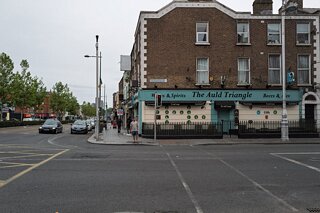
DORSET STREET HAS A COMPLEX PAST AND FUTURE
The Complexity of Dorset Street: History, Dereliction, and Transformation
Dorset Street in Dublin presents a stark urban paradox. To anyone walking or photographing its length, it frequently comes across as an unlovely, heavily trafficked thoroughfare—dominated by neon takeaway signs, high-frontage financial services such as moneylenders, cluttered shopfronts, and neglected upper storeys.
Yet beneath the immediate layer of urban wear lies one of Dublin’s oldest arterial routes, steeped in literary history, historic architecture, and major urban renewal schemes. Nothing along this street is ever as simple as it first appears, and every single building holds a completely different story depending on who you speak to.
Historical Roots and Origins
Dorset Street’s origins trace back centuries before the Georgian expansion. It began as part of the Slí Chualann, one of ancient Ireland's primary arterial roads radiating from the crossing point of the River Liffey.
By the 17th and early 18th centuries, the route was mapped as Drumcondra Lane. It was officially renamed Dorset Street around 1728 in honour of Lionel Cranfield Sackville, 1st Duke of Dorset, who served as Lord Lieutenant of Ireland. Divided into Upper and Lower Dorset Street, the street evolved into a major northern gateway to the city, bridging the city core with the emerging northern suburbs.
People of Note
Despite its current gritty reputation, Dorset Street was once a fashionable residential address that nurtured major political and cultural figures:
James Napper Tandy (1740–1803): The revolutionary leader and founding member of the Society of United Irishmen resided at 16 Dorset Street around 1779.
Peadar Kearney (1883–1942): The Irish Republican, house painter, and songwriter who composed Ireland's national anthem (Amhrán na bhFiann / The Soldier's Song) was born at 68 Dorset Street.
Seán O'Casey (1880–1964): The world-renowned dramatist (The Shadow of a Gunman, Juno and the Paycock) was born at 85 Dorset Street. His family also lived at numbers 6 and 23½.
The Saga of No. 12 and The Moy: A Lesson in Dublin Complexity
Nothing illustrates the labyrinthine nature of Dublin property and heritage quite like the long-running saga of No. 12 Upper Dorset Street and its long-derelict neighbour at No. 13, historically known as
The Moy pub.
1. The Historic Misunderstanding
For generations, local folklore, city plaques, and literary guidebooks firmly declared No. 12 to be the birthplace of the famed 18th-century playwright and Westminster MP Richard Brinsley Sheridan (1751–1816). Because of this prestigious association, the structure was placed on the Record of Protected Structures.
However, mid-18th-century Dublin did not use fixed, sequential house numbering. Numbers were assigned fluidly, shifted over time, or altered as terraces were completed. Later archival research and architectural forensics revealed a crucial twist: Sheridan's family did live along that terrace, but 18th-century street renumbering meant the actual house where Sheridan was born was likely an adjoining townhouse long since demolished in the 19th century. Modern No. 12 was built around 1745, but it was not Sheridan's home.
2. Contagious Dereliction & Planning Standoffs
Despite the misattribution, No. 12 remained legally protected. When developers sought planning permission to redevelop the plot, planning authorities repeatedly blocked outright demolition due to its statutory heritage status and intense public campaigning.
Meanwhile, next door at No. 13 sat The Moy, a traditional pub that had closed its doors and fallen into severe, decadal ruin. The dereliction of The Moy was catastrophic for No. 12. As rainwater poured through the collapsing roof and rotting timbers of the abandoned pub, water saturated the shared internal brickwork and chimney stacks. Starved of maintenance and stripped of lateral support, No. 12 began to crumble from the inside out, losing its upper floors and roof while remaining frozen in planning limbo.
3. A Painfully Slow Reconstruction Yields Quality
For those tracking the terrace over time, the eventual redevelopment phase moved at an agonizingly slow pace. Stabilizing the remaining structural elements of No. 12 while clearing the ruin of The Moy required complex structural engineering, meticulous scaffolding, and cautious site works spanning multiple years.
When the legal, financial, and planning standoffs finally cleared, the ultimate outcome proved that historic patience can yield exceptional urban architecture. Rather than erecting a cheap suburban placeholder, the resulting replacement building—spanning Nos. 12 and 13—was built to an exceptionally high standard. The modern infill design retains the rhythm, scale, and brickwork profile of the historic streetscape, presenting a refined contemporary facade that respects the spatial line of the terrace without resorting to cheap pastiche.
Across the Street: The Fire Station & The Public Housing Revolution
Directly across from No. 12 sits another architectural centerpiece: the Former Dorset Street Fire Station. Designed in 1902 by civic architect C.J. McCarthy, this striking red-brick Italianate structure with its prominent hose-drying tower is one of Dublin's finest surviving Victorian municipal buildings.
For decades, the fire station stood directly opposite the decaying 1960s Dorset Street social housing flat complex. Today, that entire block is undergoing a massive urban transformation:
The Regeneration Scheme: Demolition of the obsolete mid-century flat blocks paved the way for a major multi-million euro public housing development designed by Scott Tallon Walker and Levitt Bernstein Architects.
Community-Focused Design: The project delivers over 160 high-density, energy-efficient social homes surrounding internal green courtyards, alongside a civic community centre, childcare facilities, and a
local boxing club.
Civic Anchor: Crucially, the plan integrates the historic Dorset Street Fire Station directly into its footprint, retaining the landmark tower as the visual and cultural anchor of a vibrant, re-imagined residential neighbourhood.
Current Status and Potential Future
Dorset Street remains at an urban crossroads. As the N1 primary transit artery, it continues to suffer from heavy vehicular congestion, noise, and short-term commercial frontage. However, the combination of high-grade private infill projects like No. 12/13 and the sweeping Dublin City Council housing regeneration across the road marks a clear turning point.
As traffic-calming initiatives take hold and high-quality residential density returns to the city center, Dorset Street has the genuine potential to shed its "run-down" moniker and re-emerge as a livable, historically rich urban boulevard.
Pubs And More Pubs - Why So Many
The sheer volume of pubs that once lined Dorset Street—and the sheer number that ultimately failed or closed their doors over the last few decades—is the result of a drastic shift in how the street was used, moving from an 18th-century coaching highway to a 20th-century match-day bottleneck, before hitting modern economic realties.
1. The Coach Road Era: Where the Density Began
Long before Croke Park existed, Dorset Street was packed with public houses, inns, and spirit merchants. In 1903, Thom’s Directory recorded at least 14 or 15 pubs operating along Dorset Street alone.
The primary reason for this high concentration was its status as the great northern coach road (the N1/M1 route out of Dublin). The Last Stop Before the Country: As part of the historical Slí Chualann and later the turnpike/coaching route toward Cavan, Monaghan, and Belfast, Dorset Street was the major staging point for travellers entering or leaving the city core.
Coaching Inns & Stabling: Pubs along Dorset Street weren’t just places to grab a quick pint; they were coaching inns providing fresh horses, accommodation, food, and drink for travelers, traders, and livestock drovers coming in from the country.
Local Workers: The street was surrounded by densely populated tenement communities, market traders, and local artisans who provided a steady, day-to-day trade for neighbourhood locals like The Moy and The Waxie Dargle (named after the famous Dublin cobblers' outing).
2. The Croke Park Factor: The Double-Edged Sword
As coaching horses gave way to motor vehicles and the local tenement population moved out to new suburban housing estates in the mid-to-late 20th century, Dorset Street’s pub economy became heavily dependent on a new economic engine: GAA match days at Croke Park.
Being the direct walking corridor between the city centre (O'Connell Street) and Jones' Road / Russell Street, Dorset Street pubs enjoyed legendary game-day trade:
The "Matchday Boom": On Championship Sundays, pubs like The Waxie Dargle, The Moy, The Big Tree, and Auld Dubliner would be packed to the rafters. A pub could turn over a week’s worth of profit in just six hours of intense pre- and post-match drink trade.
The Trap of Matchday Reliance: However, relying on Croke Park created a dangerous business model. There are only so many major match days in a year (primarily during the summer GAA season). A pub cannot survive on 15 to 20 bumper Sundays a year if its mid-week, local neighbourhood trade collapses.
3. Why Did Famous Pubs Like The Joy and The Waxie Dargle Fail?
When iconic local institutions like The Moy (No. 13 Upper Dorset Street) and The Waxie Dargle eventually folded and fell into long-term dereliction, several urban forces converged at once:
Loss of Local Residential Base: The clearance of inner-city housing and old tenement blocks stripped the street of its daily "regular" drinkers who sustained the bars from Monday to Thursday.
Traffic Dominance & Environment: As Dorset Street was widened into a multi-lane arterial traffic corridor carrying heavy commuter traffic, it became an uninviting, noisy, and polluted environment for
leisure. Casual evening pub-goers drifted toward quieter residential suburbs or dedicated nightlife districts like Camden Street or Temple Bar.
The 2008 Financial Crash & Property Speculation: Many Dorset Street pubs were bought up by developers at the peak of the property boom with plans to demolish them for apartment complexes or hotel plots. When the crash hit, many of these sites were caught in planning deadlocks or bank receiverships, leaving buildings boarded up for decades. As seen with The Moy, once a pub sat vacant, water ingress and structural decay quickly took over.
Changing Irish Drinking Habits: The rise of home drinking, changing social habits, and the strict enforcement of drink-driving laws hit traditional "passing trade" and regional supporter pubs exceptionally hard.
Dorset Street Pubs Today
Today, the pubs that survive on Dorset Street—or the new venues replacing them—are those that have adapted beyond the old model. While match-day traffic from Croke Park still provides a massive seasonal bonus, modern survivors rely heavily on diversified trade, local student populations (from nearby campus developments), and the gradual repopulation of the north inner city through massive public and private housing regenerations.
Dorset Street in Dublin presents a stark urban paradox. To anyone walking or photographing its length, it frequently comes across as an unlovely, heavily trafficked thoroughfare—dominated by neon takeaway signs, high-frontage financial services such as moneylenders, cluttered shopfronts, and neglected upper storeys.
Yet beneath the immediate layer of urban wear lies one of Dublin’s oldest arterial routes, steeped in literary history, historic architecture, and major urban renewal schemes. Nothing along this street is ever as simple as it first appears, and every single building holds a completely different story depending on who you speak to.
Historical Roots and Origins
Dorset Street’s origins trace back centuries before the Georgian expansion. It began as part of the Slí Chualann, one of ancient Ireland's primary arterial roads radiating from the crossing point of the River Liffey.
By the 17th and early 18th centuries, the route was mapped as Drumcondra Lane. It was officially renamed Dorset Street around 1728 in honour of Lionel Cranfield Sackville, 1st Duke of Dorset, who served as Lord Lieutenant of Ireland. Divided into Upper and Lower Dorset Street, the street evolved into a major northern gateway to the city, bridging the city core with the emerging northern suburbs.
People of Note
Despite its current gritty reputation, Dorset Street was once a fashionable residential address that nurtured major political and cultural figures:
James Napper Tandy (1740–1803): The revolutionary leader and founding member of the Society of United Irishmen resided at 16 Dorset Street around 1779.
Peadar Kearney (1883–1942): The Irish Republican, house painter, and songwriter who composed Ireland's national anthem (Amhrán na bhFiann / The Soldier's Song) was born at 68 Dorset Street.
Seán O'Casey (1880–1964): The world-renowned dramatist (The Shadow of a Gunman, Juno and the Paycock) was born at 85 Dorset Street. His family also lived at numbers 6 and 23½.
The Saga of No. 12 and The Moy: A Lesson in Dublin Complexity
Nothing illustrates the labyrinthine nature of Dublin property and heritage quite like the long-running saga of No. 12 Upper Dorset Street and its long-derelict neighbour at No. 13, historically known as
The Moy pub.
1. The Historic Misunderstanding
For generations, local folklore, city plaques, and literary guidebooks firmly declared No. 12 to be the birthplace of the famed 18th-century playwright and Westminster MP Richard Brinsley Sheridan (1751–1816). Because of this prestigious association, the structure was placed on the Record of Protected Structures.
However, mid-18th-century Dublin did not use fixed, sequential house numbering. Numbers were assigned fluidly, shifted over time, or altered as terraces were completed. Later archival research and architectural forensics revealed a crucial twist: Sheridan's family did live along that terrace, but 18th-century street renumbering meant the actual house where Sheridan was born was likely an adjoining townhouse long since demolished in the 19th century. Modern No. 12 was built around 1745, but it was not Sheridan's home.
2. Contagious Dereliction & Planning Standoffs
Despite the misattribution, No. 12 remained legally protected. When developers sought planning permission to redevelop the plot, planning authorities repeatedly blocked outright demolition due to its statutory heritage status and intense public campaigning.
Meanwhile, next door at No. 13 sat The Moy, a traditional pub that had closed its doors and fallen into severe, decadal ruin. The dereliction of The Moy was catastrophic for No. 12. As rainwater poured through the collapsing roof and rotting timbers of the abandoned pub, water saturated the shared internal brickwork and chimney stacks. Starved of maintenance and stripped of lateral support, No. 12 began to crumble from the inside out, losing its upper floors and roof while remaining frozen in planning limbo.
3. A Painfully Slow Reconstruction Yields Quality
For those tracking the terrace over time, the eventual redevelopment phase moved at an agonizingly slow pace. Stabilizing the remaining structural elements of No. 12 while clearing the ruin of The Moy required complex structural engineering, meticulous scaffolding, and cautious site works spanning multiple years.
When the legal, financial, and planning standoffs finally cleared, the ultimate outcome proved that historic patience can yield exceptional urban architecture. Rather than erecting a cheap suburban placeholder, the resulting replacement building—spanning Nos. 12 and 13—was built to an exceptionally high standard. The modern infill design retains the rhythm, scale, and brickwork profile of the historic streetscape, presenting a refined contemporary facade that respects the spatial line of the terrace without resorting to cheap pastiche.
Across the Street: The Fire Station & The Public Housing Revolution
Directly across from No. 12 sits another architectural centerpiece: the Former Dorset Street Fire Station. Designed in 1902 by civic architect C.J. McCarthy, this striking red-brick Italianate structure with its prominent hose-drying tower is one of Dublin's finest surviving Victorian municipal buildings.
For decades, the fire station stood directly opposite the decaying 1960s Dorset Street social housing flat complex. Today, that entire block is undergoing a massive urban transformation:
The Regeneration Scheme: Demolition of the obsolete mid-century flat blocks paved the way for a major multi-million euro public housing development designed by Scott Tallon Walker and Levitt Bernstein Architects.
Community-Focused Design: The project delivers over 160 high-density, energy-efficient social homes surrounding internal green courtyards, alongside a civic community centre, childcare facilities, and a
local boxing club.
Civic Anchor: Crucially, the plan integrates the historic Dorset Street Fire Station directly into its footprint, retaining the landmark tower as the visual and cultural anchor of a vibrant, re-imagined residential neighbourhood.
Current Status and Potential Future
Dorset Street remains at an urban crossroads. As the N1 primary transit artery, it continues to suffer from heavy vehicular congestion, noise, and short-term commercial frontage. However, the combination of high-grade private infill projects like No. 12/13 and the sweeping Dublin City Council housing regeneration across the road marks a clear turning point.
As traffic-calming initiatives take hold and high-quality residential density returns to the city center, Dorset Street has the genuine potential to shed its "run-down" moniker and re-emerge as a livable, historically rich urban boulevard.
Pubs And More Pubs - Why So Many
The sheer volume of pubs that once lined Dorset Street—and the sheer number that ultimately failed or closed their doors over the last few decades—is the result of a drastic shift in how the street was used, moving from an 18th-century coaching highway to a 20th-century match-day bottleneck, before hitting modern economic realties.
1. The Coach Road Era: Where the Density Began
Long before Croke Park existed, Dorset Street was packed with public houses, inns, and spirit merchants. In 1903, Thom’s Directory recorded at least 14 or 15 pubs operating along Dorset Street alone.
The primary reason for this high concentration was its status as the great northern coach road (the N1/M1 route out of Dublin). The Last Stop Before the Country: As part of the historical Slí Chualann and later the turnpike/coaching route toward Cavan, Monaghan, and Belfast, Dorset Street was the major staging point for travellers entering or leaving the city core.
Coaching Inns & Stabling: Pubs along Dorset Street weren’t just places to grab a quick pint; they were coaching inns providing fresh horses, accommodation, food, and drink for travelers, traders, and livestock drovers coming in from the country.
Local Workers: The street was surrounded by densely populated tenement communities, market traders, and local artisans who provided a steady, day-to-day trade for neighbourhood locals like The Moy and The Waxie Dargle (named after the famous Dublin cobblers' outing).
2. The Croke Park Factor: The Double-Edged Sword
As coaching horses gave way to motor vehicles and the local tenement population moved out to new suburban housing estates in the mid-to-late 20th century, Dorset Street’s pub economy became heavily dependent on a new economic engine: GAA match days at Croke Park.
Being the direct walking corridor between the city centre (O'Connell Street) and Jones' Road / Russell Street, Dorset Street pubs enjoyed legendary game-day trade:
The "Matchday Boom": On Championship Sundays, pubs like The Waxie Dargle, The Moy, The Big Tree, and Auld Dubliner would be packed to the rafters. A pub could turn over a week’s worth of profit in just six hours of intense pre- and post-match drink trade.
The Trap of Matchday Reliance: However, relying on Croke Park created a dangerous business model. There are only so many major match days in a year (primarily during the summer GAA season). A pub cannot survive on 15 to 20 bumper Sundays a year if its mid-week, local neighbourhood trade collapses.
3. Why Did Famous Pubs Like The Joy and The Waxie Dargle Fail?
When iconic local institutions like The Moy (No. 13 Upper Dorset Street) and The Waxie Dargle eventually folded and fell into long-term dereliction, several urban forces converged at once:
Loss of Local Residential Base: The clearance of inner-city housing and old tenement blocks stripped the street of its daily "regular" drinkers who sustained the bars from Monday to Thursday.
Traffic Dominance & Environment: As Dorset Street was widened into a multi-lane arterial traffic corridor carrying heavy commuter traffic, it became an uninviting, noisy, and polluted environment for
leisure. Casual evening pub-goers drifted toward quieter residential suburbs or dedicated nightlife districts like Camden Street or Temple Bar.
The 2008 Financial Crash & Property Speculation: Many Dorset Street pubs were bought up by developers at the peak of the property boom with plans to demolish them for apartment complexes or hotel plots. When the crash hit, many of these sites were caught in planning deadlocks or bank receiverships, leaving buildings boarded up for decades. As seen with The Moy, once a pub sat vacant, water ingress and structural decay quickly took over.
Changing Irish Drinking Habits: The rise of home drinking, changing social habits, and the strict enforcement of drink-driving laws hit traditional "passing trade" and regional supporter pubs exceptionally hard.
Dorset Street Pubs Today
Today, the pubs that survive on Dorset Street—or the new venues replacing them—are those that have adapted beyond the old model. While match-day traffic from Croke Park still provides a massive seasonal bonus, modern survivors rely heavily on diversified trade, local student populations (from nearby campus developments), and the gradual repopulation of the north inner city through massive public and private housing regenerations.
DORSET STREET