

The Fujifilm X100VI’s Secret Weapon: How One “Fixed” Lens Becomes Nine
The Fujifilm X100 series has built a devoted following for a simple reason: it's a beautiful, compact camera built around a single, perfectly matched fixed lens. It's built around a single, superb 23mm F2 lens (providing a 35mm full-frame equivalent field of view), an approach that forces creative discipline and results in a camera that is a joy to carry everywhere.
But even the most dedicated X100 user eventually faces the classic dilemma. You're shooting a stunning vista and wish you could go just a little bit wider. Or you're capturing a portrait and crave a tighter, more compressed perspective without physically moving closer. The desire for more focal length flexibility often feels at odds with the camera's core appeal; adding bulky conversion lenses can compromise the very portability that makes the X100 so special.
This is where the Fujifilm X100VI changes the game. Thanks to its new high-resolution 40-megapixel sensor and some remarkably clever software, the "one lens" limitation is no longer a limitation at all. The X100VI offers a surprising number of practical, high-quality solutions that transform it into one of the most versatile compact cameras on the market, unlocking its hidden potential as a multi-lens system in a single body.
1. The Digital Crop Is So Good, It Might Replace a Lens
The most significant upgrade enabling this new versatility is the X100VI's 40-megapixel sensor, which makes the camera's digital crop modes (also called the digital teleconverter) a genuinely practical feature. This leap in resolution is made possible because Fujifilm, with foresight, designed the X100V's lens to be "future-proof," capable of resolving far more detail than its original 26MP sensor required. The X100VI is now cashing in on that investment.
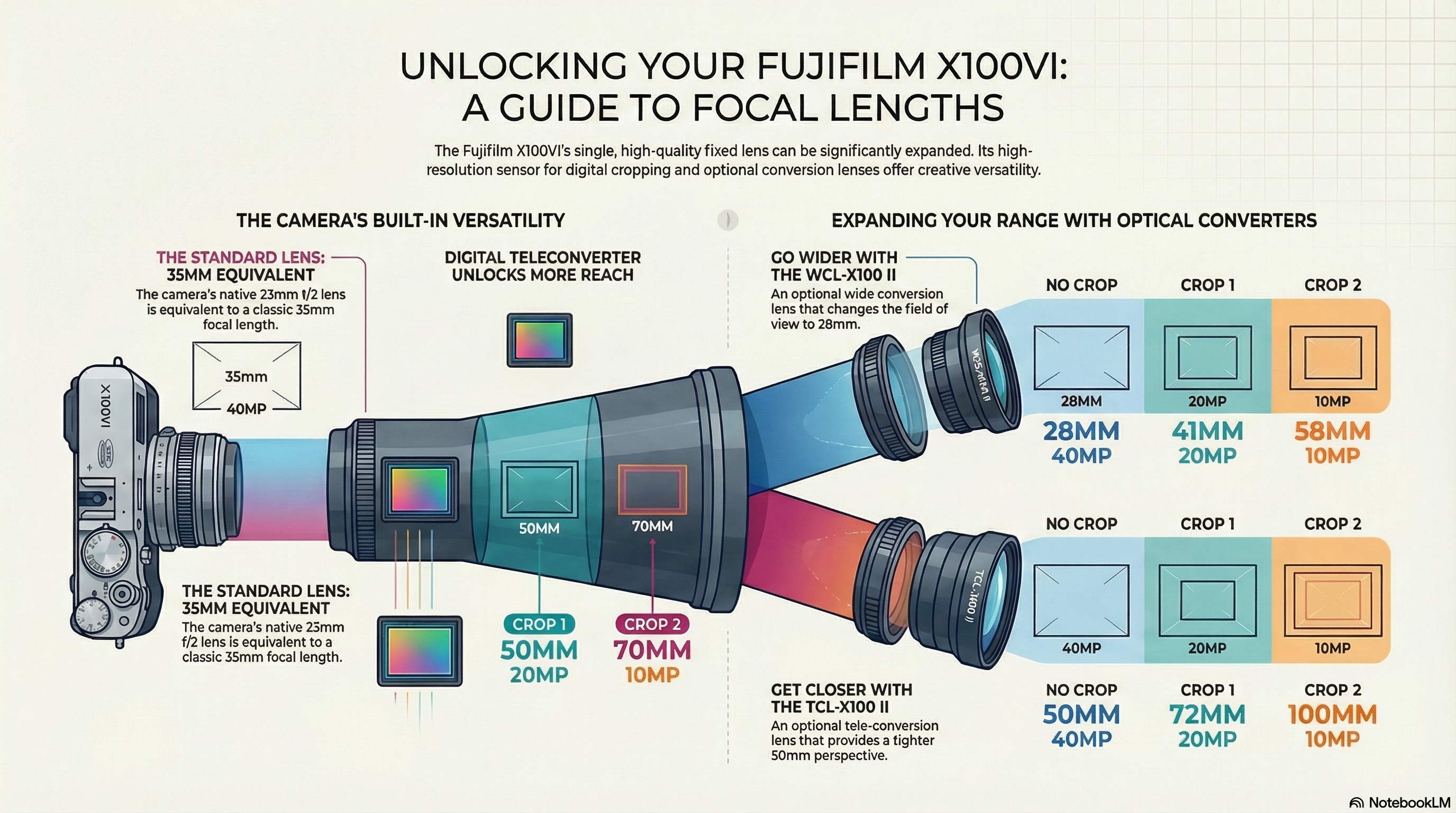
While previous models offered a form of digital zoom, the X100VI is the first in the series where the massive 40-megapixel resolution transforms this feature from a jpeg-only novelty into a professional-grade tool for both RAW and JPEG shooters. With the standard lens, the camera offers two digital crop options beyond its native 35mm equivalent view. You can punch in to a 50mm equivalent, which yields a highly detailed 20-megapixel image, or even further to a 70mm equivalent, which still provides a very usable 10-megapixel file. The quality is so impressive that it challenges the need for additional hardware.
...you can see from the test images that there's really no way of telling that it's a crop mode that you're using unless you go side by side with an image where a teleconverter lens is used and even at that you'd be hard-pressed to tell the difference unless you are putting them right next to each other...
2. You Suddenly Have a "Lens Arsenal" in One Camera
The true power of the X100VI's system is revealed when you combine the digital crop modes with Fujifilm's optional conversion lenses: the Wide Conversion Lens (WCL) and the Tele Conversion Lens (TCL). By using the digital teleconverter in tandem with these optics, a single compact camera suddenly offers an incredible range of focal lengths.
This transforms the X100VI from a single-lens camera into a comprehensive system that covers everything from wide-angle to telephoto. Here is the full range of focal lengths you can achieve:
Standard Lens:
• 35mm (40MP)
• 50mm (20MP)
• 70mm (10MP)
With Wide Conversion Lens (WCL-X100II):
• 28mm (40MP)
• 41mm (20MP)
• 58mm (10MP)
With Tele Conversion Lens (TCL-X100II):
• 50mm (40MP)
• 72mm (20MP)
• 100mm (10MP)
This transforms the X100VI into a veritable system camera in a fixed-lens body, debunking the "jack of all trades" fallacy by allowing it to master compositions from wide-angle landscapes to tight telephoto portraits.
3. The Wide Lens Still Rules, But the Telephoto is Optional
With the power of the new digital crop, the decision to buy a conversion lens becomes more nuanced, demanding a strategic choice based on shooting style.
The Wide Conversion Lens (WCL-X100II) remains an essential accessory for those who need a wider field of view. It converts the camera's lens to a true 28mm full-frame equivalent, a feat that cannot be replicated digitally—you simply cannot crop an image to make it wider. For landscape, architecture, and tight indoor shots, the WCL-X100II is an invaluable and irreplaceable tool.
The Tele Conversion Lens (TCL-X100II), however, is now more of an optional luxury. While it provides a superb optical 50mm equivalent at the full 40-megapixel resolution, the camera's built-in 50mm digital crop is so effective at 20 megapixels that many users may find the TCL's trade-offs unnecessary. As one user noted after pairing the TCL-X100II with the high-resolution body, the trade-off is simply "not worth it," as the added bulk fundamentally compromises the camera's compact, "pocketable" nature. The choice is clear: for those who prioritize ultimate image quality for large prints at 50mm, the TCL-X100II remains a viable, if bulky, option. For everyone else, the convenience and portability offered by the built-in 20-megapixel crop makes the TCL-X100II a luxury that can be confidently skipped.
4. A 10-Megapixel Photo is More Powerful Than You Think
A common concern among photographers is that heavy cropping will result in low-resolution files that are unsuitable for anything beyond social media. The X100VI's 40-megapixel sensor effectively puts this fear to rest.
Even at its most extreme digital crop—yielding a 10-megapixel file at a 70mm or 100mm equivalent focal length—the image quality is more than sufficient for high-quality printing. The source material provides specific, practical examples of what you can expect:
• A 10MP image can produce "really good 4x6 prints all the way up to 8x10 prints."
• A 20MP image can produce "a really nice 11x14 image."
This capability confirms that even the most aggressive crop modes on the X100VI are not just novelties. They are practical, powerful tools that produce files suitable for creating physical prints, making the entire focal range of the camera system genuinely usable.
5. Insider Tip: Add Auto-Detection to Cheaper Lenses with a Simple Hack
Fujifilm offers two generations of its conversion lenses. The "Mark II" versions (WCL-X100II and TCL-X100II) contain a small magnet that allows the camera to automatically detect when the lens is attached and apply the necessary software corrections. The older, first-generation versions (WCL-X100 and TCL-X100) are optically identical but require the user to manually select the lens in the camera menu.
However, savvy users have discovered a simple and cost-effective "hack." Because the only functional difference is the magnet, you can add this modern feature to the cheaper, first-generation lenses yourself.
You don't need to buy the new version of the conversion lens. Optically they are the same, but the II version has a built-in magnet that tells your camera a converter is attached. You can stick a little magnet to the right spot on the first version—which is also cheaper—and you have the II version's functionality.
Conclusion: More Than Meets the Eye
The Fujifilm X100VI redefines the fixed-lens category by blurring the lines between a compact carry camera and a multi-lens system. On the surface, it maintains the beloved identity of a simple, elegant camera. But underneath, the intelligent combination of a high-resolution sensor, powerful digital cropping tools, and well-designed optional optics creates one of the most versatile and capable compact systems available today. It respects its minimalist roots while offering a universe of creative flexibility that was previously unimaginable in such a small package.
This evolution prompts a fascinating question about the future of camera design. With digital cropping becoming this good, is the future of compact cameras not about interchangeable lenses, but about a single, perfect lens amplified by powerful software?