OUR EXPERIENCE
Est. 2025
OUR EXPERIENCE
Travel Advisory: The "Official" Mistake – Why We Ditched the Fuji BC-W126S in Ireland
By The Urban Cartographer
When you pick up a camera as capable (and elusive) as the Fujifilm X100VI, you want to support it with the best reliable gear. naturally, when we picked up our unit from an official dealer in Dublin, we asked for a charger.
The dealer explicitly recommended the official Fujifilm BC-W126S over the cheaper third-party alternatives. We took their advice, paid the premium (approx. €60), and headed north for a week of shooting in Belfast.
That was a big mistake.
Here is why every street photographer visiting the UK or Ireland needs to be aware of a major design flaw in Fujifilm’s official charging kit.
The Street Photographer’s Dilemma
Street photography is a volume game. On a heavy shooting day in a new city, we easily burn through three to four batteries. The workflow is standard: one in the camera, one in the pocket, and two back at the hotel charging for the next day.
Reliable wall power isn’t a luxury; it’s a necessity.
The Design Flaw: Global Brick vs. Local Switch
The problem with the BC-W126S sold in this region is the specific "clip-on" 3-pin adapter supplied with it. Instead of a unit that connects via a cable (keeping the brick on the desk), the adapter snaps directly onto the back of the charger, turning it into a rigid, bulky wall-wart.
When we arrived in Belfast, we hit a wall—literally.
The Conflict: UK and Irish (BS 1363) wall sockets almost always feature an On/Off rocker switch.
The Failure: The Fuji charger is so wide and sits so flush against the wall that the body of the charger physically overlaps the switch. As you push the charger in, it hits the rocker and turns the socket OFF.
We found ourselves in a hotel room trying to balance the charger halfway out of the socket just to keep the electrons flowing. For a "premium" official accessory, it is mechanically incompatible with the standard electrical infrastructure of the country it is sold in.
The Solution: Go Third Party
We eventually abandoned the official charger and purchased a HedBox unit. Not only was it more affordable, but it also offered interchangeable plates, allowing us to charge both our Fujifilm and Sony batteries on the same reliable device.
The Bottom Line: If you are planning a trip to Ireland or the UK with your X100VI:
Do not assume the official charger is the "safe" buy.
Avoid the rigid "clip-on" wall adapters.
Buy a third-party charger (like HedBox or Nitecore) or ensure you have a unit that uses a trailing cable.
Don't let a €60 piece of plastic ruin a day of shooting.
The Solution: A Genuine Upgrade (For Less Money)
We eventually abandoned the official charger and purchased a HedBox unit. This wasn't just a fix for the socket issue; it was a massive upgrade in versatility.
Unlike the official Fuji unit, which is tethered to a wall outlet (if you can get it to fit), the HedBox is designed for the reality of travel:
To make it easy for our readers, here is the breakdown of why we switched:
❌ The Official Fuji BC-W126S (UK/IE Version)
The Dealbreaker: The clip-on plug adapter creates a bulky block that physically clashes with the on/off switches on Irish and British wall sockets.
Limited: Only charges one battery at a time.
Inflexible: AC power only—useless in a car or without a wall outlet.
✅ The Upgrade: HedBox RP-DC50
The Fix: Connects via a standard cable, meaning the "brick" sits on the desk, not hanging off the wall. No blocked switches.
Road Ready: Comes with a 12V Car Adapter, allowing us to charge batteries while driving between locations.
Universal: With interchangeable plates, we can charge our Fujifilm X100VI and Sony gear on the same device.
Bonus: Features a USB Output port, effectively turning the charger into a power hub for our phones.
Our Advice: Save your money. Skip the official charger and grab a HedBox (or similar dual-plate system) that understands the needs of a traveling photographer.
BELOW IS AN ALTERNATIVE VIEW WITH A GENERIC CHART
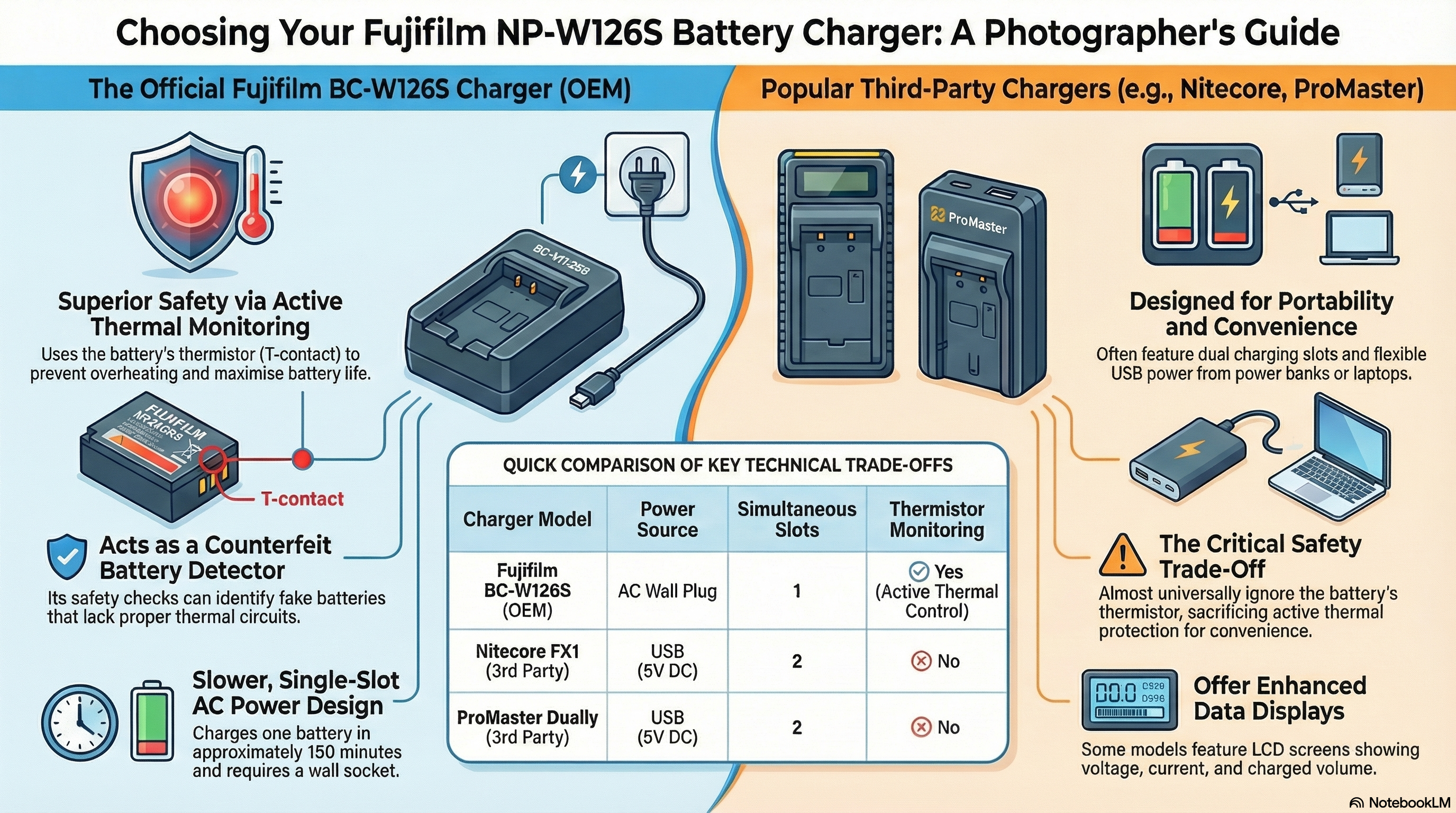
An Alternative View: 4 Surprising Secrets Your Fujifilm Battery Charger Is Hiding
For many Fujifilm photographers, the official BC-W126S battery charger is a source of quiet frustration. It's slow, charges only one battery at a time, and feels expensive for what it does. Faced with the obvious appeal of cheaper, dual-slot, USB-powered third-party chargers, switching seems like a no-brainer. It's easy to assume Fujifilm's charger is simply outdated.
But when you trade that official black box for a more convenient alternative, you give up critical, non-obvious features engineered for safety and battery longevity. What secrets are hiding inside Fujifilm's boring, single-slot charger? The answers reveal a deliberate engineering choice that prioritizes your thousand-dollar camera's safety over charging speed—a choice most third-party alternatives ignore.
1. Your 'Dumb' Charger’s Hidden Superpower: Dynamic Thermal Monitoring
A genuine Fujifilm NP-W126S battery features four electrical contacts: Positive (+), Negative (-), Data (D), and Thermistor (T). The official BC-W126S charger is engineered as a complete system, designed to connect with and utilize all four. The T-contact is the charger's direct, non-negotiable communication line to a Negative Temperature Coefficient (NTC) thermistor embedded deep within the battery's cells. This component is a special resistor whose electrical resistance changes predictably with temperature, sitting at about 10kΩ at room temperature and decreasing as the battery warms. This connection creates a "dynamic thermal control loop"—the single most important safety interlock for your battery. The official charger actively monitors the thermistor's resistance to gauge the battery's true internal temperature. If it detects a dangerous rise in heat, it can dynamically throttle the charging current or halt the process entirely. This isn't a bug; it's a non-negotiable protocol. The moderate 0.6C charge rate, which includes both Constant Current (CC) and Constant Voltage (CV) phases, is a deliberate strategy to reduce internal heat stress, minimize the risk of lithium plating, and mitigate chemical wear. This is the core engineering that maximizes the long-term health and cycle life of your batteries.
2. The Unseen Risk: How Third-Party Chargers Trade Safety for Convenience
Popular third-party chargers, like the Nitecore FX1 and ProMaster Dually, are undeniably convenient. They are more affordable, charge two batteries at once, and can be powered by any ubiquitous USB source, from a laptop to a power bank. The critical trade-off, however, is that these chargers almost universally operate by using only the positive (+) and negative (-) terminals, completely ignoring the crucial thermistor (T) contact.
By ignoring the T-contact, the charger is flying blind, pushing a constant current into a black box with no awareness of the potentially volatile chemical reactions occurring inside. Even if a charger like the Nitecore FX1 displays a temperature reading on its LCD screen, this is likely an ambient reading from a sensor located in the charger's housing, not a true measurement of the battery's chemical cells. This convenience comes at the direct cost of the primary safety feature engineered by the original manufacturer, abandoning the very system designed to prevent thermal runaway.
3. Your Charger's Second Job: Counterfeit Cop
Manufacturers of counterfeit NP-W126S batteries have a clever method to deceive chargers that require a thermistor signal. Instead of installing a real, temperature-sensitive thermistor, they employ a "fixed resistor bypass," soldering a cheap, fixed-value 10kΩ resistor between the T-contact and ground. This simple component tricks the official charger into believing the battery's temperature is always a safe, static 25°C (77°F), regardless of how hot the cells actually get. The dynamic thermal protection is completely neutralized, allowing the charger to continue pushing current into a dangerously overheating battery. This knowledge provides a practical diagnostic test. If you are using the official BC-W126S charger and a battery becomes abnormally hot to the touch—without the charger's LED indicator changing or stopping the charge—it is a strong sign that the battery is a counterfeit with a bypassed safety circuit. That battery should be retired immediately. This internal deception is the most dangerous flaw, but counterfeiters often reveal themselves with external clues as well, such as sloppy printing on the casing or a weight that differs from the official 47-gram specification.
4. A Surprising Flaw: When Official Gear Fails the Real-World Test
While the internal engineering of OEM gear is often superior, it isn't always perfect in its practical application. A significant real-world issue was reported by users in the UK and Ireland, where the specific "clip-on" 3-pin adapter supplied with the BC-W126S is so bulky that its body physically blocks and turns off the rocker switch found on standard BS 1363 wall sockets. As you push the charger into the wall, its own housing flicks the power switch to the "off" position.
This forced users into a comical balancing act, attempting to keep the charger halfway out of the socket just to maintain an electrical connection—a frustrating experience for a premium, official accessory. This oversight demonstrates that while the charger's internal safety engineering is sophisticated, real-world usability can be a blind spot. In certain situations, a third-party charger that uses a simple power cable instead of a rigid, bulky adapter can be a more practical solution.
Conclusion: The Deliberate Choice Between Safety and Speed
Fujifilm’s design is a testament to risk mitigation engineering, deliberately prioritizing the battery's chemical safety and long-term health above all else. In contrast, the third-party market is driven by feature-first convenience, delivering user-requested functions like dual-slots, USB power, and faster charging speeds. That convenience, however, comes with an invisible but critical safety trade-off: the abandonment of the battery's own thermal monitoring system.
Now that you know the hidden engineering behind your gear, how will you balance the demands of convenience against the crucial need for safety in your own photography workflow?
Drag & drop a folder of images
or add them via the component inspector