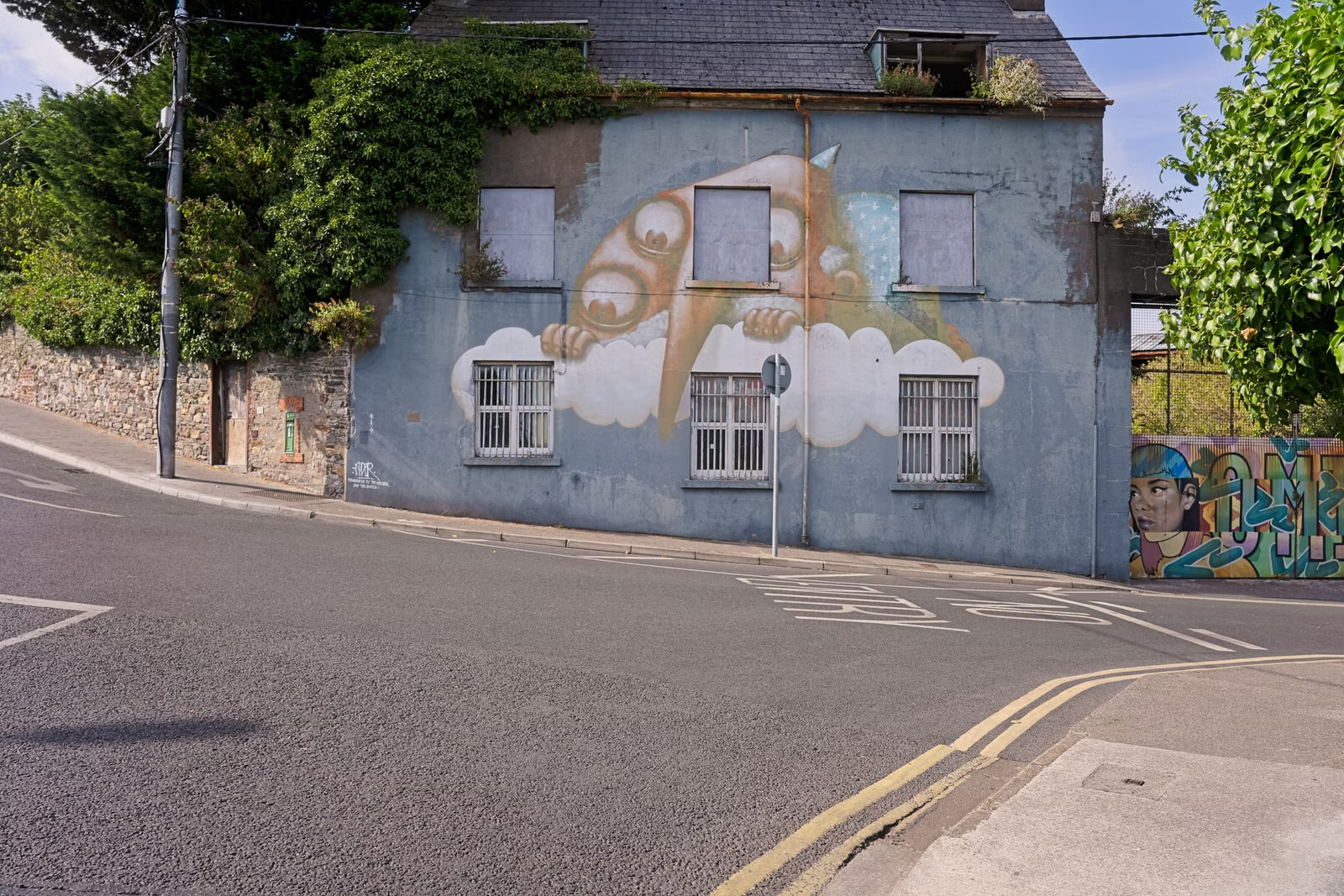
The Mural: Ador's The Cloud (2017)

Artist: Ador, the French street artist and illustrator based in Nantes. Piece: The Cloud, painted in August 2017 as part of that year's Waterford Walls programme. Details: The piece depicts his characteristic long-nosed, wide-eyed satirical creature reclining on a cloud across the blue-grey rendered gable, working around the security-grilled window apertures. To the right, through the open gateway into the garden footprint, is the portrait mural painted by Louise McKenna.

NEW STREET AS IT WAS IN JULY 2018

The Mural By Kashink

This is an official mural—or more precisely, the surviving wrap-around elements of one.
The Mural and Artist

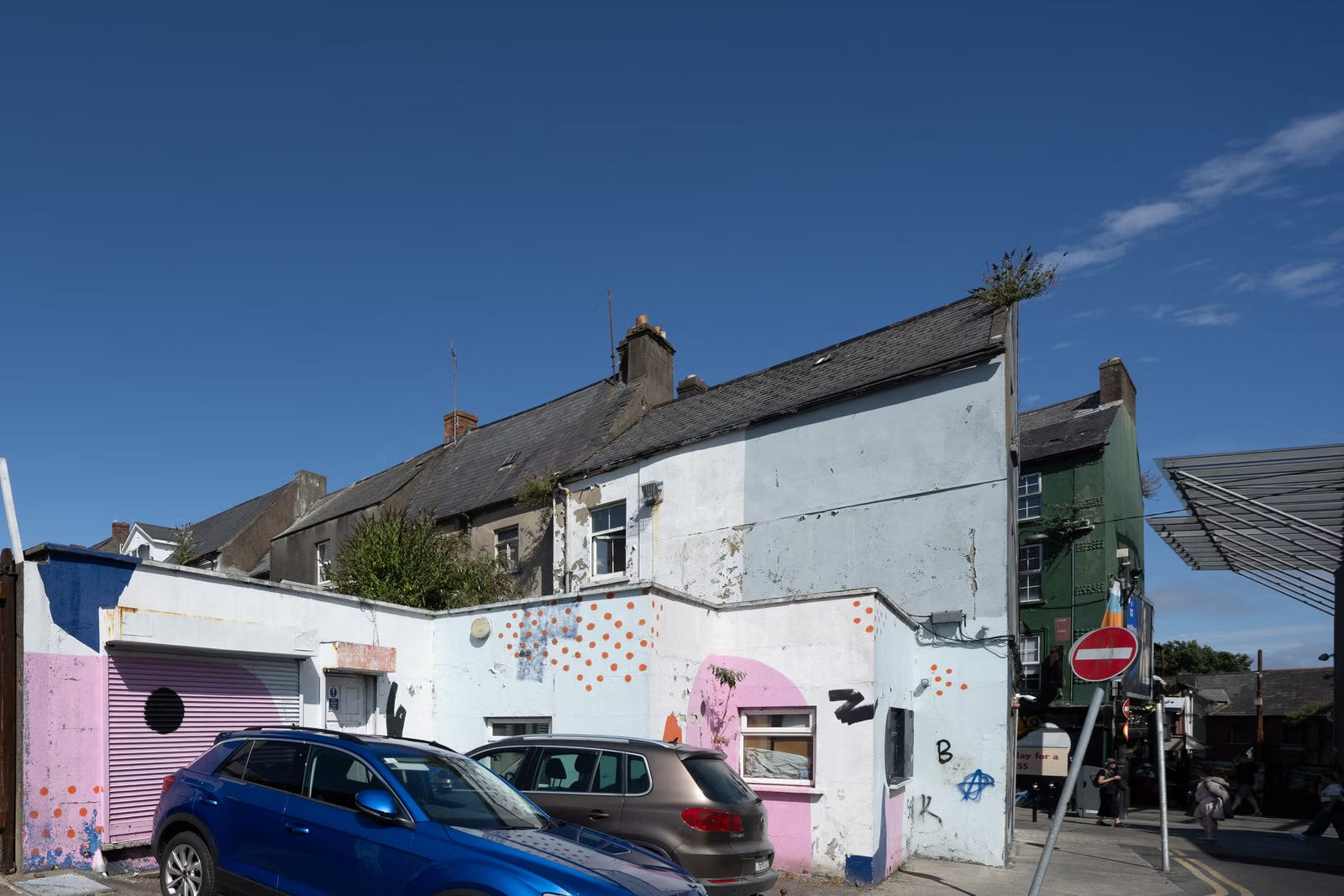
Artwork: Painted across the single-storey commercial/workshop building (including the roller shutter, rendered walls, and the return facing the street).   
 Artist: Created by French visual artist and graphic designer Kashink (or executed in collaboration with festival artists focusing on playful, bold, Memphis-inspired pop patterns) during a previous edition of Waterford Walls.
Style & Features: The piece uses vibrant pastel pinks, deep cobalt blues, geometric shapes, and repeating dotted cluster patterns that wrap around the corners, window frames, and roller shutter of the structure.   
 
Context on the Street
In your earlier photograph looking toward the Apple Market, you can see the side return of this exact same white-and-pink painted building on the left edge of the frame, right next to Fintan Magee's tall gable piece.   
 
While it lacks a towering vertical presence like the residential gables, treating lower-level utility structures, workshops, and roller shutters in this playful, decorative fashion has been a staple of the festival's effort to brighten neglected service laneways and mews yards off New Street and John Street.   
 

MY 2026 VISIT TO NEW STREET

CARRIGEEN PARK IN WATERFORD

A recent walk through Waterford led to an unexpected convergence of local folklore, medieval military architecture, and childhood memories from the northern coast of Donegal.

Tucked away off the main thoroughfares lies a quiet residential street known today as Carrigeen Park. During a brief stroll, I was approached by two welcoming, community-minded residents who pointed up beyond the rooftops and urged me to capture a photograph. From street level, clearly visible against the skyline, stood the stepped stone crown of one of Waterford’s surviving medieval towers.
Although an impromptu gathering of curious local children meant postponing the photography for another day, the encounter sparked two fascinating questions: Which tower watches over this corner of the city, and how did Carrigeen Park come to bear its name?

The two gentlemen told me that where they now live was originally known as Carrigeen Lane and were not at al pleased by the name change.

From ‘Lane’ to ‘Park’: The Evolution of Carrigeen

The two local residents who pointed out the tower were quite right about the street’s historic title. Historical maps, 19th-century valuation records, and early civil registers confirm that for generations the street was known as Carrigeen Lane (often split into Carrigeen Lane Upper and Carrigeen Lane Lower).

Lying within the historic parish of St Patrick, the lane directly flanked the western ramparts of the old Norman city. In the late 19th century (c. 1890), neat terraces of two-bay artisan worker cottages were constructed along its length. Over the course of 20th-century municipal renumbering and modern urban renewal, the street name evolved into Carrigeen Park (with deeds and local vernacular occasionally referring to Carrigeen Place).

This recent visit to Waterford paired with an excursion through my un-geotagged digital archives from 2021—prompted an unexpected convergence of urban topography, medieval military architecture, and childhood memories from the Donegal coast.

While retracing my steps around the western perimeter of the old walled city, I found myself revisiting two intimately connected thoroughfares: Thomas Hill and Carrigeen Park. Sifting through images from both visits, one dominant stone structure immediately provides the visual and historical anchor for the entire area: the formidable 15th-century Beach Tower.

The Anchor on the Slate: Beach Tower

Perched high on a natural outcrop of dark slate, Beach Tower is one of the most complete surviving mural towers along Waterford’s ancient defensive circuit.

Depending on where you stand, the tower presents two entirely different faces:

The High Ground (Thomas Hill): Approaching from the upper ridge along Thomas Hill brings you near the tower’s substantial stone foundations and the surviving line of the medieval ramparts. From here, early sentries held an commanding view looking out toward Granagh Castle and the winding River Suir.

The Low Vantage (Carrigeen Park): Standing below in Carrigeen Park, the perspective shifts dramatically upwards. The tower’s distinctive 15th-century Irish stepped battlements (crenellations) rise boldly above modern rooftops and chimneys—a sudden, striking glimpse of the Middle Ages framed by residential terraces.

Restored and conserved through the work of the Waterford Civic Trust in 1996, the tower bridges the two streetscapes both physically and historically.

High and Low: Connecting Thomas Hill & Carrigeen Lane

Though separated by a dramatic change in elevation, Thomas Hill and Carrigeen Park belong to the exact same geological and civic fabric.

WATERFORD WALLS 101 PHOTOGRAPHS

TWO MURALS BOTH BY SMUG

I used a Sony A7RII with a Voigtlander 15mm Lens


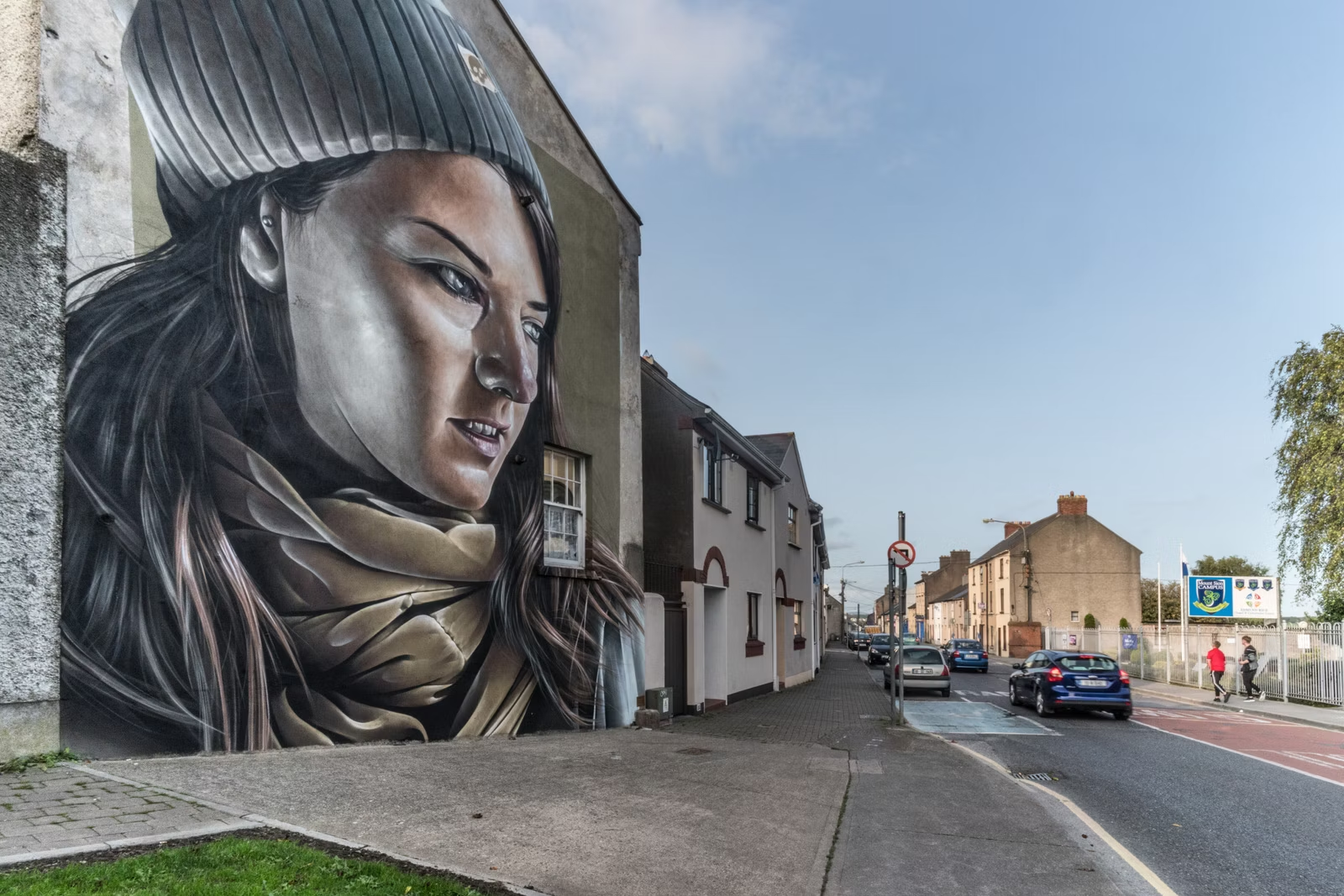
Both murals are by the same artist: the internationally renowned Australian street and graffiti artist Smug (also known as Smug One, born Sam Bates).
Both pieces were painted freehand using aerosol spray paint during the Waterford Walls International Street Art Festival in August 2016 (located in the Stephen Street / New Street area of Waterford city centre).

The female subject in the beanie and scarf is a portrait of Louise Flynn, who was a key curator and director for the Waterford Walls project.

The male portrait faces her just down the terrace/street, framed in the same distinctive rounded-rectangle backdrop over an exposed gable end wall.

About the Artist: Smug (Sam Bates)

Hailing originally from a small town south of Sydney, Australia, and later basing his studio practice in Glasgow, Scotland, Smug has established himself as one of the world's foremost practitioners of large-scale photorealistic and hyperrealistic street art.

Signature Technique and Style

100% Freehand Aerosol Control: Smug is celebrated in the urban art world for executing monumental, gallery-grade photorealism entirely freehand using standard spray cans—working without grids, stencils, or digital projectors even on multi-story facades.

Hyper-Detail & Textures: His control of can pressure and nozzle caps allows him to render micro-textures with extraordinary precision: individual hair strands, beard stubble, pores, fabric weave in knitted beanies, weathered skin, and reflections in the iris.

Play of Light and Subdued Palettes: As seen in both Waterford portraits, Smug frequently balances muted, naturalistic, desaturated tones (earthy greys, moss greens, and soft tans) against striking rim lighting and sharp highlights that give the figures immense sculptural depth against the building facades.

Architectural Integration: Rather than covering the entire brick or pebble-dashed surface indiscriminately, he frequently frames his portraits within clean, rounded "apertures" or pseudo-canvases that leave the surrounding masonry visible, respecting the architectural character of the host structure.

Everyday Characters & Empathy: While much of his broader portfolio features cheeky self-portraits, humorous vignettes, or local folklore, his human portraiture consistently captures warm, grounded, unpretentious people—often local residents, friends, or cultural peers—imbued with a quiet dignity and intense presence.
Across Ireland and the UK, Smug has painted several landmark works—including his famous St Mungo mural in Glasgow, various pieces across Belfast, and subsequent monumental works in Waterford (such as his massive facade at the former Crowne Plaza/Ard Rí site).

WATERFORD WALLS 101 PHOTOGRAPHS
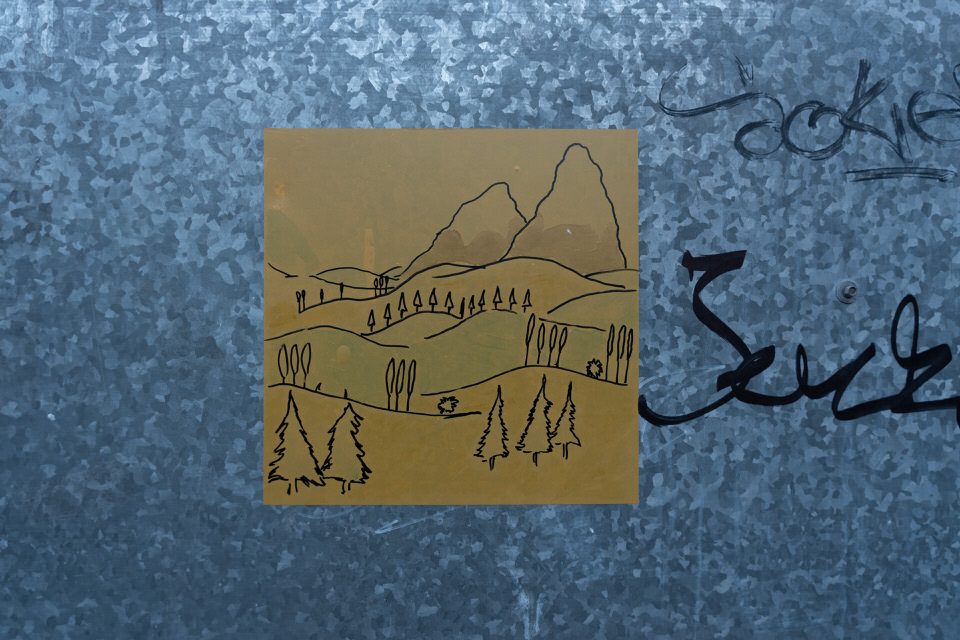
Affixed to a galvanised panel on Penrose Lane, this work is a piece of "slap-up" sticker art (or paste-up street tagging).   
 
The Artwork: Rendered in black fine-liner on a mustard-yellow adhesive square, it features a minimalist, stylised upland landscape. Rolling hills planted with rhythmic stands of pine and deciduous trees lead the eye towards a cleft, precipitous mountain ridge reminiscent of the Comeragh Mountains and the Coumshingaun coum in County Waterford.   

Street Art Culture: Hand-drawn labels and stickers of this kind are typically anonymous additions left by artists, illustrators, and passers-by engaged with Waterford’s vibrant urban art scene and events like the Waterford Walls festival. Placed alongside raw tags, they form a spontaneous, informal visual layer over the city's functional infrastructure.   


WATERFORD WALLS 101 PHOTOGRAPHS