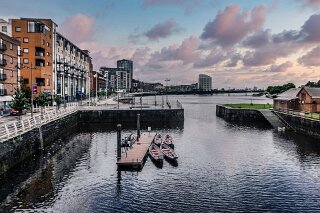
I PHOTOGRAPHED THE AREA DURING MY FIRST SOLO VISIT TO LIMERICK
SARSFIELD BRIDGE AND NEARBY [MY JUNE 2014 VISIT TO LIMERICK WHEN I BASED MYSELF AT THE PIER HOTEL]
I booked a room at the Pier Hotel in June 2014 expecting perfect summer weather and it rained most of the time and this constrained my activities and in general I was very disappointed. While June is often expected to bring the best of the early summer light, June 2014 was notoriously unsettled across Ireland, with frequent low-pressure systems pushing Atlantic fronts directly up the Shannon Estuary.
I used a Sony NEX-7 with a selection of three lenses: E 16mm F2.8, E 18-200mm F3.5 - 6.3 and E 30mm F3.5 Macro. The zoom was excellent and it was the kit lens supplied with the Sony Vg10E Camcorder.
When heavy rain settles over that part of the river, it changes the entire atmosphere around Sarsfield Bridge:
Atmospheric Tones: The wide expanse of the Shannon turns a heavy, dark slate-grey, and the wet, cut limestone balustrades and piers take on a deep, reflective charcoal sheen.
The Roofless Boat Club: Against that backdrop of persistent rain, the exposed, skeletal timber framing of the unroofed Limerick Boat Club would have looked particularly desolate and battered, standing starkly above the swollen tideway.
The Quays & Bridgehead: Standing outside the Pier Hotel or looking along Bishop’s Quay and Harvey’s Quay, the mist and driving drizzle often obscure the downstream views toward the docks, narrowing the visual focus right down to the sodden masonry of Alexander Nimmo’s arches and the churning water beneath.
Persistent drizzle and overcast skies certainly make exploring the quays a wetter endurance test, though the rain-slicked stonework and diffuse, low-contrast river light offer a very distinct, moody character.
Overview of Sarsfield Bridge and the Surrounding Area
Sarsfield Bridge is one of the most prominent architectural and transport landmarks spanning the River Shannon in Limerick city centre. Designed by the Scottish civil engineer Alexander Nimmo and opened in 1835 as the Wellesley Bridge (named after Richard Wellesley, 1st Marquess Wellesley), it was later renamed in honour of Patrick Sarsfield, the Irish Jacobite leader and Earl of Lucan.
Key Characteristics & Immediate Area
Engineering and Structure: The bridge consists of five elegant elliptical arches constructed from local cut limestone, along with an open balustrade and an operable swivel section at the southern end designed originally to allow masted sailing vessels into the upper docks and canal basin.
Monuments: At the centre of the bridge stands the 1916 War of Independence memorial, erected in the mid-20th century to replace an earlier monument to Viscount Fitzgibbon that was destroyed in 1930.
Immediate Environs:
Southern Bank (City Centre & Quays): Connects into Sarsfield Street, Bishop's Quay, and Howley's Quay, offering riverfront walkways, commercial buildings, and panoramic views upstream toward King John's Castle and Thomond Bridge.
Northern Bank (Ennis Road / Strand Barracks): Leads toward the Treaty Stone, Clancy's Strand, and the historic Strand Barracks.
Mid-River Activity: The bridge pier supports boathouses directly attached to its structure, anchoring Limerick's long-standing connection to competitive and recreational rowing.
The Pier Hotel & Limerick Boat Club in June 2014
The Pier Hotel: Situated directly at the bridgehead on Sarsfield Bridge and Bishop's Quay, staying here in June 2014 offered direct front-row vistas across the Shannon, the full span of the bridge, and the adjacent quays.
Limerick Boat Club
Limerick Boat Club Storm Damage: On 12 February 2014, Ireland was struck by Storm Darwin, which brought violent hurricane-force winds across Munster (with gusts exceeding 160 km/h recorded nearby at Shannon Airport). During the storm, the entire curved timber and metal roof was violently ripped off the Limerick Boat Club boathouse at Wellesley Pier.
State in June 2014: Following the disaster, video footage of the roof peeling away went viral globally. In June 2014—just four months after the storm—the club remained completely unroofed, exposed to the elements, and derelict, as initial cleanup, damage assessments, and the subsequent multi-year "Raise the Roof" restoration campaign were only in their infancy.
I booked a room at the Pier Hotel in June 2014 expecting perfect summer weather and it rained most of the time and this constrained my activities and in general I was very disappointed. While June is often expected to bring the best of the early summer light, June 2014 was notoriously unsettled across Ireland, with frequent low-pressure systems pushing Atlantic fronts directly up the Shannon Estuary.
I used a Sony NEX-7 with a selection of three lenses: E 16mm F2.8, E 18-200mm F3.5 - 6.3 and E 30mm F3.5 Macro. The zoom was excellent and it was the kit lens supplied with the Sony Vg10E Camcorder.
When heavy rain settles over that part of the river, it changes the entire atmosphere around Sarsfield Bridge:
Atmospheric Tones: The wide expanse of the Shannon turns a heavy, dark slate-grey, and the wet, cut limestone balustrades and piers take on a deep, reflective charcoal sheen.
The Roofless Boat Club: Against that backdrop of persistent rain, the exposed, skeletal timber framing of the unroofed Limerick Boat Club would have looked particularly desolate and battered, standing starkly above the swollen tideway.
The Quays & Bridgehead: Standing outside the Pier Hotel or looking along Bishop’s Quay and Harvey’s Quay, the mist and driving drizzle often obscure the downstream views toward the docks, narrowing the visual focus right down to the sodden masonry of Alexander Nimmo’s arches and the churning water beneath.
Persistent drizzle and overcast skies certainly make exploring the quays a wetter endurance test, though the rain-slicked stonework and diffuse, low-contrast river light offer a very distinct, moody character.
Overview of Sarsfield Bridge and the Surrounding Area
Sarsfield Bridge is one of the most prominent architectural and transport landmarks spanning the River Shannon in Limerick city centre. Designed by the Scottish civil engineer Alexander Nimmo and opened in 1835 as the Wellesley Bridge (named after Richard Wellesley, 1st Marquess Wellesley), it was later renamed in honour of Patrick Sarsfield, the Irish Jacobite leader and Earl of Lucan.
Key Characteristics & Immediate Area
Engineering and Structure: The bridge consists of five elegant elliptical arches constructed from local cut limestone, along with an open balustrade and an operable swivel section at the southern end designed originally to allow masted sailing vessels into the upper docks and canal basin.
Monuments: At the centre of the bridge stands the 1916 War of Independence memorial, erected in the mid-20th century to replace an earlier monument to Viscount Fitzgibbon that was destroyed in 1930.
Immediate Environs:
Southern Bank (City Centre & Quays): Connects into Sarsfield Street, Bishop's Quay, and Howley's Quay, offering riverfront walkways, commercial buildings, and panoramic views upstream toward King John's Castle and Thomond Bridge.
Northern Bank (Ennis Road / Strand Barracks): Leads toward the Treaty Stone, Clancy's Strand, and the historic Strand Barracks.
Mid-River Activity: The bridge pier supports boathouses directly attached to its structure, anchoring Limerick's long-standing connection to competitive and recreational rowing.
The Pier Hotel & Limerick Boat Club in June 2014
The Pier Hotel: Situated directly at the bridgehead on Sarsfield Bridge and Bishop's Quay, staying here in June 2014 offered direct front-row vistas across the Shannon, the full span of the bridge, and the adjacent quays.
Limerick Boat Club
Limerick Boat Club Storm Damage: On 12 February 2014, Ireland was struck by Storm Darwin, which brought violent hurricane-force winds across Munster (with gusts exceeding 160 km/h recorded nearby at Shannon Airport). During the storm, the entire curved timber and metal roof was violently ripped off the Limerick Boat Club boathouse at Wellesley Pier.
State in June 2014: Following the disaster, video footage of the roof peeling away went viral globally. In June 2014—just four months after the storm—the club remained completely unroofed, exposed to the elements, and derelict, as initial cleanup, damage assessments, and the subsequent multi-year "Raise the Roof" restoration campaign were only in their infancy.