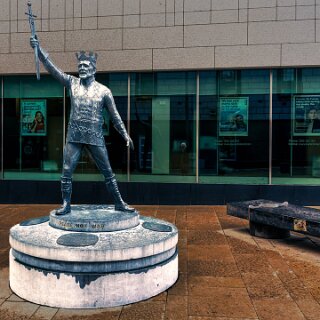
MY FIRST TIME TO PHOTOGRAPH THIS SCULPTURE IN LIMERICK
Richard Harris And The Other Public Statues Of Limerick
Limerick’s public figurative monuments have a notable history of generating spirited debate, where civic affection frequently collides with artistic interpretation. When a city holds cultural titans such as Terry Wogan, Anthony Foley, and Richard Harris in near-sacred regard, any public representation is scrutinised under an unforgiving lens.
My first photographic survey of Limerick took place in June 2014, operating out of the Pier Hotel on Shannon Street with a Sony NEX-7. The objective was straightforward: establish an empirical baseline of the city’s public sculpture and urban monuments to track visual and structural changes over the subsequent decades. Among the various figurative works catalogued across the city centre, Jim Connolly’s bronze tribute to Richard Harris on Bedford Row remains one of the most contentious.
Richard Harris on Bedford Row: The Actor and the Bronze
Unveiled in September 2007 by Mayor Ger Fahy, the life-size bronze monument by sculptor Jim Connolly portrays Richard Harris in the guise of King Arthur from the 1967 film adaptation of the musical Camelot. Positioned atop a circular limestone plinth inscribed with the words "PEACE NOT WAR", the figure stands with a broadsword held upright in front of him. Four bronze narrative relief panels wrap around the base, highlighting defining cinematic milestones across Harris’s long career.
The monument has divided local opinion since its unveiling. Many residents and visitors argue that encasing Harris in theatrical regal armour distances the viewer from the authentic, roguish Limerick native who remained fiercely proud of his working roots. Photographically, the facial modelling and rigid posture can appear static, struggling to convey the kinetic intensity, wit, and weathered charm of the actor’s real-life countenance.
The Life and Legacy of Richard Harris (1930–2002)
Early Years & Sporting Passion: Born on 1 October 1930 into a prominent flour-milling family on the Ennis Road, Richard St John Francis Harris was educated at Crescent College. A gifted rugby union player, he starred in Munster Junior and Senior Cup campaigns and turned out for Garryowen RFC before a severe bout of tuberculosis in his late teens cut his athletic ambitions short.
Dramatic Breakthrough: Turning to drama during his convalescence, Harris trained at the London Academy of Music and Dramatic Art (LAMDA). His breakthrough role as the brooding rugby league player Frank Machin in Lindsay Anderson’s This Sporting Life (1963) earned him the Best Actor Award at the Cannes Film Festival and his first Academy Award nomination.
Stardom and Versatility: Beyond cinema, he became an unlikely pop sensation with his dramatic 1968 recording of Jimmy Webb’s epic ballad MacArthur Park. In 1990, he delivered a legendary, Academy Award-nominated performance as the tragic patriarch 'Bull' McCabe in Jim Sheridan’s adaptation of John B. Keane’s The Field.
Later Career: Harris introduced himself to new generations of filmgoers as the philosophical Roman Emperor Marcus Aurelius in Ridley Scott’s Gladiator (2000) and as Headmaster Albus Dumbledore in the first two Harry Potter films before his death in London in October 2002.
The Sculptor: Jim Connolly and the Kilbaha Foundry
The sculptor behind the Bedford Row bronze, Jim Connolly, is a veteran Irish figurative artist who trained at the Limerick School of Art and Design. In the 1970s, Connolly established a dedicated bronze foundry on the Loop Head Peninsula in Kilbaha, County Clare.
Working alongside his son, sculptor Séamus Connolly, the Kilbaha Foundry has spent half a century specialising in the labour-intensive traditional lost-wax (cire perdue) casting method. This process allows the sculptor to translate hand-worked clay models directly into durable bronze while preserving fine textural detail.
Jim Connolly has produced numerous commemorative busts and national monuments celebrating Irish political, literary, and sporting figures. His output in County Clare and the Mid-West includes a second bronze of a youthful Richard Harris playing squash, erected at Kilkee in 2006 and unveiled by actor Russell Crowe.
Limerick Public Sculpture: The 2014 Visual Baseline
The 2014 survey established photographic records for a broad spectrum of civic monuments throughout the city:
The Dockers (Howley’s Quay): Sculpted by Mike Duhan and unveiled in 2003, this life-size bronze depicts two dockworkers hauling a heavy timber plank, honouring the generations of manual labourers who sustained Limerick's commercial river trade along the Shannon.
The Broken Heart Memorial (Steamboat Quay): Created by Maria Pizzuti as the winning entry in a 1996 design competition, this sculpture was unveiled on 21 May 1997 by Mayor Kieran O’Hanlon. Situated at the historic departure point where thousands boarded emigrant vessels during the Great Famine (1845–1849), the cleaved stone heart was originally engineered as an active water feature with integrated copper piping.
The Singer from Quimper (Harvey’s Quay / Shannon Riverside): Sculpted by Rowan Gillespie and unveiled in 1992, this bronze of an expressive woman with an upraised tambourine celebrates the civic twinning charter between Limerick and Quimper in Brittany. It sits on a circular engraved plinth, repositioned during the 2006 quayside redevelopments.
The Bard of Thomond / Michael Hogan (Sarsfield Bridge Approach): An expressive figurative bronze capturing the 19th-century poet seated with pen in hand, looking out over the Shannon.
Patrick Sarsfield Monument (Cathedral Place): John Lawlor’s classical 1881 bronze depicting the 17th-century defender of Limerick pointing his sword toward the city ramparts within the grounds of St John’s Cathedral.
Daniel O'Connell Monument (The Crescent): John Hogan’s 1857 statue of "The Liberator," standing over the Georgian southern approach to O’Connell Street.
The Treaty Stone (Clancy’s Strand): Positioned opposite King John’s Castle on a carved 1865 limestone pedestal, commemorating the 1691 Treaty of Limerick.
Tait’s Clock (Baker Place): The Victorian Gothic limestone clock tower and drinking fountain erected in 1867 to honour former Mayor Sir Peter Tait, pioneer of the local clothing factory industry.
Limerick’s public figurative monuments have a notable history of generating spirited debate, where civic affection frequently collides with artistic interpretation. When a city holds cultural titans such as Terry Wogan, Anthony Foley, and Richard Harris in near-sacred regard, any public representation is scrutinised under an unforgiving lens.
My first photographic survey of Limerick took place in June 2014, operating out of the Pier Hotel on Shannon Street with a Sony NEX-7. The objective was straightforward: establish an empirical baseline of the city’s public sculpture and urban monuments to track visual and structural changes over the subsequent decades. Among the various figurative works catalogued across the city centre, Jim Connolly’s bronze tribute to Richard Harris on Bedford Row remains one of the most contentious.
Richard Harris on Bedford Row: The Actor and the Bronze
Unveiled in September 2007 by Mayor Ger Fahy, the life-size bronze monument by sculptor Jim Connolly portrays Richard Harris in the guise of King Arthur from the 1967 film adaptation of the musical Camelot. Positioned atop a circular limestone plinth inscribed with the words "PEACE NOT WAR", the figure stands with a broadsword held upright in front of him. Four bronze narrative relief panels wrap around the base, highlighting defining cinematic milestones across Harris’s long career.
The monument has divided local opinion since its unveiling. Many residents and visitors argue that encasing Harris in theatrical regal armour distances the viewer from the authentic, roguish Limerick native who remained fiercely proud of his working roots. Photographically, the facial modelling and rigid posture can appear static, struggling to convey the kinetic intensity, wit, and weathered charm of the actor’s real-life countenance.
The Life and Legacy of Richard Harris (1930–2002)
Early Years & Sporting Passion: Born on 1 October 1930 into a prominent flour-milling family on the Ennis Road, Richard St John Francis Harris was educated at Crescent College. A gifted rugby union player, he starred in Munster Junior and Senior Cup campaigns and turned out for Garryowen RFC before a severe bout of tuberculosis in his late teens cut his athletic ambitions short.
Dramatic Breakthrough: Turning to drama during his convalescence, Harris trained at the London Academy of Music and Dramatic Art (LAMDA). His breakthrough role as the brooding rugby league player Frank Machin in Lindsay Anderson’s This Sporting Life (1963) earned him the Best Actor Award at the Cannes Film Festival and his first Academy Award nomination.
Stardom and Versatility: Beyond cinema, he became an unlikely pop sensation with his dramatic 1968 recording of Jimmy Webb’s epic ballad MacArthur Park. In 1990, he delivered a legendary, Academy Award-nominated performance as the tragic patriarch 'Bull' McCabe in Jim Sheridan’s adaptation of John B. Keane’s The Field.
Later Career: Harris introduced himself to new generations of filmgoers as the philosophical Roman Emperor Marcus Aurelius in Ridley Scott’s Gladiator (2000) and as Headmaster Albus Dumbledore in the first two Harry Potter films before his death in London in October 2002.
The Sculptor: Jim Connolly and the Kilbaha Foundry
The sculptor behind the Bedford Row bronze, Jim Connolly, is a veteran Irish figurative artist who trained at the Limerick School of Art and Design. In the 1970s, Connolly established a dedicated bronze foundry on the Loop Head Peninsula in Kilbaha, County Clare.
Working alongside his son, sculptor Séamus Connolly, the Kilbaha Foundry has spent half a century specialising in the labour-intensive traditional lost-wax (cire perdue) casting method. This process allows the sculptor to translate hand-worked clay models directly into durable bronze while preserving fine textural detail.
Jim Connolly has produced numerous commemorative busts and national monuments celebrating Irish political, literary, and sporting figures. His output in County Clare and the Mid-West includes a second bronze of a youthful Richard Harris playing squash, erected at Kilkee in 2006 and unveiled by actor Russell Crowe.
Limerick Public Sculpture: The 2014 Visual Baseline
The 2014 survey established photographic records for a broad spectrum of civic monuments throughout the city:
The Dockers (Howley’s Quay): Sculpted by Mike Duhan and unveiled in 2003, this life-size bronze depicts two dockworkers hauling a heavy timber plank, honouring the generations of manual labourers who sustained Limerick's commercial river trade along the Shannon.
The Broken Heart Memorial (Steamboat Quay): Created by Maria Pizzuti as the winning entry in a 1996 design competition, this sculpture was unveiled on 21 May 1997 by Mayor Kieran O’Hanlon. Situated at the historic departure point where thousands boarded emigrant vessels during the Great Famine (1845–1849), the cleaved stone heart was originally engineered as an active water feature with integrated copper piping.
The Singer from Quimper (Harvey’s Quay / Shannon Riverside): Sculpted by Rowan Gillespie and unveiled in 1992, this bronze of an expressive woman with an upraised tambourine celebrates the civic twinning charter between Limerick and Quimper in Brittany. It sits on a circular engraved plinth, repositioned during the 2006 quayside redevelopments.
The Bard of Thomond / Michael Hogan (Sarsfield Bridge Approach): An expressive figurative bronze capturing the 19th-century poet seated with pen in hand, looking out over the Shannon.
Patrick Sarsfield Monument (Cathedral Place): John Lawlor’s classical 1881 bronze depicting the 17th-century defender of Limerick pointing his sword toward the city ramparts within the grounds of St John’s Cathedral.
Daniel O'Connell Monument (The Crescent): John Hogan’s 1857 statue of "The Liberator," standing over the Georgian southern approach to O’Connell Street.
The Treaty Stone (Clancy’s Strand): Positioned opposite King John’s Castle on a carved 1865 limestone pedestal, commemorating the 1691 Treaty of Limerick.
Tait’s Clock (Baker Place): The Victorian Gothic limestone clock tower and drinking fountain erected in 1867 to honour former Mayor Sir Peter Tait, pioneer of the local clothing factory industry.