CLARE STREET PUBLIC PARK
CLARE STREET PUBLIC PARK IN LIMERICK [TERENCE O'BRIEN PARK]
O'Brien's Park—officially Terence Albert O'Brien Park and frequently referred to by locals simply as Clare Street Park—is a historic public park situated along Clare Street in Limerick, directly opposite the Technological University of the Shannon (TUS) Limerick School of Art and Design.
History and Origins
The park is dedicated to Blessed Terence Albert O'Brien (1600–1651), the Dominican Bishop of Emly who was executed following the Cromwellian Siege of Limerick in 1651. Developed and opened to the public in the 1940s, it provided a designated civic green space for the eastern approaches of the city. While its commemorative title honours the 17th-century martyr, its location along Clare Street led generations of Limerick residents to know it informally as Clare Street Park.
The Main Arch Entrance Not As Old As Some Believe It To Be
The entrance on Clare Street features a freestanding gateway constructed around 1940.
Architectural Style: Designed in the form of a classical Roman triumphal arch, the structure was cast in concrete textured to resemble ashlar stone masonry.
Layout: It employs a tripartite configuration—a tall central round-headed vehicular arch flanked by lower pedestrian portals crowned with classical entablatures and steel gates.
Design Precedent: The composition intentionally echoes the 19th-century John Russell memorial gates at Limerick's People's Park on Pery Square, creating a grand civic gateway within an urban streetscape.
The Victorian Industrial Fountain
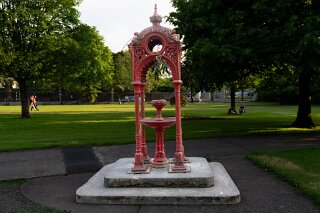
The park houses an elaborate 19th-century cast-iron drinking fountain with an industrial heritage.
Factory Origins: Contrary to the assumption that it was designed as an open-air public monument, the fountain was originally erected in 1866 inside the Tait Clothing Factory (later the Limerick Clothing Factory) on Lord Edward Street.
Peter Tait's Commission: It was commissioned by industrialist and three-time Mayor of Limerick, Sir Peter Tait, to supply fresh drinking water to his vast factory workforce.
Foundry Details: Manufactured by Walter Macfarlane & Co. at the Saracen Foundry in Glasgow (Design No. 8), the canopy structure stands over nine feet high on four ornate columns.
Inscriptions and Emblems: It features filigree arches, griffins, biblical scriptural roundels (St. John 4:14), the Tait family crest with the motto Gratiam dat Deus, and the practical instruction "Keep The Pavement Dry". When the factory was reorganised in the 20th century, the fountain was salvaged as a heritage artefact and re-erected in the park.
The Bandstand and Canal Walkway Entrance
Towards the centre of the grounds stands an open-sided pavilion and shelter. Built with a raised plinth and conical roof, it serves both as an all-weather shelter and as a traditional bandstand platform for local community performances and seasonal gatherings.
Canal and River Access: In addition to the formal Clare Street entrance, the rear of the park provides direct pedestrian access to the Park Canal towpath. This secondary entrance links the park directly into the shared walking and cycling greenway that runs alongside the canal, connecting the city centre downstream to the River Shannon and upstream towards the University of Limerick (UL) riverside walkway.
Sir Peter Tait and the Limerick Clothing Factory
Sir Peter Tait (1828–1890), a native of Lerwick in the Shetland Islands, arrived in Limerick in the 1840s as an employee of Cannock & White (later Cannock's department store). Demonstrating an exceptional entrepreneurial drive, he revolutionised garment manufacturing by pioneering the factory-scale application of steam-powered sewing machines and the division of labour.
Mass-Production Innovation: Tait established the Limerick Clothing Factory on Lord Edward Street in 1853. By reorganising garment assembly into sequential, specialised tasks and mechanising cutting and stitching, he turned Limerick into one of the largest uniform manufacturing centres in the world.
Global Military Contracts: Tait secured major military uniform contracts for the British Army during the Crimean War (1853–1856), outfitting tens of thousands of soldiers in record time. During the American Civil War (1861–1865), he became a primary supplier of grey woollen uniforms, jackets, trousers, and overcoats to the Confederate States Army, running blockades into Southern ports via Bermuda and Nassau.
Civic Role: Tait served three consecutive terms as Mayor of Limerick (1866–1868) and was knighted in 1868.
Worker Welfare & Factory Artefacts: At its height, the factory employed well over 1,000 workers—predominantly local women. Tait introduced welfare innovations, such as providing clean on-site drinking water via the ornate Walter Macfarlane cast-iron fountain erected in 1866 (now preserved in O'Brien's Park).
Victorian Cast-Iron Heritage in Limerick
During the 19th and early 20th centuries, cast iron became a defining structural and decorative medium in Limerick, supplied both by local foundries and renowned Scottish ironworks.
Tait’s Clock
Erected in Baker Place in 1867 to honour Sir Peter Tait's services to the city, the monument was funded by public subscription and contributions from his factory workforce. Designed by architect William Fogerty, it combines cut limestone with decorative metalwork and four clock dials.
People's Park
Limerick’s premier Victorian public park contains some of the city's finest architectural ironwork:
The Bandstand: A 19th-century cast-iron bandstand featuring decorative brackets, slender fluted columns, and iron railings, originally produced by Walter Macfarlane & Co.
Drinking Fountains & Gates: Elaborate perimeter railings and entrance gates, along with historic ornamental ironwork, frame the park entrance opposite Pery Square.
Civic Bridges and River Railings
Sarsfield Bridge
Opened as Wellesley Bridge in 1835, it features swivel-bridge mechanisms and decorative cast-iron parapet balustrades along the River Shannon.
Mathew Bridge
Mathew Bridge: Spanning the Abbey River, the bridge incorporates classical cast-iron lamp standards and heavy decorative balustrading dating from the mid-19th century.
Local Foundries
While high-end civic canopies and fountains were frequently commissioned from Glasgow (such as the Saracen Foundry and Sun Foundry), Limerick had an active domestic iron-founding industry. Foundries such as the Shannon Foundry and City Foundry produced utilitarian street ironwork, drainage grates, coal-hole covers, decorative balcony railings, and boot scrapers that remain visible across the Georgian streetscapes of Newtown Pery.
O'Brien's Park—officially Terence Albert O'Brien Park and frequently referred to by locals simply as Clare Street Park—is a historic public park situated along Clare Street in Limerick, directly opposite the Technological University of the Shannon (TUS) Limerick School of Art and Design.
History and Origins
The park is dedicated to Blessed Terence Albert O'Brien (1600–1651), the Dominican Bishop of Emly who was executed following the Cromwellian Siege of Limerick in 1651. Developed and opened to the public in the 1940s, it provided a designated civic green space for the eastern approaches of the city. While its commemorative title honours the 17th-century martyr, its location along Clare Street led generations of Limerick residents to know it informally as Clare Street Park.
The Main Arch Entrance Not As Old As Some Believe It To Be
The entrance on Clare Street features a freestanding gateway constructed around 1940.
Architectural Style: Designed in the form of a classical Roman triumphal arch, the structure was cast in concrete textured to resemble ashlar stone masonry.
Layout: It employs a tripartite configuration—a tall central round-headed vehicular arch flanked by lower pedestrian portals crowned with classical entablatures and steel gates.
Design Precedent: The composition intentionally echoes the 19th-century John Russell memorial gates at Limerick's People's Park on Pery Square, creating a grand civic gateway within an urban streetscape.
The Victorian Industrial Fountain
The park houses an elaborate 19th-century cast-iron drinking fountain with an industrial heritage.
Factory Origins: Contrary to the assumption that it was designed as an open-air public monument, the fountain was originally erected in 1866 inside the Tait Clothing Factory (later the Limerick Clothing Factory) on Lord Edward Street.
Peter Tait's Commission: It was commissioned by industrialist and three-time Mayor of Limerick, Sir Peter Tait, to supply fresh drinking water to his vast factory workforce.
Foundry Details: Manufactured by Walter Macfarlane & Co. at the Saracen Foundry in Glasgow (Design No. 8), the canopy structure stands over nine feet high on four ornate columns.
Inscriptions and Emblems: It features filigree arches, griffins, biblical scriptural roundels (St. John 4:14), the Tait family crest with the motto Gratiam dat Deus, and the practical instruction "Keep The Pavement Dry". When the factory was reorganised in the 20th century, the fountain was salvaged as a heritage artefact and re-erected in the park.
The Bandstand and Canal Walkway Entrance
Towards the centre of the grounds stands an open-sided pavilion and shelter. Built with a raised plinth and conical roof, it serves both as an all-weather shelter and as a traditional bandstand platform for local community performances and seasonal gatherings.
Canal and River Access: In addition to the formal Clare Street entrance, the rear of the park provides direct pedestrian access to the Park Canal towpath. This secondary entrance links the park directly into the shared walking and cycling greenway that runs alongside the canal, connecting the city centre downstream to the River Shannon and upstream towards the University of Limerick (UL) riverside walkway.
Sir Peter Tait and the Limerick Clothing Factory
Sir Peter Tait (1828–1890), a native of Lerwick in the Shetland Islands, arrived in Limerick in the 1840s as an employee of Cannock & White (later Cannock's department store). Demonstrating an exceptional entrepreneurial drive, he revolutionised garment manufacturing by pioneering the factory-scale application of steam-powered sewing machines and the division of labour.
Mass-Production Innovation: Tait established the Limerick Clothing Factory on Lord Edward Street in 1853. By reorganising garment assembly into sequential, specialised tasks and mechanising cutting and stitching, he turned Limerick into one of the largest uniform manufacturing centres in the world.
Global Military Contracts: Tait secured major military uniform contracts for the British Army during the Crimean War (1853–1856), outfitting tens of thousands of soldiers in record time. During the American Civil War (1861–1865), he became a primary supplier of grey woollen uniforms, jackets, trousers, and overcoats to the Confederate States Army, running blockades into Southern ports via Bermuda and Nassau.
Civic Role: Tait served three consecutive terms as Mayor of Limerick (1866–1868) and was knighted in 1868.
Worker Welfare & Factory Artefacts: At its height, the factory employed well over 1,000 workers—predominantly local women. Tait introduced welfare innovations, such as providing clean on-site drinking water via the ornate Walter Macfarlane cast-iron fountain erected in 1866 (now preserved in O'Brien's Park).
Victorian Cast-Iron Heritage in Limerick
During the 19th and early 20th centuries, cast iron became a defining structural and decorative medium in Limerick, supplied both by local foundries and renowned Scottish ironworks.
Tait’s Clock
Erected in Baker Place in 1867 to honour Sir Peter Tait's services to the city, the monument was funded by public subscription and contributions from his factory workforce. Designed by architect William Fogerty, it combines cut limestone with decorative metalwork and four clock dials.
People's Park
Limerick’s premier Victorian public park contains some of the city's finest architectural ironwork:
The Bandstand: A 19th-century cast-iron bandstand featuring decorative brackets, slender fluted columns, and iron railings, originally produced by Walter Macfarlane & Co.
Drinking Fountains & Gates: Elaborate perimeter railings and entrance gates, along with historic ornamental ironwork, frame the park entrance opposite Pery Square.
Civic Bridges and River Railings
Sarsfield Bridge
Opened as Wellesley Bridge in 1835, it features swivel-bridge mechanisms and decorative cast-iron parapet balustrades along the River Shannon.
Mathew Bridge
Mathew Bridge: Spanning the Abbey River, the bridge incorporates classical cast-iron lamp standards and heavy decorative balustrading dating from the mid-19th century.
Local Foundries
While high-end civic canopies and fountains were frequently commissioned from Glasgow (such as the Saracen Foundry and Sun Foundry), Limerick had an active domestic iron-founding industry. Foundries such as the Shannon Foundry and City Foundry produced utilitarian street ironwork, drainage grates, coal-hole covers, decorative balcony railings, and boot scrapers that remain visible across the Georgian streetscapes of Newtown Pery.