TWO VISITS 2025 AND 2026
THE LEGACY CATALOG
* In The Year 2008
* In The Year 2011
* In The Year 2017
* Henrietta Back In 2010
My Two Visits To Sion Row
Sion Row: The Transformation of Ferrybank’s Historic Quayside Cottages
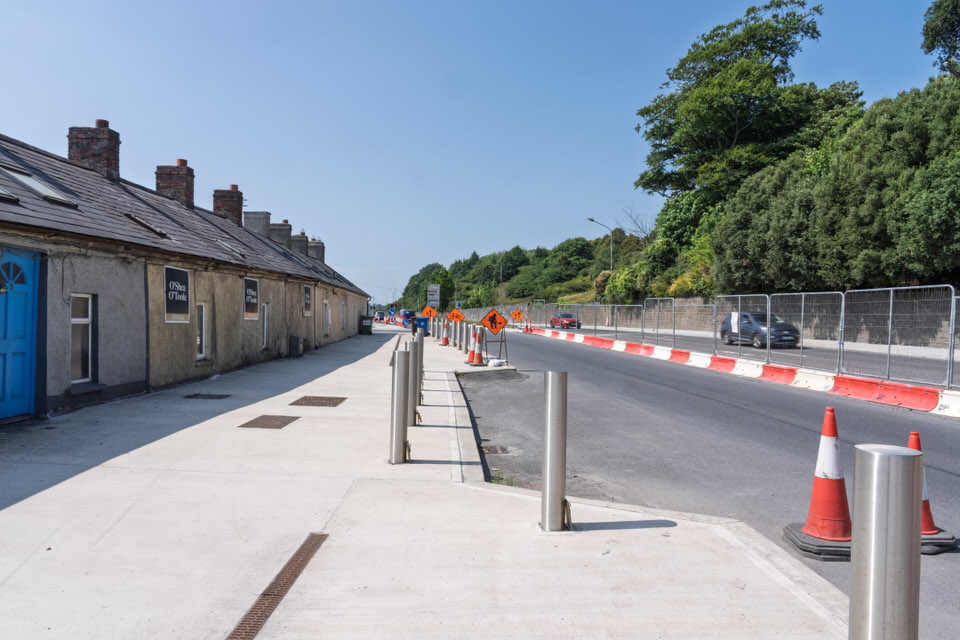
- Positioned directly along Dock Road (R711) in Ferrybank, the distinctive single-storey terrace known as Sion Row (Nos. 1–10) stands as one of the few surviving historical residential streetscapes on Waterford’s North Quays.
Industrial Origins & Typology
- Dating from the nineteenth century, the row was originally erected to house quayside labourers, dockers, and railway workers serving the thriving North Wharf commercial docks, shipyards, and nearby rail yards. While popular vernacular often mistakenly applies the blanket term "artisan dwelling"—a label specifically derived from commercial philanthropic bodies like the Dublin Artisans' Dwellings Company (DADC)—Sion Row is a genuine speculatively built working-class terrace of dock cottages.
Decades of Decline & Remarkable Market Lows
-
As the industrial activities along the North Quays waned during the late twentieth century, Sion Row faced severe neglect, vacancies, and compounding dereliction. The true extent of this decline is reflected in the official Property Price Register during the post-2008 economic crash and early SDZ planning phases, where properties changed hands for nominal sums:
-
November 2014: No. 5 Lower Sion Row sold for a mere €7,000.
-
July 2015: No. 4 Sion Row changed hands for €30,000.
-
December 2015: No. 9 Sion Row sold for €25,000.
Regeneration & Current Integration
-
With the formal designation of the Waterford North Quays Strategic Development Zone (SDZ) and direct state backing through the Urban Regeneration and Development Fund (URDF), the fate of the terrace reversed. Rather than facing demolition, the row has undergone comprehensive structural refurbishment.
-
Visible across the terrace today are newly re-pitched slate roofs, integrated rooflights, renewed brick chimneys, and updated fenestration. Concurrently, major road realignment and public realm works executed by BAM and the local authority have installed widened, accessible pavements, stainless steel pedestrian safety bollards, and low retaining walls to accommodate the modified road gradient.
-
The financial realignment followed swiftly: No. 9 resold for €88,000 in 2018, No. 1 and No. 2 reached €150,000 and €156,000 respectively in 2022, and No. 1 achieved €170,000 in 2023.
-
Future Role at the City Gateway
-
Once isolated beside a heavy industrial transport corridor, Sion Row now directly overlooks the entry plaza to the new multi-modal Public Transport Hub and the landing span of the Sustainable Transport Bridge across the River Suir. The retained cottages serve as a crucial visual link between Ferrybank’s working-class maritime heritage and Waterford’s modernised transit infrastructure.
About Artisan Dwellings
The term originates with the Dublin Artisans' Dwellings Company (DADC), a semi-philanthropic commercial housing enterprise founded in 1876 by figures including Sir William Findlater and the Guinness family.
The Origin vs. Common Usage
The Specific Company: The DADC specifically constructed planned housing schemes across Dublin (and later ventures like the Thomond Artisan's Dwellings Company elsewhere) aimed at regularly employed tradesmen, artisans, and police officers.
Genericized Label: Over time, estate agents and the general public genericized the term "artisan dwelling" or "artisan cottage" as a blanket catch-all for almost any Victorian or Edwardian compact, single-storey or two-storey brick/stone terraced cottage.
True Typology for Sion Row: Rows like Sion Row in Waterford were not built by an artisan dwelling company, but were instead speculative single-storey dockers', railway workers', and quay labourers' cottages built to serve the riverside wharves and rail yards.
They were almost certainly private rental properties leased to workers on weekly tenancies, rather than company-provided "tied" housing or owner-occupied homes.
Tenure & Ownership Model
Private Landlordism / Speculative Investment: In nineteenth-century Ireland, speculative housing of this scale was typically financed by local merchants, builders, or landholders who acquired ground leases along expanding transport corridors. These investors built rows of simple dwellings to generate recurring rental yields from the influx of casual and semi-skilled labourers.
Absence of Tied / Company Housing: Unlike the industrial model villages in the UK (such as Saltaire or Port Sunlight) or specific railway company towns (like the Great Southern and Western Railway’s purpose-built estate at Inchicore in Dublin), dock and railway employers on Waterford's North Wharf rarely built dedicated housing portfolios for casual quay labour. Dockers were hired on a daily or casual "calling-on" basis, meaning shipping companies took no responsibility for their permanent shelter.
Weekly Tenancies: The occupants—ranging from dockers, carters, and coal-heavers to mariners, ferrymen, and railway porters—paid weekly rents. Tenancies could be precarious, fluctuating with the volume of river shipping and seasonal agricultural exports passing through the port.
Rarity of Early Owner-Occupation: Working-class homeownership was virtually non-existent in urban Ireland during the 1800s and early 1900s. Dockers and railway hands earned weekly wages that left no margin for capital accumulation or commercial mortgages.
The Prevalence Of "Sion" In Waterford Placenames
The prevalence of "Sion" in Waterford placenames stems from two distinct historical influences: the local geography of the Ferrybank bluffs and the city's prominent religious history.
Sion Hill & The Ferrybank Estate
Sion Hill House & Demesne: Directly rising behind Dock Road and the North Quays is the prominent elevated ridge known as Sion Hill. In the 18th and early 19th centuries, it was the demesne of the Pope family—a wealthy merchant shipping dynasty who built Sion Hill House (c. 1820) overlooking the River Suir.
Quayside Spin-Offs: As the quays developed below the hill, features along the waterfront took their name from the overlooking estate, resulting in Sion Row (the cottages at the bottom of the slope) and Lower Sion Row.
Mount Sion & Edmund Rice
Mount Sion (Barrack Street): On the south side of the river, the name has deep religious roots. In 1802–1803, when Blessed Edmund Rice founded the first school and monastery of the Christian Brothers at Barrack Street, the elevated site overlooking the medieval city was named Mount Sion (the biblical spelling often anglicised as Sion rather than Zion).
Cultural Legacy: Bishop Thomas Hussey named the grounds because the high view across Waterford reminded him of Mount Zion overlooking Jerusalem. This cemented "Mount Sion" as one of the most famous cultural and sporting names in the city, encompassing Mount Sion CBS, the monastery, and the celebrated Mount Sion GAA Club.
Topographical Convention
Naming prominent, elevated hills and grand Georgian/Regency estates after biblical heights like Mount Sion or Mount Pisgah was a common convention among 18th- and 19th-century Irish planners and landed gentry to evoke dignity and commanding views. Between the northern river bluffs in Ferrybank and Edmund Rice’s foundation on the southern heights, the name became permanently woven into both banks of Waterford.
Many Of The Murals Were Incomplete When I Left Waterford
As many of the murals were incomplete when I left Waterford at 11am Friday morning I will not be able to photograph the completed works until August 2027 however I photographed the artists in action and actually got to speak with some of the artists. Another issue that I had was that I visited an number of sites where old artwork remained until Thursday.
My stay In Waterford was dictated by hotel room availability which meant that I had choices to make. The event started 7th August with the 16th being the final day but I could get accommodation for four nights Monday to Friday morning. As a back up I had a booking for the last week in August but there were issues as Booking.Com had been hacked and I was receiving constant emails claiming that my booking was about to be cancelled. Now that I am in a position to review my visit to Waterford a later visit could well have been a better option - when I visited earlier festivals there was a buzz to being there during the creation phase but that buzz was lacking this year.
In the past this was not a problem but this year there was a major problem is that in general many of the murals were very much incomplete when I left Waterford on Friday morning - so what I photographed were works in progress. As already mentioned some Artists did not begin their projects until Wednesday or Thursday however some completed their project within 24 hours.
By late Wednesday I was getting worried as almost every large mural looked somewhat similar and the situation had not really improved by late Thursday.
Before any actual artwork takes shape, artists coat their primed wall in random spray-painted squiggles, numbers, loops, and doodles.
When walking the city as a photographer during these early phases, every single location looks like the same chaotic tag-job because they are all using the exact same workflow:
-
The Scribble Phase: The artist sprays random, dense shapes over the blank wall.
-
The Overlay: They step back, photograph the scribbled wall on a phone or iPad, and overlay their pre-designed digital sketch (usually in Procreate or Photoshop) at 50% opacity over the photo.
-
The Map: Each random loop or symbol becomes a precise reference point. Where a line in their sketch crosses a specific squiggle on screen, they map that exact intersection on the physical wall.
Why It Has Replaced Older Methods
-
Until a few years ago, artists relied on measured geometric chalk grids, paper pounce wheels, or nighttime projectors:
-
Projectors don't work in daytime light or tight alleys, and require heavy gear.
-
Chalk grids require tape measures, spirit levels, and hours of tedious geometric scaling.
-
The Scribble Grid takes 10 minutes to spray, works on any irregular surface (even brick recesses or corrugated metal), and allows high-precision scaling regardless of wall scale.
The Photographic Dilemma
- From a street photographer's perspective, this initial stage lacks stylistic variety because the underlying mechanic is identical everywhere.
However, as soon as artists begin blocking in their base colours and laying down outlines over the next 24 to 48 hours, those scribbles will disappear under solid paint layers, and the individual visual identity of each piece will finally emerge. The problem being that I was not there to see the final artwork
International Artists
Zabou (France)
- Style & Career: Based in London, Zabou is internationally renowned for her striking, high-contrast figurative realism. She uses spray paint to blend portraits of real, expressive humans with bold color fields and graphic components.
- Key Visuals: Highly detailed portraits featuring dramatic side-lighting and emotional intensity.
VILE (Portugal)
- Style & Career: Rodrigo Miguel (VILE) is famous for his mind-bending 3D transparent/cut-out graffiti technique. Using precise shading, stencil work, and perspective tricks, he renders his name as if it were carved directly through solid concrete walls, revealing the empty background space behind them.
TELMO MIEL (Netherlands)
- Style & Career: The artistic duo Telmo Pieper and Miel Krutzmann are globally celebrated for their large-scale surrealist photo-realism. They fuse layered imagery, overlapping human forms, and dreamlike elements into a single cohesive piece.
MR CENZ (UK)
- Style & Career: A staple of the London street scene since 1988, Mr Cenz creates distinctive futuristic female portraits. His signature aesthetic blends classic graffiti lettering, photorealistic faces, neon hues, and abstract translucent flow-lines.
MR.DHEO (Portugal)
- Style & Career: Self-taught artist known for hyper-realistic narrative portraiture. His work often tackles political commentary, pop culture, and social critique with crisp lines and dramatic contrasts.
Fintan Magee (Australia)
- Style & Career: Frequently referred to as "the Australian Banksy," Magee is a world-class muralist whose work explores social issues, climate change, migration, and the working class.
- Key Visuals: Large, painterly figures rendered with soft light, atmospheric texture, and water reflections.
Dan Kitchener / DANK (UK)
- Style & Career: DANK is legendary for his atmospheric cinematic street scenes, particularly rainy, neon-soaked nightscapes of Tokyo, Hong Kong, and London.
- Key Visuals: Wet pavement reflections, glowing light blurs, and dramatic rain effects rendered with incredible speed using spray paint.
L7MATRIX (France/Brazil)
- Style & Career: Known for combining raw graffiti lettering with fine-art realism. His most famous subjects are hyper-vibrant, exploding birds and animals that seem to dissolve into dynamic splatters, lines, and movement.
Fio Silva (Argentina)
- Style & Career: Dynamic, organic murals featuring wild birds, flora, and fauna. Her style relies on heavy black line work, bold color blocking, and sweeping lines that flow along the architecture of the wall.
DAN FERRER (Spain)
- Style & Career: Ferrer’s work blends figurative realism with allegory and childhood symbolism. He often depicts larger-than-life children breaking through limitations or exploring dream worlds.
CONSE (Spain)
- Style & Career: Master of hyper-realism and portraiture. He focuses heavily on capturing subtle skin textures, deep expressions, and intimate human moments on massive scales.
SPEKER (Italy) & SILYME (Italy)
- Style & Career: Traditional graffiti writers turned muralists who specialize in technical wildstyle lettering, sharp geometric angles, dynamic color gradients, and complex letter construction.
NOL (Netherlands)
- Style & Career: Distinctive for his whimsical, retro-cartoon character designs. NOL uses bold black outlines, playful narrative themes, and bright primary colors.
ADOR (France)
- Style & Career: Illustrative, satirical, and story-driven. ADOR creates imaginary worlds populated by quirky, long-nosed humanoid characters engaged in chaotic or humorous scenarios.
KMG (Scotland)
- Style & Career: Illustrative street artist known for her cheeky, humorous, and bold character-based work that frequently pokes fun at modern society and pop culture.
WRN (Brazil) & MARIE (Brazil)
- Style & Career: Bringing South American tropical street aesthetics, rich patterns, and vibrant color palettes rooted in Brazilian urban culture.
Irish & Northern Irish Artists
DAN LEO (Ireland)
- Style & Career: One of Ireland's most recognizable street artists. Dan Leo's work is characterized by heavy black outlines, sharp geometric partitioning, and vibrant graphic depictions of animals and wildlife.
ROB HILKEN (Northern Ireland)
- Style & Career: Belfast-based artist and curator whose work focuses on geometric abstraction, color field theory, and structural symmetry that interacts with urban architecture.
SHANE HA (Ireland)
- Style & Career: Galway-born visual artist (often signing as Torc_art) whose style blends illustrative geometry, Celtic knotwork elements, and modern pop-surrealist characters.
RASK (Ireland)
- Style & Career: A veteran of the Irish graffiti scene, Rask is renowned for his technical prowess in classic lettering, complex wildstyle, and large-scale collaborative pieces.
SOAK (Ireland)
- Style & Career: Longstanding Irish writer and muralist known for versatile lettering, character design, and heavy involvement in the grassroots national graffiti scene.
STAYLO (Ireland)
- Style & Career: Focuses on contemporary lettering, bold color choices, and clean vector-like spray execution across urban landscapes.
MUL (UK/Ireland)
- Style & Career: Known for the ubiquitous "Heart" and continuous-line characters, MUL focuses on rapid, high-impact graphic iconography that interacts playfully with urban infrastructure.
OMIM (Ireland), NOVICE (Ireland), RO (Ireland), NIALLOL (Ireland), LAIDBACK (Ireland)
- Style & Career: Core contributors to the evolving Irish street art circuit. Their styles range from raw freehand graffiti and calligraffiti to contemporary character-driven compositions.
EMBER (Ireland), KONE (Ireland), KAROL (Ireland), HMC (Ireland), ANDYMC (Ireland)
- Style & Career: Represents a mix of established writers and emerging Irish crews. Expect high-energy lettering, sharp fill-ins, and complex color schemes designed to pop against weather-worn stone and concrete.
Ailbhe Larsen (Ireland)
- Style & Career: Illustrative artist whose work leans toward fine-art storytelling, fine linework, and soft, organic motifs that contrast sharply with raw urban brickwork.
Photographic Field Strategy
- Hyper-Realism & Portraits (Zabou, Conse, Mr.Dheo, Fintan Magee): Photograph these with a mid-to-telephoto focal length (50mm–85mm) to avoid field distortion and preserve exact facial proportions.
- 3D Illusion & Perspective Works (VILE, Telmo Miel): Stand directly at the artist's intended "vanishing point" (usually offset slightly from center) to capture the intended optical depth effect.
- Wide Architectural Gables (Dan Kitchener, Fio Silva): High-resolution wide-angle lenses (15mm–24mm) are essential in Waterford's tighter medieval laneways to capture the full scope of multi-story gable end pieces without perspective clipping.
Railway Stations
* Clontarf Railway Station
* Docklands Railway Station
* Malahide Railway Station
Examples Of Waterford Walls Murals
Why Was I Using A NEX-7 In May 2016
I was a bit surprised when I realised that I used a Sony NEX-7 in May 2015 but when I checked my catalogs I discovered that the A7RII arrived late in 2015 and the 90mm F2.8 Macro lens at Christmas. I continued to use the NEX-7 for about a year as and easy to carry backup camera.
When the Sony NEX-7 debuted in late 2011, it didn't just iterate on compact mirrorless cameras—it completely redefined what serious photographers expected from a small body. Coming out of an era defined by bulky DSLRs, the NEX-7 proved that shrinking the physical footprint did not mean sacrificing control, resolution, or handling.
The Rangefinder Ergonomics & Built-In OLED EVF
Earlier compact mirrorless options (including the NEX-5) felt like upgraded point-and-shoots with touchscreen menus and optional clip-on viewfinders. The NEX-7 changed that completely by embedding a brilliant 2.36-million-dot OLED Electronic Viewfinder (EVF) directly into the top-left corner of a solid, magnesium-alloy rangefinder-style body. This gave photographers eye-level framing without forcing an awkward top attachment, making manual focusing with focus peaking seamless and intuitive.
The Legendary Tri-Navi Control System
-
The defining operational triumph of the NEX-7 was its Tri-Navi interface. Featuring two twin twin-dial thumb rollers on the top plate alongside a rear control wheel, it offered three simultaneous parameter adjustments without ever taking your eye away from the EVF:
-
Direct Tactile Access: Instantly adjust Aperture, Shutter Speed, and ISO (or exposure compensation) on the fly.
-
No Menu Diving: Solved the primary complaint of early mirrorless platforms by putting manual shooting mechanics directly under your thumbs.
-
Ultra-Fast Shutter Lag: Delivered a rapid 0.02-second shutter release lag—at the time, the world's fastest.
Class-Leading 24.3 MP APS-C Sensor
- At its launch, its 24.3-megapixel Exmor APS-C sensor delivered resolution and dynamic range that directly rivaled—and often surpassed—mid-to-high-end full-frame and APS-C DSLRs of the time. It captured rich fine detail, provided immense cropping flexibility, and proved that a tiny body could handle demanding archive work.
The E-Mount Bridge & VG10E Ecosystem
- The NEX-7 served as the key bridge to professional mirrorless adoption. Paired alongside video-focused hardware like the NEX-VG10E—which introduced the large APS-C sensor and interchangeable E-mount optics into a dedicated video camcorder form factor—Sony established a unified lens ecosystem.
By combining DSLR-grade image quality, rangefinder handling, manual tactile control, and high adaptability for adapted glass, the NEX-7 laid the foundational architecture that eventually evolved into the high-resolution A7R series and flagship A1 bodies.