Sony Alpha Flagship Firmware 4.0: AF+ and Authenticity
Est. 2025
L'Esprit de la Ville
Est. 2025
Sony Alpha Flagship Firmware 4.0: AF+ and Authenticity
5 Photography “Rules” Your Modern Camera Just Broke
Introduction: Ditching the Dogma
Photography is filled with a wealth of time-honored "rules" passed down through generations. Advice like always using the lowest possible ISO, adhering to the "sunny 16" rule, or following the reciprocal rule for handheld shutter speeds were once essential guidelines, etched into the photographic community's collective muscle memory. While these principles provided a solid foundation for film and early digital cameras, the incredible technological leaps in modern sensors, processors, and stabilization systems demand a fundamental re-evaluation of the trade-offs inherent in the exposure triangle.
It's time to move past a simple technological update and embrace a change in philosophy: a shift from a fear of noise to a war on blur. This article will explore five fundamental pieces of old advice that you can now confidently ignore—and even break—to leverage your camera's full potential and capture better, sharper images.
--------------------------------------------------------------------------------
1. Old Rule: Always Use the Lowest ISO.
Modern Reality: Prioritize a Fast Shutter to Eliminate Blur.
The long-held belief that photographers must always use the lowest possible ISO setting (e.g., ISO 100 or 200) is perhaps the most persistent hangover from early digital photography. It stems from a time when pushing sensitivity resulted in significant, often unrecoverable, image degradation. The modern paradigm, however, is simple and absolute: motion blur is a destructive and unrecoverable error, whereas digital noise is a manageable, and often correctable, characteristic.
To an analyst, the technical difference is critical. Motion blur occurs when light from a detail spreads across multiple pixels on the sensor, permanently averaging away and destroying the original information. The original data is not simply obscured; it is permanently lost. Digital noise, in contrast, is a random variation of brightness and color that is effectively an overlay on the true image signal. While high levels of noise can obscure detail, the underlying structural information often remains intact. Capturing a running child, for instance, might result in a blurry mess at 1/60s, but that same child will be perfectly crisp at 1/1000s or 1/1250s, regardless of the ISO required to get there.
Modern post-processing software, leveraging artificial intelligence, can now differentiate between unwanted noise and essential image detail with astonishing accuracy. This allows for remarkable noise removal while preserving, and sometimes even enhancing, sharpness.
"A sharp, slightly noisy image contains the underlying detail, while a blurry file contains only a 'silky smear' that cannot be rescued."
--------------------------------------------------------------------------------
2. Old Rule: Use the "1/Focal Length" Shutter Speed.
Modern Reality: Image Stabilization Threw That Rule Out the Window.
For decades, the traditional "reciprocal rule" was the gold standard for handheld photography. Developed for 35mm film, it stated that your shutter speed should be at least the reciprocal of your lens's focal length—for example, shooting at 1/200s or faster with a 200mm lens. For crop sensors, the rule was even more demanding; on a 1.6x crop body, that 200mm lens would require 1/320s or faster.
This rule is now largely obsolete thanks to a game-changing technology: modern Image Stabilization (IS). Known by various names like Vibration Reduction (VR), Optical Image Stabilization (OIS), or In-Body Image Stabilization (IBIS), this technology fundamentally rewrites the rules for handheld shooting. OIS works by using a "floating lens element" to counteract shake, while IBIS uses a "floating sensor" to achieve the same goal.
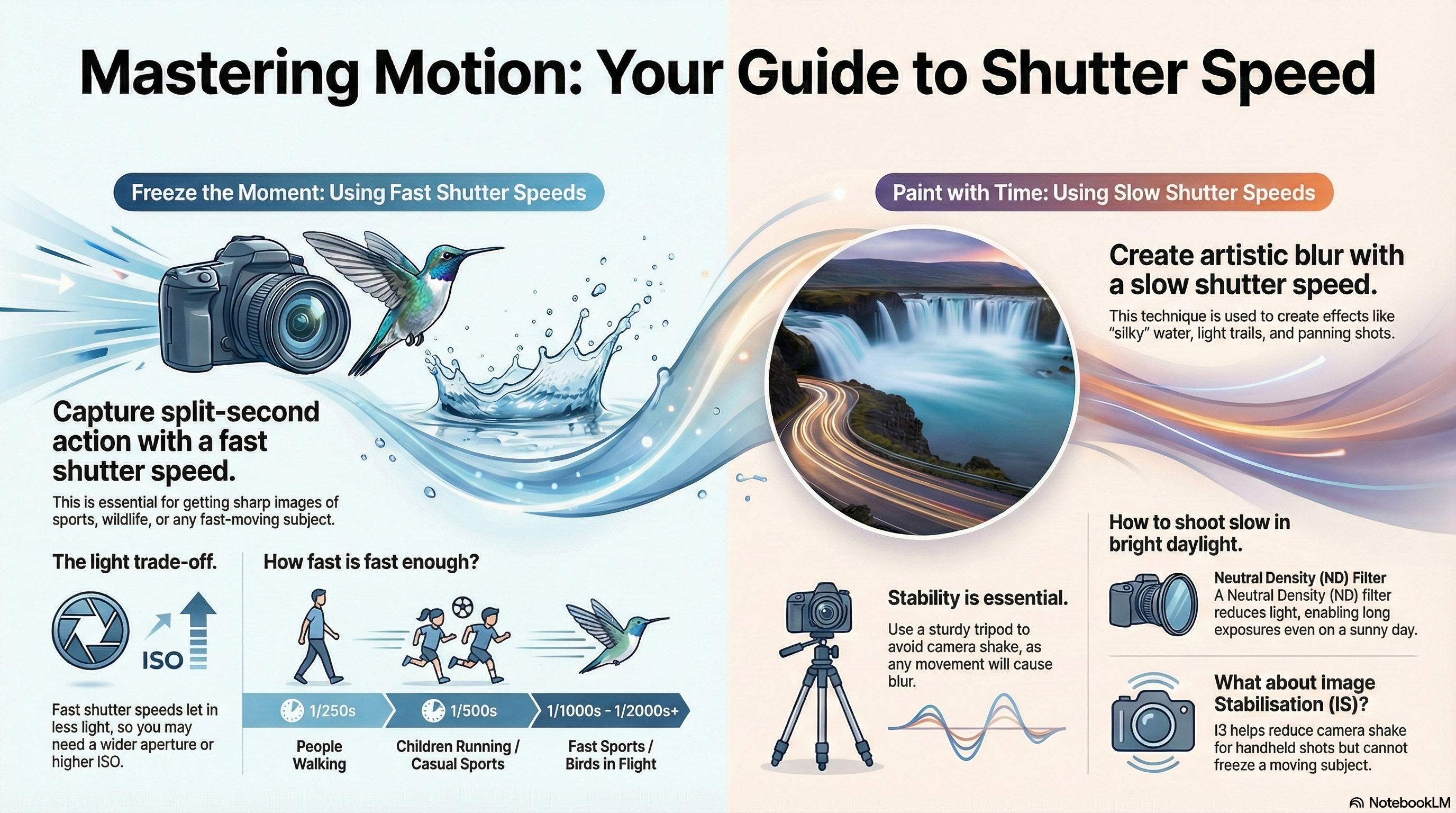
The benefit is quantified in "stops of stabilization." Each "stop" allows you to double your exposure time, meaning you can use a shutter speed one stop slower. A system with 5 stops of stabilization makes it theoretically possible to capture a sharp handheld shot at 1/8th of a second where the old rule would have demanded 1/250th.
This isn't just theory. In a real-world test, a Leica M10 with no stabilization struggles to produce a sharp image at 1/30s. A modern Canon R5 with cooperative IBIS and lens IS, however, is "spectacular" and perfectly sharp at 1/15s, even at 105mm. This technology is a massive advantage in low-light situations, allowing photographers to keep their ISO significantly lower by using dramatically slower shutter speeds than were ever possible without a tripod.
--------------------------------------------------------------------------------
3. The Crucial Caveat: Image Stabilization Does NOT Freeze Your Subject.
Does image stabilization help with fast moving subjects? No.
This is the most common and critical misunderstanding of the technology. Photographers assume that because their camera has incredible 5-axis stabilization, they can photograph people or pets at slow shutter speeds like 1/15s and get a sharp result. This assumption leads to countless blurry photos.
It is essential to distinguish between the two different types of motion that can ruin a photo. Image Stabilization—whether in the lens (OIS) or in the camera body (IBIS)—only compensates for the photographer's movement (camera shake). It does absolutely nothing to prevent motion blur caused by the subject's own movement across the frame.
Only a fast shutter speed can freeze a moving subject. To capture a running child without motion blur, you still need a shutter speed of 1/1000s or faster, just as you always have. Stabilization will not help with this. For maximum sharpness, these technologies must be understood as a complete, harmonious system where each component solves a different problem:
• Fast Shutter Speed: Freezes the motion of your subject.
• Image Stabilization (IBIS/OIS): Negates the motion of the photographer.
• Auto ISO: Provides the required sensitivity to make the exposure possible under these constraints.
--------------------------------------------------------------------------------
4. Old Rule: Pros Only Shoot in Full Manual Mode.
Modern Reality: Auto ISO is an Essential Professional Tool.
There is a persistent idea that "real photographers" only use full Manual mode, implying that any "auto" feature is a crutch for beginners. In the modern era, this could not be further from the truth. Auto ISO has evolved from a novice feature into a sophisticated tool that is essential to many professional workflows.
The modern pro workflow isn't about giving up control; it's about using Manual Mode (M) with Auto ISO enabled. This technique involves setting clear boundaries for the camera. The photographer sets a minimum shutter speed (e.g., 1/500s, to prevent subject motion blur) and a maximum ISO (e.g., 12800, based on the camera's performance).
This is strategic automation. By locking in the creative variables—aperture for depth of field and shutter speed for motion—the photographer delegates the purely mathematical task of exposure balancing to the camera's processor. This frees up crucial mental bandwidth, allowing them to concentrate on composition, anticipation, and capturing the decisive moment without "faffing around" with settings as light changes. The one weakness is that matrix metering can still be fooled by high-contrast scenes. The professional's solution is to ride the Exposure Compensation dial, proactively telling the camera to brighten or darken the final image, demonstrating true mastery of the system.
It's also crucial to understand the camera's decision hierarchy. In a mode like Shutter Priority with Auto ISO, the camera will first try to adjust the aperture to its physical limit before it begins to raise the ISO. The implication of this is profound: by prioritizing the temporal dimension (Shutter Speed), the photographer accepts that the spatial consistency (Depth of Field) may fluctuate rapidly and unexpectedly.
--------------------------------------------------------------------------------
Conclusion: Embrace the Technology
Modern cameras do more than just take better pictures; they enable entirely new strategies for achieving sharpness and perfect exposure. The goal is no longer to rigidly follow rules designed for a bygone era, but to understand the technology deeply enough to know which rules to break.
This approach represents a liberation from technical minutiae. By using strategic automation and entrusting the camera with the mathematical task of exposure balancing within carefully defined boundaries, the photographer is freed to dedicate their full attention to the true essence of the craft: composition, anticipation, and the capture of the decisive moment.
Now that your camera has broken these old rules, what other creative boundaries can you push past?