
Fujifilm's Impossible Camera: 5 Surprising Truths About the GFX100RF
For decades, photographers have been caught in a dilemma. On one hand, the siren song of medium format photography, with its unparalleled detail, depth, and tonal richness. On the other, the brutal reality of its size and weight—systems historically shackled to the studio, too cumbersome for the spontaneity of the street or the rigors of travel. The dream has always been to have that ultimate image quality without the physical burden.
Fujifilm’s new GFX100RF is a groundbreaking attempt to solve this very problem, but not by following convention. Instead, it is a camera defined by a distinct philosophy of deliberate compromise. Its design creates a fundamental conflict between its inviting, rangefinder-style handling and its demanding technical requirements. It is a camera that, on paper, seems to contradict itself at every turn.
This article explores the five most surprising truths that arise from this philosophy—the calculated trade-offs and unexpected strengths that make the GFX100RF one of the most intriguing, and challenging, photographic tools of our time.
1. A 102-Megapixel Medium Format Camera That Weighs Less Than an Entry-Level Kit
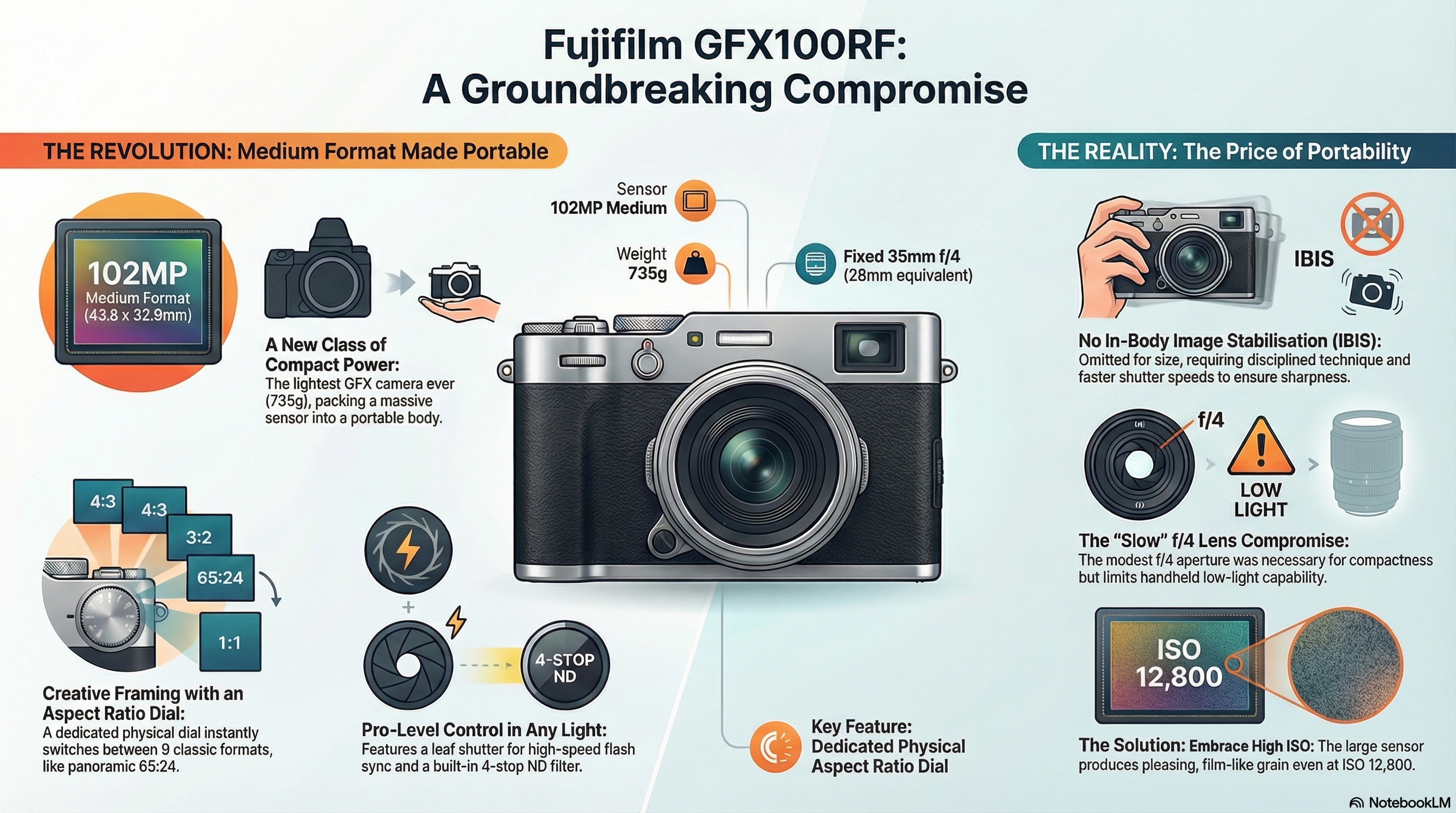
The Fujifilm GFX100RF packs a 102-megapixel medium format sensor that is a staggering approximately 1.7 times larger than a full-frame sensor. This is the engine responsible for the breathtaking detail and dynamic range that defines the GFX system. You would expect a camera built around such a massive sensor to be equally massive.
Here is the first surprise: it isn't. Weighing a mere 735g with its fixed lens, battery, and memory card, the GFX100RF is the lightest camera in the entire GFX series. To put that in perspective, it’s lighter than the GFX50R body only (775g) and even weighs less than some smaller-sensor cameras like the Fujifilm X-T5 when paired with its 16-50mm kit lens (797g).
This feat of engineering fundamentally alters the perception of medium format photography. It transforms a system once seen as a deliberate, studio-bound tool into something that can be an everyday companion, ready for the street, travel, and documentary work. It's a camera that elicits a common, disbelieving reaction upon first handling: "Bloody he**, how is this medium format!?"
2. It Purposely Lacks In-Body Image Stabilization (IBIS)
In a world where In-Body Image Stabilization (IBIS) is considered an essential feature for any high-resolution camera, the GFX100RF deliberately omits it. This wasn't an oversight; it was a foundational compromise. To achieve its incredibly compact size and light weight, Fujifilm's engineers made the conscious decision to exclude the IBIS mechanism, which would have required a larger, heavier body.
This choice creates the camera's central paradox. Its rangefinder-style form factor encourages a spontaneous, handheld shooting style, yet its unforgiving 102MP technical core demands a slow, deliberate, and exceptionally stable methodology more akin to traditional, tripod-based medium format work. The camera’s handling invites you to shoot from the hip, but its sensor magnifies every tiny vibration into visible motion blur. There is no technological safety net.
In an era of computational aids, the GFX100RF makes a bold, almost defiant statement: it is a camera that demands mastery, not just operation. It rewards meticulous technique and unforgivingly punishes carelessness.
3. The Leaf Shutter is Its Unsung Hero
Following directly from the controversial lack of IBIS, the camera's most crucial mitigating factor is a piece of classic technology: the leaf shutter.
A leaf shutter is a mechanism located within the lens itself, rather than in the camera body like a traditional focal plane shutter. This design introduces significantly less mechanical vibration—or "shutter shock"—into the system when an image is captured. For a camera with a hyper-sensitive 102-megapixel sensor, this reduction in internal vibration is a key advantage for handheld shooting, allowing a skilled photographer to use slower shutter speeds than would normally be possible and still achieve critically sharp images.
But the leaf shutter’s true power move is its ability to allow for high-speed flash synchronization at any shutter speed up to 1/4000 sec. This feature is essential for complex flash photography, such as balancing bright ambient daylight with strobe illumination. For professional environmental portrait and commercial photographers, this single capability creates a unique value proposition that directly counters the camera's other limitations, making it a surprisingly potent tool for creative lighting on location.
4. It Has Physical Dials for Cropping and Reframing
Instead of treating its 102 megapixels as just a number for creating enormous prints, Fujifilm designed the GFX100RF to be actively and creatively cropped while shooting. This philosophy is made tangible through two dedicated physical controls that transform reframing from a post-processing chore into an immediate, creative decision.
- The Digital Teleconverter lever: A dedicated toggle on the front of the camera allows the user to instantly crop into the sensor, simulating focal lengths equivalent to 36mm, 50mm, and 63mm. Thanks to the massive sensor resolution, these crops retain incredible detail, yielding a 61.5MP file at the 36mm equivalent, 31.2MP at 50mm, and a still-robust 19.6MP at 63mm.
- The Aspect Ratio Dial: A first for Fujifilm's digital cameras, a dedicated dial on the top plate gives immediate access to nine different aspect ratios. These range from the classic 1:1 square format and cinematic 16:9 to the iconic panoramic 65:24, which pays homage to Fujifilm's legendary TX-1 film camera.
This design approach is a powerful statement. It encourages photographers to think about their final composition in the moment, using the camera's physical controls to frame the world with intent, rather than simply capturing a large file to be fixed later.
5. Its "Slow" Lens and Lack of IBIS Give It Incredible Stamina
The two most-discussed limitations of the GFX100RF are its lack of IBIS and its "slow" fixed f/4 maximum aperture lens. These were the primary compromises made in the name of portability. However, these perceived weaknesses are directly responsible for one of the camera's greatest practical strengths: exceptional battery life.
By removing power-hungry components like an IBIS unit, Fujifilm created a camera with incredible stamina. The GFX100RF is CIPA-rated for an impressive 820 shots on a single charge. To put this into context, the more feature-rich Fujifilm GFX 100 II is rated for only 540 shots. The GFX100RF's greatest operational strength—its class-leading endurance—is not an accidental perk, but a direct and calculated dividend paid by its most debated engineering compromises.
A Master of a Niche, or a Niche Too Far?
The Fujifilm GFX100RF is a camera born from a clear and uncompromising philosophy. It is not an attempt to be all things to all people; it is a finely honed tool for a very specific type of photographer. It offers the pinnacle of image quality in a body that defies the historical constraints of its format, but it demands skill, discipline, and a deep understanding of its limitations to unlock that potential.
For many, its compromises—the lack of IBIS, the modest aperture, the fixed lens—will be dealbreakers. For others, these same constraints will be seen as a welcome challenge, a return to a more fundamental and focused way of making photographs.
Ultimately, the GFX100RF is not a camera for the pragmatist seeking an all-around tool; the GFX 100S II fills that role with superior versatility. Instead, this is an uncompromising instrument for the photographic purist—one who accepts its significant limitations as the necessary cost for achieving the pinnacle of image quality in a uniquely portable, tactile, and deeply engaging form factor.
